

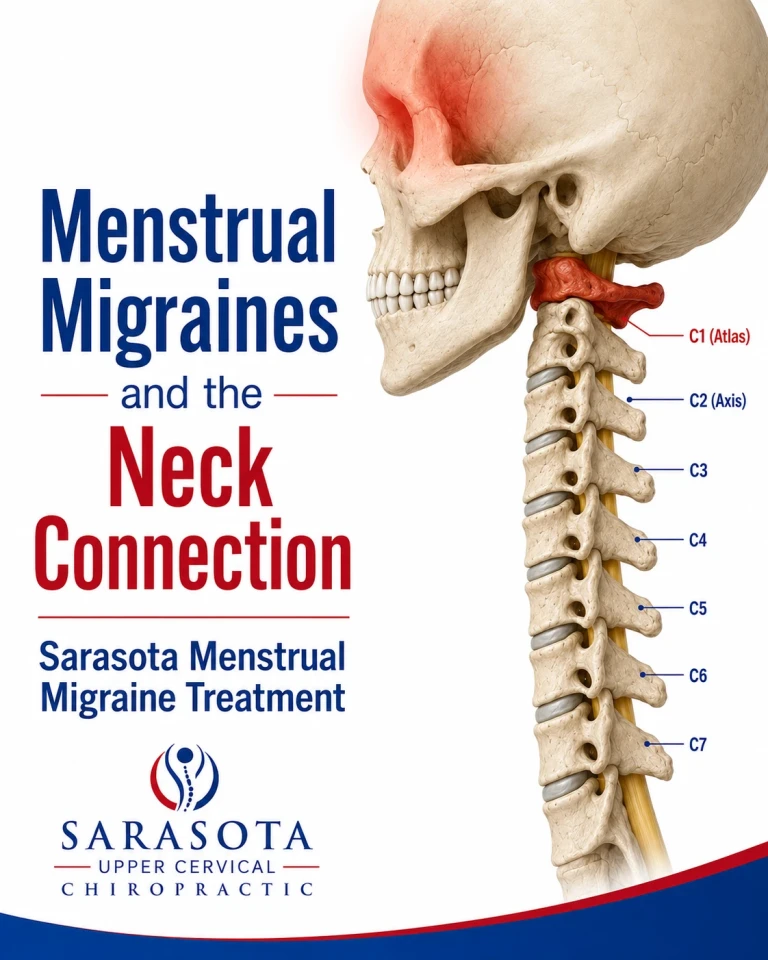
Menstrual migraine treatment in Sarasota, Bradenton, and Lakewood Ranch has to account for something patients notice long before anyone tells them it is documented: the attacks that arrive with a period are not simply migraines that happen to fall on those days. They are longer, more severe, more likely to bring nausea, more resistant to the medication that works the rest of the month, and more likely to come back after initially responding.
That is a recognised clinical entity, not an impression, and it changes how the condition should be managed.
Schedule Your Appointment
Schedule appointmentThe two definitions
The International Classification of Headache Disorders distinguishes two patterns, both defined by attacks occurring in a window from two days before menstruation through the first three days of bleeding, in at least two of three cycles.
Pure menstrual migraine means attacks occur only in that window and at no other time of the cycle. It is the less common of the two.
Menstrually related migraine means attacks occur in that window but also at other times. This is the far more common pattern, and it is frequently missed, because a woman having migraines throughout the month is unlikely to be asked whether some of them cluster.
Keeping a diary that records both headache days and cycle days for three cycles is the single most useful diagnostic step, and it is the one thing that makes preventive timing possible.
The mechanism: withdrawal, not level

The key insight dates to work by Somerville in the early 1970s, and it is frequently misunderstood.
Menstrual migraine is not triggered by low oestrogen. It is triggered by falling oestrogen. Somerville showed that maintaining oestrogen levels artificially could delay the attack, while allowing the natural late-luteal decline permitted it. The nervous system responds to the rate of withdrawal, not the absolute level.
This explains several otherwise puzzling observations. It explains why migraine often improves during the second and third trimesters of pregnancy, when oestrogen is high and stable, and why attacks frequently return sharply postpartum. It explains why the placebo week of a combined oral contraceptive is a predictable headache window. And it explains why migraine frequently worsens during perimenopause, when hormonal fluctuation is at its most erratic, before often improving after menopause when levels stabilise at a low baseline.
Mechanistically, oestrogen influences the trigeminovascular system directly. It modulates calcitonin gene-related peptide, the neuropeptide central to migraine pathophysiology and the target of the newer migraine drug class. Oestrogen also affects serotonergic tone, nitric oxide, and prostaglandin activity — the last of which contributes to why menstrual attacks often come with prominent cramping and why anti-inflammatories can help both problems.
The trigeminocervical complex, and where the neck fits
Migraine pain is generated through the trigeminovascular system: trigeminal sensory fibres innervating the dura and cranial blood vessels release neuropeptides including CGRP and substance P, producing neurogenic inflammation and sensitising the nerve endings.
Those trigeminal afferents converge in the trigeminal nucleus caudalis, which extends downward into the upper cervical spinal cord to approximately the C2 and C3 level. There, they share second-order neurons with afferents arriving from the upper cervical nerve roots. This convergence zone is the trigeminocervical complex, and it is established neuroanatomy rather than a chiropractic construct.
Related article
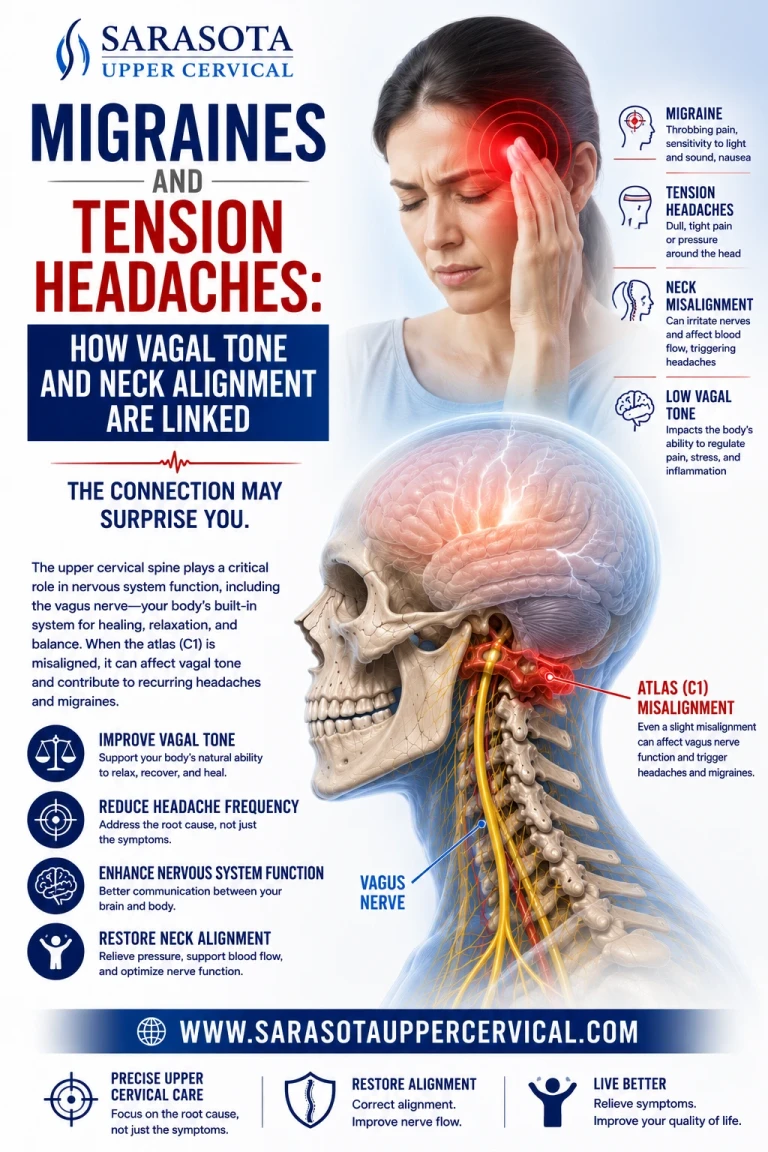
Its clinical consequences are well recognised in the headache literature. Neck pain is extremely common in migraine, frequently preceding the headache and often reported as more consistent than nausea. Upper cervical input can influence the excitability of the same second-order neurons that process cranial input, which is why cervical dysfunction can lower the threshold at which an attack is triggered.
Stated at its honest strength: hormonal withdrawal drives the timing of menstrual migraine, and the neck does not cause it. What upper cervical input can plausibly do is contribute to the baseline excitability of the trigeminocervical complex, so that the hormonal trigger arrives at a system that is either closer to or further from its threshold. Lowering non-hormonal contributors to that excitability is a coherent aim in a person who cannot change the hormonal fluctuation itself.
I am labelling that as reasoned physiology, not demonstrated treatment mechanism. There is no clinical trial of upper cervical chiropractic in menstrual migraine specifically, and I am not going to present the broader manual therapy literature for migraine as though it were.
What medical management involves
Because menstrual attacks are predictable, they permit an approach unavailable for most migraine: timed short-term prevention. Mini-prophylaxis involves taking medication across the vulnerable window rather than continuously — longer-acting triptans such as frovatriptan or naratriptan, or non-steroidal anti-inflammatories, started a couple of days before the expected onset and continued through it. This is only possible with a diary establishing the pattern.
Acute treatment follows standard migraine principles, with the caveat that menstrual attacks respond less reliably and may need a more assertive approach. Hormonal strategies, including continuous or extended-cycle contraception to eliminate the withdrawal, are used in some patients.
One safety point belongs in any article on this topic. Migraine with aura combined with combined hormonal contraceptives carries an increased risk of ischaemic stroke, and this substantially affects contraceptive choice. If you have migraine with aura and are taking a combined oestrogen-containing contraceptive, that is a conversation to have with your physician.
How care is delivered here
Related article
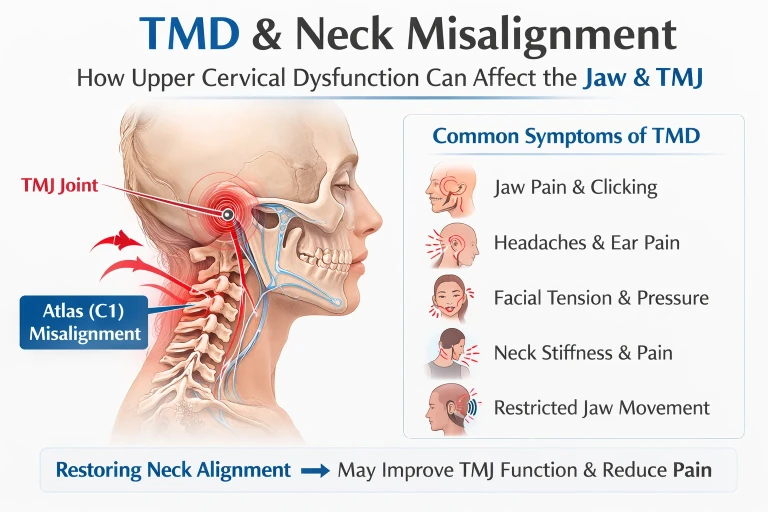
Lakewood Ranch TMD Specialist | Neck & Jaw Connection | Holistic TMD Relief
Mar 12, 2026
Upper cervical correction involves no twisting, no popping, no cracking, and no pulling of the neck. Cone beam computed tomography measures the three-dimensional position of the atlas and axis against your own anatomy so that a correction is calculated rather than estimated. Objective measures — leg length assessment, cervical range of motion, postural and balance measurement, and thermographic pattern tracking — determine whether a correction is indicated and whether it is holding. When the measures show it is holding, no adjustment is given.
That last point matters particularly here. In a cyclical condition, symptoms fluctuate for reasons that have nothing to do with what was done in the office, and it is easy to attribute a good week to an adjustment when the cycle simply moved on. Objective measures and a headache diary are what separate signal from cycle.
Red flags
A sudden severe headache reaching maximum intensity within seconds or a minute requires emergency evaluation. So does a headache with fever and neck stiffness, with new weakness or numbness, with confusion or altered consciousness, with seizure, or with visual loss.
A clear change in your established headache pattern warrants medical review. So does a new headache after the age of fifty, a headache that is consistently worse when lying flat or on waking, or one that worsens with coughing or straining. Aura symptoms that last more than an hour, that affect only one side consistently over many attacks, or that appear for the first time in someone taking a combined hormonal contraceptive need assessment. New headache during pregnancy or postpartum requires medical evaluation, including blood pressure measurement, because pre-eclampsia can present this way.
An evaluation in Sarasota
If your migraines cluster around your cycle, the first useful step is a three-cycle diary and a conversation with your physician about timed prevention. Where you also have persistent neck involvement — pain preceding attacks, suboccipital tightness, restricted rotation, or a history of head or neck injury — an upper cervical evaluation can determine whether cervical input is contributing to the threshold at which those attacks are triggered. It works alongside your medical care rather than in place of it. To arrange a consultation-call 941 259-1891.
Dr. Drew Hall, Upper Cervical Chiropractor
Serving Sarasota, Bradenton, and Lakewood Ranch, Florida
This article is for general educational purposes only and is not medical advice, a diagnosis, or a treatment recommendation for any individual. Migraine should be diagnosed and managed by a qualified medical provider. Upper cervical chiropractic is an area of focus within chiropractic; it is not a board-recognized specialty, and no claim of specialization or superiority is made or implied. Menstrual migraine is driven by oestrogen withdrawal; upper cervical care does not alter hormonal fluctuation and is not a treatment for menstrual migraine, and no such claim is made here. No clinical trial evidence exists for upper cervical chiropractic in menstrual migraine, and the trigeminocervical convergence described is established neuroanatomy presented as reasoned rationale rather than demonstrated treatment mechanism. Migraine with aura combined with oestrogen-containing contraceptives is associated with increased ischaemic stroke risk; contraceptive and all medication decisions belong solely with your prescribing physician. Cone beam computed tomography is used as a precision measurement and analysis tool, not as a stand-alone diagnostic device. Individual results vary and no specific outcome is guaranteed. Seek emergency medical attention for sudden severe headache, headache with fever and neck stiffness, new weakness or numbness, confusion, seizure, or visual loss. Always consult a qualified healthcare provider regarding diagnosis and treatment.


Leave a comment