

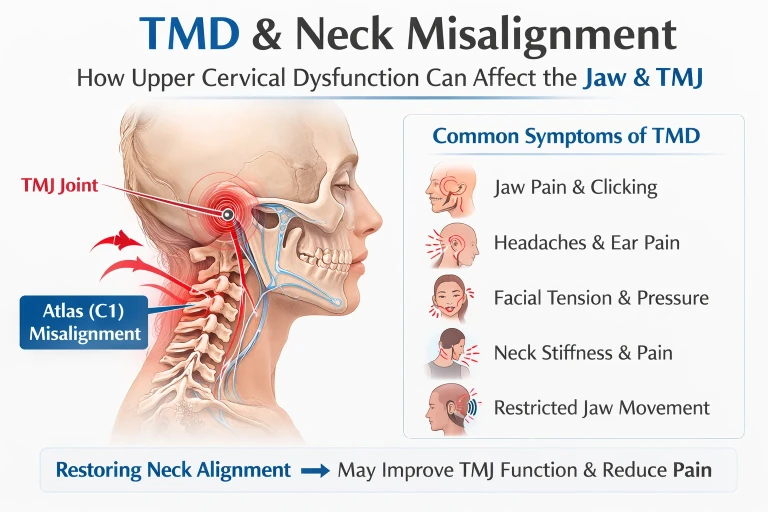
If you’re dealing with jaw pain, clicking, popping, ear pressure, or facial tension in Lakewood Ranch, you may have been told the problem is strictly dental.
Night guard.
Bite adjustment.
Muscle relaxers.
Anti-inflammatories.
Schedule Your Appointment
Schedule appointmentWhile these may help temporarily, many patients never hear about the deeper neurological connection between the neck, the brainstem, and the trigeminal nerve system.
If you are searching for holistic TMD relief, it is critical to understand this:
The jaw does not function independently of the upper cervical spine.
👉 Call 941-259-1891 to schedule your FREE consultation
Or click here to book online.
Understanding TMD: More Than a Jaw Problem
Temporomandibular Disorder (TMD) can cause:
• Jaw clicking or popping
• Pain while chewing
• Facial tightness
• Ear pressure or ringing
• Headaches
• Limited mouth opening
• Locking of the jaw
• Neck stiffness
The temporomandibular joint (TMJ) is one of the most neurologically integrated joints in the body.
Its control system is deeply rooted in the brainstem.
To understand why TMD becomes chronic, we need to understand the trigeminal system.
The Trigeminal Nerve: The Jaw’s Control Center
The trigeminal nerve (cranial nerve V) is responsible for:
• Sensation to the face
• Jaw muscle control
• Mastication (chewing)
• Bite force regulation
The trigeminal nerve nucleus extends into the brainstem and upper cervical spinal cord.
This means the control center for your jaw muscles is intimately connected to the upper neck.
The muscles of mastication — including:
• Masseter
• Temporalis
• Medial pterygoid
• Lateral pterygoid
— are regulated through neural pathways that interface directly with the brainstem and upper cervical region.
If there is irritation or distortion at the brainstem level, the jaw muscles may become hyperactive or imbalanced.
👉 Call 941-259-1891 to schedule your FREE consultation
Or click here to book online.
The Atlas (C1) and Brainstem Relationship
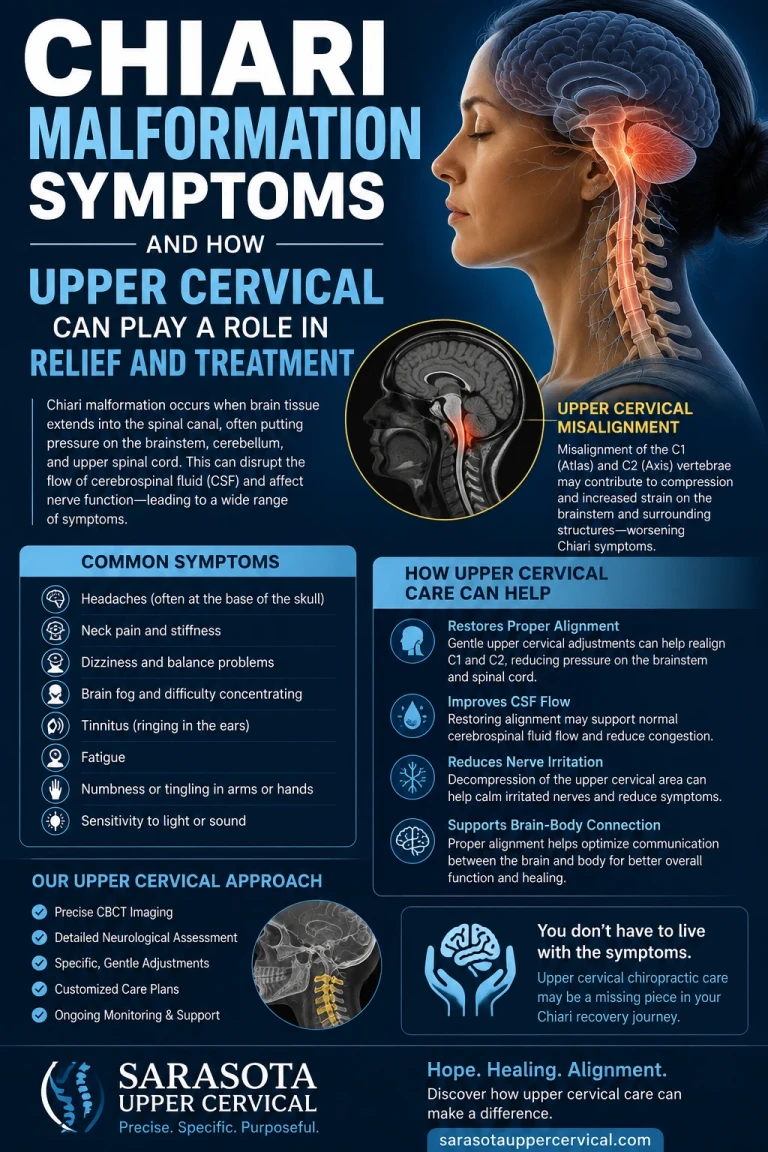
The atlas (C1) is the top bone in the spine. It supports the skull and surrounds the brainstem.
Related article
When properly aligned, the atlas allows for:
• Balanced muscle tone
• Proper cranial nerve signaling
• Even proprioceptive input
• Stable neurological communication
When misaligned, however, it may:
• Create mechanical stress beneath the brainstem
• Distort proprioceptive input
• Alter trigeminal nucleus activity
• Increase muscle guarding in the jaw
• Contribute to facial asymmetry
Even subtle atlas misalignment can influence trigeminal nerve output.
The result?
Chronic jaw tension.
How Trauma Contributes to TMD
Many TMD patients have a history of:
• Car accidents
• Slip and falls
• Sports injuries
• Whiplash
• Concussions
These traumas frequently injure the joint capsule at the upper cervical spine.
When the joint capsule is injured:
• Inflammation occurs
• Motion becomes restricted
• Instability develops
• Muscles tighten protectively
Because the trigeminal nucleus extends into the upper cervical region, instability here may alter mastication muscle control.
Jaw clenching and grinding often follow.
The jaw is compensating for instability higher in the chain.
Neck Posture and Jaw Function
Forward head posture is common today.
When the head shifts forward:
• The atlas moves out of neutral alignment
• Suboccipital muscles tighten
• Brainstem tension increases
• Jaw muscle tone shifts
The jaw is suspended beneath the skull.
If the skull is misaligned due to atlas displacement, the bite may feel uneven and the muscles may fire asymmetrically.
Many TMD patients notice:
• One side feels tighter
• Pain is worse on one side
• Clicking occurs unilaterally
Related article
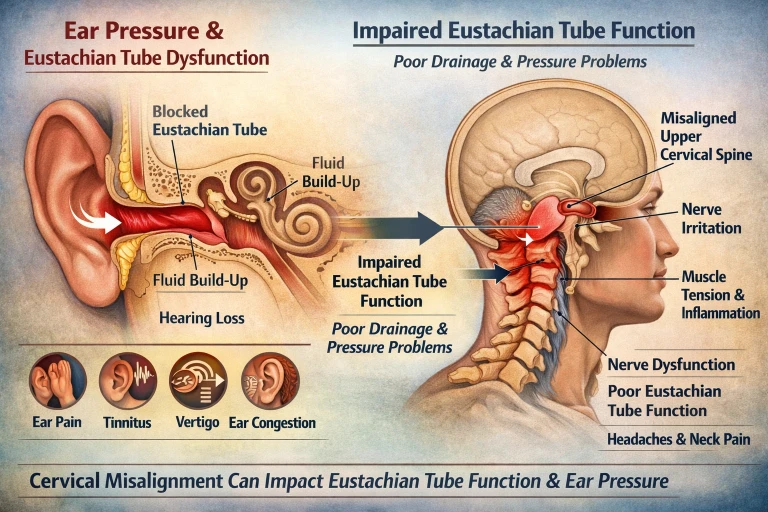
Why Won’t My Ear Pop? Eustachian Tube Dysfunction Relief in Sarasota and Bradenton
Mar 14, 2026These asymmetries often mirror cervical misalignment patterns.
Why Treating the Jaw Alone Isn’t Enough
Night guards can reduce tooth damage.
Massage can temporarily relax muscles.
But if the neurological control system is irritated at the brainstem level, tension often returns.
True holistic TMD relief must address:
• Structural alignment
• Brainstem stability
• Trigeminal nerve regulation
• Muscle balance
That begins at C1.
The Importance of 3D CBCT Imaging
Every person’s anatomy is unique.
No two atlas misalignments are identical.
That is why advanced 3D Cone Beam CT (CBCT) imaging is critical.
CBCT allows us to measure:
• Exact rotational displacement
• Lateral deviation
• Angular misalignment
• Skull-to-atlas relationship
• Structural asymmetry
Without imaging, adjustments are generalized.
With CBCT imaging, the correction is tailored precisely to your specific misalignment pattern.
Precision is especially important in conditions involving cranial nerves.
No Twisting, Popping, or Pulling
Many TMD patients are sensitive to aggressive manipulation.
Upper cervical chiropractic is gentle and specific.
There is:
• No forceful twisting
• No aggressive cracking
• No yanking or pulling
Adjustments are:
• Low-force
• Measured
• Data-driven
• Designed to restore alignment without added stress
Related article
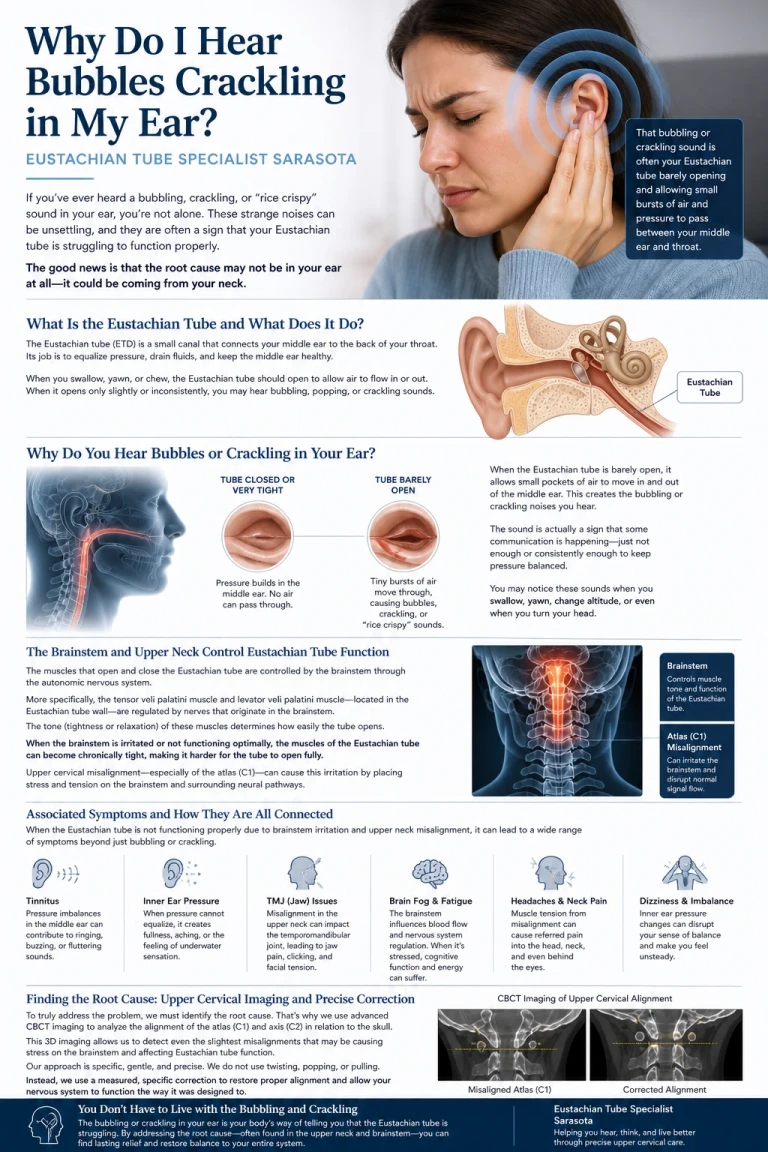
Why Do I Hear Bubbles or Crackling in My Ear? | Eustachian Tube Specialist Sarasota
May 04, 2026When atlas alignment improves, the brainstem may function with less mechanical irritation.
This may help normalize trigeminal signaling.
Objective Testing: When to Adjust
We utilize objective measures to determine if misalignment is present and whether correction is needed.
These include:
Leg Balance Analysis
Neurological imbalance can present as subtle asymmetry in leg length patterns.
Thermal scanning measures heat differences along the spine, indicating nervous system irritation.
These tools help determine:
• If the atlas is misaligned
• If the correction is holding
• If adjustment is necessary
Adjustments are not routine — they are based on measurable findings.
A Holistic Approach to TMD Relief
Holistic TMD relief means addressing:
• Jaw mechanics
• Muscle balance
• Brainstem regulation
• Upper cervical alignment
When atlas misalignment is corrected, many patients report:
• Reduced jaw tension
• Less clicking or popping
• Improved bite comfort
• Fewer headaches
• Decreased ear pressure
• Better overall relaxation
The jaw and neck are inseparable in function.
When the neck stabilizes, the jaw often follows.
Lakewood Ranch TMD Specialist | Neck & Jaw Connection
If you are struggling with TMD in Lakewood Ranch and have tried dental-only approaches without lasting relief, it may be time to evaluate the upper cervical spine.
Your jaw is not an isolated joint.
It is part of a neurologically integrated system centered in the brainstem.
👉 Call 941-259-1891 to schedule your FREE consultation
Or click here to book online.
Holistic TMD relief begins by restoring balance where your head meets your spine.
When the atlas is aligned, the nervous system can function more efficiently — and your jaw muscles may finally relax.
Leave a comment