

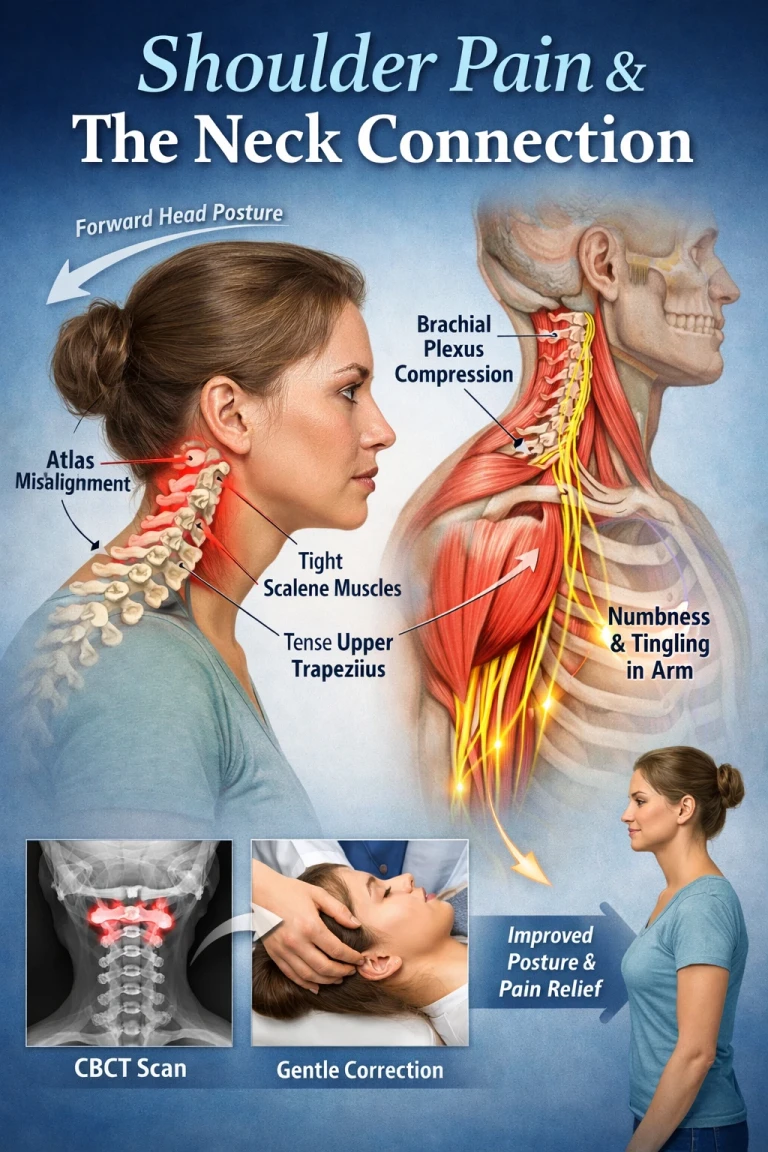
Shoulder pain, arm numbness, and tingling are some of the most common complaints seen in healthcare today. Many people assume the problem starts in the shoulder joint itself—perhaps a rotator cuff injury, tendonitis, or a pinched nerve in the arm. While those can certainly be contributing factors, there is a deeper, often overlooked root cause that deserves attention: the upper neck.
More specifically, the relationship between anterior head carriage (forward head posture) and dysfunction at the top of the spine—the atlas (C1) and axis (C2)—can have a profound impact on shoulder mechanics, nerve function, and muscle tone throughout the upper body.
Schedule Your Appointment
Schedule appointmentIn this article, we’ll break down how the upper cervical spine influences posture, how that leads to shoulder pain and neurological symptoms, and how precise upper cervical care using advanced imaging like CBCT can help restore normal function.
Click here to book a FREE consultation.
Understanding Anterior Head Carriage
Anterior head carriage—commonly known as forward head posture—occurs when the head shifts in front of the shoulders instead of being balanced directly over them. For every inch the head moves forward, the stress on the muscles and joints of the neck and upper back increases dramatically.
This postural distortion creates a cascade of compensations:
Overactivation of the scalene muscles
Tightening of the upper trapezius
Weakening and dysfunction of the rotator cuff muscles
Increased strain on the cervical spine and surrounding ligaments
But what many people don’t realize is that posture is not just a muscular issue—it is neurologically controlled.
The Brainstem: The Control Center of Posture
At the base of the skull lies the brainstem, a critical structure that regulates vital functions such as breathing, heart rate, and importantly—postural muscle tone.
The brainstem constantly receives input from three major systems:
The eyes (visual system)
The inner ear (vestibular system)
The joints and muscles of the upper neck (proprioceptive system)
When these systems are in harmony, your posture is balanced and efficient. However, when there is abnormal input—especially from the upper cervical spine—it can disrupt this delicate balance.
Click here for a FREE consultation.
The Atlas Misalignment and Its Effects
The atlas (C1) is uniquely designed to support the skull and protect the brainstem. Because of its position and mobility, it is also vulnerable to misalignment from injuries, poor posture, or repetitive stress.

When the atlas becomes misaligned, several things can occur:
Altered neurological signaling between the brainstem and body
Increased tension in the suboccipital muscles
Compensation patterns that shift the head forward
Dysregulation of postural tone throughout the upper body
This is where anterior head carriage often begins—not just as a habit, but as a neurological adaptation.
How Forward Head Posture Leads to Shoulder Pain
As the head shifts forward, the muscles of the neck and shoulders are forced to compensate.
1. Scalene Muscle Overactivation
The scalenes, located on the front and side of the neck, become hyperactive to help stabilize the head. This constant contraction pulls the neck forward even further, reinforcing the postural distortion.
2. Upper Trapezius Tightness
The upper traps become chronically tight as they attempt to support the weight of the head. This leads to:
Neck stiffness
Shoulder tension
Headaches
3. Rotator Cuff Dysfunction
The altered position of the head and neck changes the biomechanics of the shoulder joint. Over time, this can lead to:
Shoulder impingement
Reduced range of motion
Chronic pain and inflammation
The key point is this: the shoulder is often a victim, not the source of the problem.
The Connection to Arm Numbness and Tingling
One of the most telling signs that the problem extends beyond the shoulder is the presence of neurological symptoms like:
Arm numbness
Tingling in the fingers
Weakness in the arm or hand
These symptoms are often related to the brachial plexus, a network of nerves that travels from the neck into the arm.
Scalene Entrapment of the Brachial Plexus
When the scalene muscles become tight and overactive (as seen in forward head posture), they can compress the brachial plexus as it passes between them.
This can lead to a condition similar to thoracic outlet syndrome, where nerve signals are disrupted, resulting in:
Numbness
Tingling
Burning sensations
Decreased strength
Again, the root cause often traces back to abnormal posture driven by upper cervical dysfunction.
Why Treating the Shoulder Alone Often Fails
Many patients go through months—or even years—of:
Physical therapy
Massage
Stretching
Anti-inflammatory medications
While these can provide temporary relief, they often fail to address the underlying neurological and structural issue at the top of the spine.
If the brainstem continues to receive distorted input from a misaligned atlas, the body will continue to maintain abnormal muscle tone and posture.
This is why symptoms frequently return.
The Role of CBCT Imaging in Upper Cervical Care
One of the most advanced tools in modern upper cervical care is CBCT (Cone Beam Computed Tomography) imaging.
Unlike traditional X-rays, CBCT provides a 3-dimensional view of the upper cervical spine, allowing practitioners to:
Measure the exact degree and direction of misalignment
Analyze asymmetries unique to each patient
Develop a highly individualized correction plan
This level of precision is critical because no two misalignments are the same.
Gentle, Precise Corrections—No Twisting or Popping
A common misconception about chiropractic care is that it involves forceful twisting or cracking of the neck. Upper cervical care is fundamentally different.
Corrections are:
Extremely gentle
Highly specific
Based entirely on CBCT findings
Delivered without twisting, popping, or pulling
Related article

The goal is not to force the spine into position, but to allow the body to realign itself once the interference is removed.
Restoring Posture and Muscle Balance
When the atlas is properly aligned, several positive changes can occur:
Normalization of brainstem signaling
Reduction in scalene and trapezius tension
Improved shoulder mechanics
Decreased nerve irritation
Restoration of balanced posture
As the head returns to a more neutral position over the shoulders, the entire kinetic chain begins to function more efficiently.
Patients often report:
Reduced shoulder pain
Improved range of motion
Decreased numbness and tingling
Better overall posture
A True Root-Cause Approach to Shoulder Pain Relief in Sarasota
If you are dealing with chronic shoulder pain, arm numbness, or tingling—especially if traditional treatments haven’t provided lasting relief—it may be time to look beyond the shoulder itself.
The upper neck plays a critical role in:
Postural control
Muscle tone regulation
Nerve function
Addressing misalignment at the atlas through precise, CBCT-guided care offers a unique and powerful approach to restoring function and relieving symptoms.
Final Thoughts
Shoulder pain and neurological symptoms in the arm are rarely isolated issues. They are often part of a larger pattern involving posture, muscle imbalance, and nervous system dysfunction.
By understanding the connection between anterior head carriage and the upper cervical spine, you open the door to a more complete and lasting solution.
If you’re searching for shoulder pain relief and treatment in Sarasota, consider evaluating the upper neck. The answer may not be where the pain is—but where the problem begins.


Leave a comment