

If your ear ringing gets louder when you clench your jaw, turn your head, or press on your neck — or if it shifts in pitch when you change position — that detail matters more than most people realize. It points toward a specific, often-overlooked category of tinnitus called somatic tinnitus, where signals from the muscles, joints, and nerves of the neck and jaw influence what you hear.
For many people in Sarasota who have been told their tinnitus has “no known cause,” this movement-related pattern is the clue that has been missed. It suggests the problem may not start in the ear at all, but in the upper neck — and that opens the door to a structural approach that focuses on the source rather than masking the sound.
Schedule Your Appointment
Schedule appointmentIf your tinnitus changes with movement, schedule a free consultation today — book here or call 941-259-1891.
What Is Somatic Tinnitus?
Somatic tinnitus (also called somatosensory tinnitus) is tinnitus that can be brought on, worsened, or changed by sensory input from the body — most often from the neck and jaw. The defining feature is simple: the sound changes when you move. Clenching the jaw, turning or tilting the head, pressing on certain neck muscles, or even moving the eyes can make the ringing louder, softer, higher, or lower.
This is different from tinnitus that comes purely from hearing loss or inner-ear damage. In those cases, the sound generally stays the same no matter what you do with your body. When the sound is responsive to movement, it tells us the auditory system is being influenced by the somatosensory system — the network of nerves that carries position, tension, and movement information from the neck and jaw into the brainstem.
This is not a rare footnote. Research on tinnitus has found that a substantial share of people with tinnitus can have their symptom changed by movements of the jaw or neck, with temporomandibular (jaw) joint dysfunction and cervical (neck) spine dysfunction being the most common sources. In other words, the body-influenced subtype is a major part of the overall tinnitus picture — not an exception to it.
The Movement Test: A Clue You Can Notice Yourself
One of the reasons somatic tinnitus is so useful to recognize is that you can often spot the pattern at home. Pay attention to whether your tinnitus changes when you:
Clench your teeth firmly
Open your jaw wide or push it forward
Turn your head fully to one side
Tilt your head back or forward
Press on the muscles at the base of your skull or along your neck
Hold a sustained posture, like long hours at a desk or phone
If any of these reliably changes the volume or character of the sound, that is a meaningful signal. It does not prove the neck is the cause on its own — but it strongly suggests a somatic component worth evaluating. This is exactly the kind of finding that a thorough upper cervical evaluation is built to investigate.

Why the Upper Neck Is So Often Involved
To understand why the neck can change what you hear, it helps to look at where these signals meet in the brain.
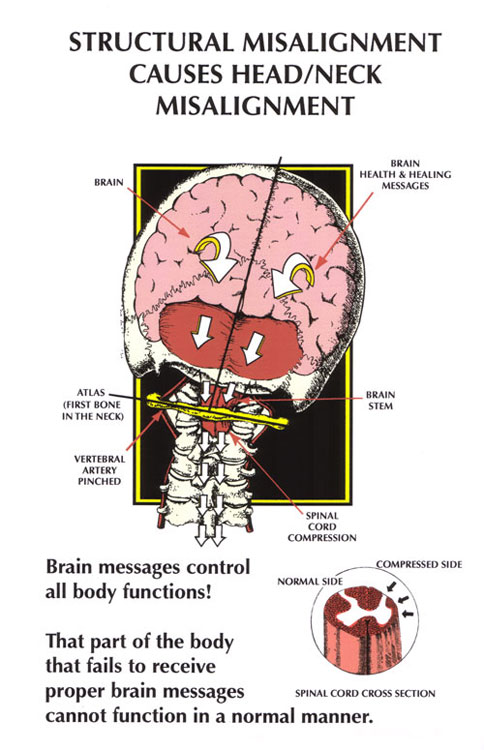
The nerves carrying sensation from the upper neck — particularly around the atlas (C1) and axis (C2) — feed into the same region of the brainstem that processes early auditory information. Anatomists describe a convergence point where somatosensory input from the neck and jaw meets the auditory pathway. The trigeminal nerve, which carries sensation from the face and head, also has extensive connections into both the upper cervical region and the auditory system.
Because these systems share circuitry, irritation or abnormal signaling from the upper neck can effectively “cross-talk” into auditory processing. When the atlas is misaligned, the steady stream of distorted position and tension information it sends upward can contribute to the brain generating or amplifying a phantom sound. This is the structural connection that upper cervical care focuses on.
It also explains a pattern many patients describe: tinnitus that appeared or worsened after a period of neck strain, poor posture, dental work, or a head or neck injury — events that change how the upper neck and jaw send signals into that shared brainstem region.
Upper Cervical Care: Focusing on the Structural Source
Upper cervical chiropractic focuses specifically on the alignment of the top two bones in the neck — the atlas (C1) and axis (C2). When these are misaligned, they can alter the signaling and biomechanics of the very region most tied to somatic tinnitus.
By restoring more normal alignment, upper cervical care aims to:
Reduce irritation of the upper cervical nerves
Restore more balanced muscle tone in the neck
Improve the quality of position and movement signals reaching the brainstem
Support normal neurological communication in the region where neck and auditory signals converge
The goal is not to mask the sound. It is to identify and address a potential structural driver of it.
Why Candidacy and Careful Selection Matter
Here is the honest, important part: tinnitus has many possible causes, and not everyone’s tinnitus comes from the neck. The research is clear that the people who respond best to a structural, neck-focused approach are those whose tinnitus has a genuine somatic component — which is exactly why careful screening matters so much.
Studies on treating the cervical spine for tinnitus emphasize the same theme: the benefit shows up in a properly selected subgroup, and identifying who falls into that group — through thorough evaluation — is the key step. This is why a responsible upper cervical office does not promise results to everyone. Instead, the first job is to determine whether your specific case shows the structural signs that make you a strong candidate.
That candidacy-first approach protects you. It means the evaluation is designed to find out whether upper cervical care is genuinely appropriate for your situation, rather than applying the same answer to every person who walks in with ringing ears.
Precision Matters: 3D Imaging and Customized Corrections
One of the most important aspects of upper cervical care is its precision. Before any correction is made, detailed 3D imaging (CBCT scans) is used as a precision tool to:
Analyze your unique anatomy
Measure the exact position of the atlas
Determine the precise angle and vector of any correction
This is not guesswork — it is a data-driven, highly individualized approach. For somatic tinnitus specifically, this precision is what allows care to focus on the exact region where neck signals and auditory processing intersect.
No Twisting, Popping, or Pulling
Many people hesitate to seek chiropractic care because they picture forceful adjustments. Upper cervical care is different. Corrections are:
Gentle and specific
Performed with no twisting, popping, or cracking
Designed to allow the body to hold the correction over time
The goal is not endless repeated adjustments — it is making the right correction and giving the body the chance to stabilize and hold it.
Who Is a Candidate?
You may be a candidate for an evaluation if you experience:
Tinnitus that changes when you move your jaw, neck, head, or eyes
Ringing that gets louder with clenching, posture, or neck tension
Tinnitus alongside neck pain, headaches, jaw issues, or dizziness
A history of head or neck injury, whiplash, or significant dental or postural strain
Tinnitus that has not responded to sound-based or medication approaches
Each case is different, which is why a thorough evaluation is essential before any conclusions are drawn.
Related article

Post-Viral POTS: Why Autonomic Symptoms Persist After Infection | Sarasota
Aug 02, 2026A Natural Approach to Relief
Many traditional approaches to tinnitus focus on masking the sound, medication, or simply waiting for symptoms to settle. Upper cervical care offers a different path — one that focuses on identifying and addressing a potential structural cause in the upper neck. For the right candidate, working with the body’s own alignment and signaling, rather than only covering the symptom, can be a meaningful option.
Take the First Step Toward Answers
If your tinnitus changes with movement, that is a clue worth taking seriously — and it may point to a structural, correctable source in your upper neck.
Schedule your free consultation today to find out if you’re a candidate for upper cervical care. Book here or call 941-259-1891 to get started.
Learn More
For the full picture of how the neck and tinnitus are connected, start with our complete guide: A Complete Guide to Tinnitus and the Neck Connection. You may also want to read Understanding the Upper Cervical Connection to Ear Ringing and, if your tinnitus has a whooshing or pulsing quality, Whooshing & Pulsatile Tinnitus Treatment and Relief in Sarasota.
Frequently Asked Questions
1.What is somatic tinnitus?
Somatic tinnitus is tinnitus that can be changed by movements or sensory input from the body, most often the neck and jaw. Its defining feature is that the sound shifts in volume or pitch when you move — for example, when you clench your jaw or turn your head.
2.How do I know if my tinnitus is coming from my neck?
A telling sign is that the ringing changes when you move your jaw, neck, head, or eyes, or when you press on certain neck muscles. While this does not confirm a cervical cause on its own, it is a strong reason to seek a thorough upper cervical evaluation, which may include 3D imaging to assess the alignment of the atlas.
3.Can upper cervical chiropractic help somatic tinnitus?
For people whose tinnitus has a genuine somatic component, addressing upper neck alignment may help by reducing irritation in the region where neck and auditory signals converge. Results vary, and not everyone is a candidate — which is why careful evaluation and patient selection come first.
4.Is the correction painful or forceful?
No. Upper cervical corrections are gentle and specific, with no twisting, popping, or cracking. The aim is to make a precise correction and allow the body to hold it over time.
5.What should I do first?
Schedule a free consultation to find out whether your tinnitus shows the structural signs that make you a candidate for care. You can book online or call 941-259-1891.
This content is for informational purposes only and does not constitute medical advice.
Leave a comment