

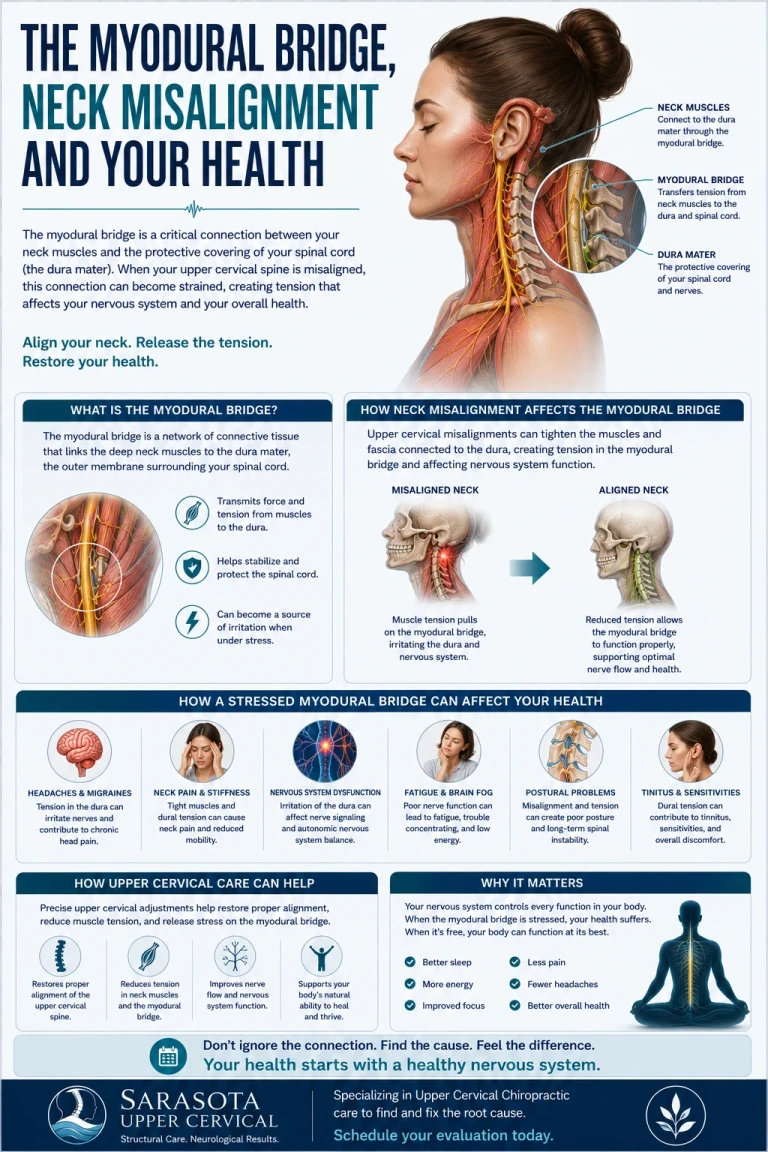
Most people have never heard of the myodural bridge, and yet for anyone whose health changed after a neck injury, whiplash, or head trauma, it may be one of the most important structures in the body to understand. It is a small, dense connection deep in the upper neck that links your muscles directly to the protective covering of your spinal cord and brain. When it works well, you never notice it. When an upper neck injury disrupts it, the effects can reach far beyond the neck itself.
This guide explains what the myodural bridge is, what it does, how upper neck injuries may compromise it, and why an upper cervical evaluation focuses on this critical region.
Schedule Your Appointment
Schedule appointmentIf your health changed after a neck or head injury, schedule a free consultation — book here or call 941-259-1891 to see if you’re a candidate for care.
What Is the Myodural Bridge?
The myodural bridge is a dense band of connective tissue that physically connects the small, deep muscles at the base of your skull to the dura mater, the tough membrane that surrounds and protects your spinal cord and brain.
It was formally described in modern anatomy in 1995, and research since then has mapped it in detail. The bridge arises primarily from three deep suboccipital muscles — the rectus capitis posterior minor, the rectus capitis posterior major, and the obliquus capitis inferior, and passes through the small spaces between the skull, the atlas (C1), and the axis (C2) to attach to the spinal dura. In other words, it is a direct mechanical link between the muscles that move your head and the membrane that houses your central nervous system.
One of the most striking findings in the research is that the myodural bridge exists not only in humans but across many animal species — from mammals to birds — which strongly suggests it serves a necessary, conserved function rather than being an anatomical accident.
What Does the Myodural Bridge Do?
The leading understanding is that the myodural bridge serves at least two important roles.
It anchors and protects the spinal cord during movement. The bridge helps maintain the normal shape and position of the dura around the spinal cord, particularly as the head moves. It acts as a tension-regulating anchor, helping prevent the dura from buckling or folding inward when you turn, nod, or tilt your head.
It helps pump cerebrospinal fluid. This is the role that has generated the most excitement in recent research. Cerebrospinal fluid (CSF) is the fluid that bathes and nourishes your brain and spinal cord and clears waste from them. Studies have shown that when the suboccipital muscles contract during head movement, the myodural bridge transmits that tension to the dura, changing pressure in the surrounding space and helping propel CSF along its circulation pathway. In effect, the small muscles of your upper neck appear to function as part of a pump that keeps this vital fluid moving.
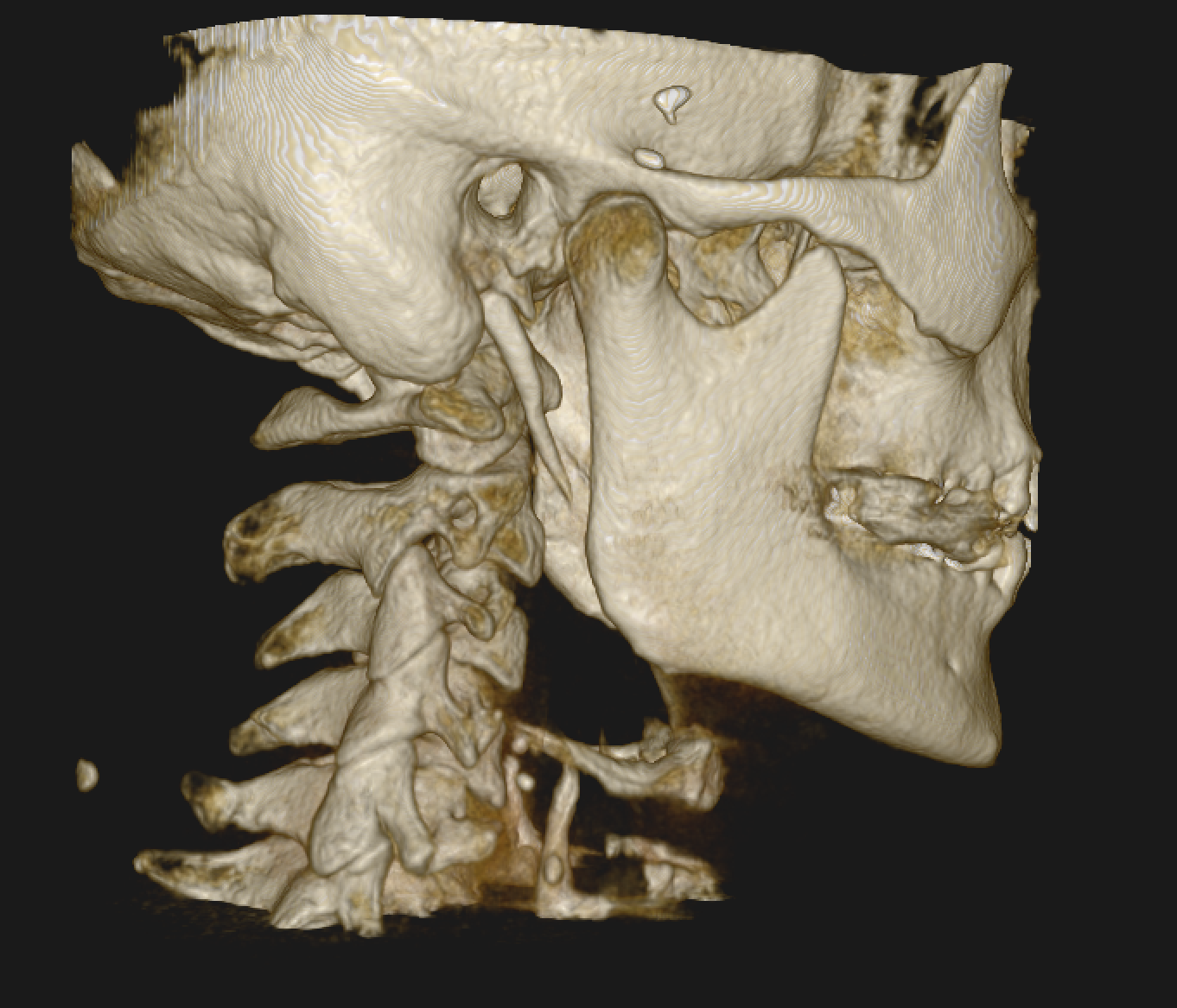
The bridge is built for this job. It is composed largely of strong collagen fibers, which allow it to transmit substantial mechanical force from muscle to dura — exactly what a tension-based pump and anchor would require.
How Upper Neck Injuries May Compromise the Bridge
Here is where the myodural bridge becomes clinically meaningful. Because it is a direct mechanical link between muscle and the covering of the spinal cord, anything that disrupts the deep suboccipital muscles or the alignment of the upper neck can change how the bridge functions.
Hyperflexion-extension injuries,the rapid back-and-forth of the head that happens in whiplash, car accidents, sports collisions, falls, and similar trauma — stimulate these deep muscles and transmit tensile forces through the bridge to the cervical dura. When upper cervical misalignment or instability is present, abnormal tension in the suboccipital muscles can be transferred through the bridge to the upper spinal cord and brainstem region.
Researchers have proposed several ways this disruption could matter:
Chronic spasm or shortening of the deep suboccipital muscles, often triggered by upper neck trauma, may create abnormal sustained tension on the dura.
Altered tension on the dura may affect the smooth, normal flow of cerebrospinal fluid.
Abnormal pull on the dura has been associated in the literature with chronic headaches and neck pain.
Distorted signaling from this densely innervated region may contribute to broader nervous system symptoms.
It’s worth being clear about the state of the science here: the anatomy of the myodural bridge and its CSF-pump role are well documented, while the full range of symptoms attributed to its dysfunction is an active and evolving area of research rather than fully settled fact. What is well established is that this region is anatomically positioned to influence the nervous system in important ways, which is exactly why it deserves careful attention after a neck injury.
Related article

Vestibular Disorder Treatment Sarasota | Upper Cervical Chiropractic Guide
May 31, 2026Why This Region Connects to So Many Symptoms
The upper neck is one of the most neurologically dense and important junctions in the entire body. Within a few centimeters, you have the brainstem, the junction of brain and spinal cord, the origins of major nerves, critical blood vessels, and — through the myodural bridge — a direct mechanical line to the membrane surrounding the central nervous system.
This is why upper neck injuries can produce symptoms that seem unrelated to the neck: headaches, pressure or fullness in the head, dizziness, difficulty concentrating or “brain fog,” and a general sense that your health hasn’t been right since an injury. When a single region influences fluid dynamics, nerve signaling, and the mechanical protection of the spinal cord all at once, dysfunction there can ripple widely. The myodural bridge is one important piece of why the upper neck punches so far above its size.
Upper Cervical Care: Focusing on the Structural Source
Upper cervical chiropractic focuses specifically on the alignment of the atlas (C1) and axis (C2) — the exact region where the myodural bridge lives and where these deep suboccipital muscles attach. The premise is straightforward: if misalignment in this region is creating abnormal tension and irritation, then restoring more normal alignment may help that region function as it should.
By addressing upper cervical alignment, care aims to reduce irritation in the suboccipital region, restore more balanced muscle tone in the deep muscles tied to the bridge, and support the normal mechanics of this critical junction. The goal is not to chase symptoms one by one, but to address a potential structural source that may be influencing several of them.
Why Candidacy and Careful Evaluation Come First
Not every symptom traces back to the upper neck, and not everyone is a candidate for upper cervical care. This is why a thorough evaluation always comes first. The patterns that make an upper cervical involvement more worth investigating include:
1.Health changes that began or worsened after whiplash, a concussion, or head or neck trauma
2.Chronic headaches or neck pain that haven’t responded to other approaches
3.A combination of head pressure, dizziness, and cognitive symptoms
4.A sense that “nothing has been right” since an upper neck injury
A responsible evaluation is designed to determine whether your specific case shows the structural signs that make care appropriate, and to tell you honestly if it doesn’t.
Precision Matters: 3D Imaging and Customized Corrections
Before any correction is considered, detailed 3D imaging (CBCT scans) is used as a precision tool to analyze your individual anatomy and measure the exact position of the atlas. Given how small, deep, and critical the structures of this region are — the myodural bridge among them — this precision is essential. It allows care to focus on the exact area where muscle, bone, and the covering of the spinal cord all converge.
No Twisting, Popping, or Pulling
Upper cervical corrections are gentle and specific, performed with no twisting, popping, or cracking. This is especially relevant for a region as delicate and important as the upper neck. The goal is to make a precise correction and allow the body to hold it over time, so this critical junction can stabilize — not to deliver repeated forceful manipulation.
Related article
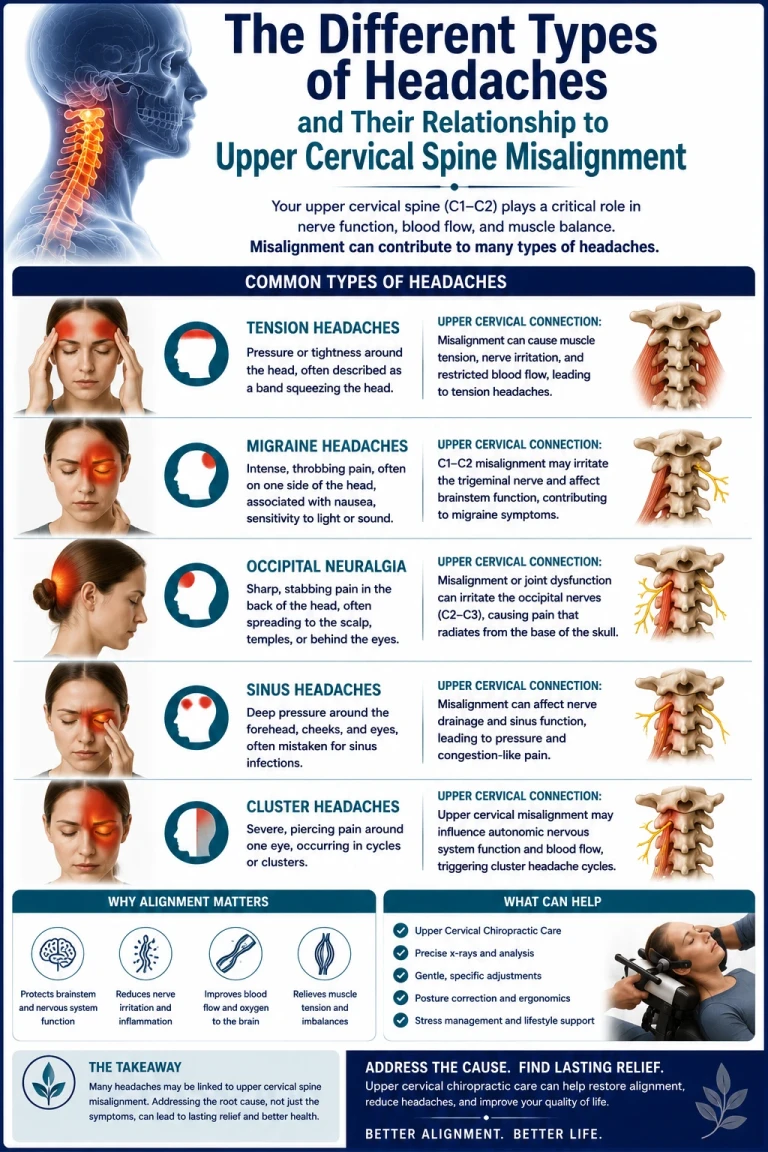
The Different Types of Headaches and Their Relationship to Upper Cervical Spine Misalignment
May 23, 2026Take the First Step Toward Answers
If your health changed after a neck or head injury and you’ve never had the upper neck thoroughly evaluated, the myodural bridge and the structures around it may be a missing piece of your picture.
Schedule your free consultation today to find out whether you’re a candidate for upper cervical care. Book here or call 941-259-1891 to get started.
Learn More
For related reading on how the upper neck connects to specific symptoms, explore our guides on post-concussion syndrome and the upper cervical connection, headaches and the upper neck, and dizziness and the upper cervical connection. (Links will point to the published articles.)
Frequently Asked Questions
1.What is the myodural bridge?
The myodural bridge is a dense band of connective tissue that connects the deep muscles at the base of the skull to the dura mater, the protective membrane surrounding the spinal cord and brain. It passes through the spaces between the skull, atlas (C1), and axis (C2).
2.What does the myodural bridge do?
Research indicates it serves two main roles: anchoring and protecting the spinal cord’s covering during head movement, and helping pump cerebrospinal fluid. When the deep neck muscles contract, the bridge transmits tension to the dura, helping propel the fluid that bathes the brain and spinal cord.
3.Can a neck injury affect the myodural bridge?
Yes, this is a proposed mechanism in the research. Hyperflexion-extension injuries such as whiplash stimulate the deep suboccipital muscles and transmit force through the bridge to the cervical dura. When upper neck misalignment or instability is present, abnormal muscle tension can be transferred through the bridge toward the upper spinal cord and brainstem region.
4.What symptoms are associated with myodural bridge dysfunction?
The anatomy and cerebrospinal fluid-pump role are well documented, while the full range of attributed symptoms is still being researched. Abnormal tension in this region has been associated in the literature with chronic headaches and neck pain, and the densely neurological nature of the area means it may relate to other symptoms as well. A thorough evaluation is needed to assess any individual case.
5.How does upper cervical care address this region?
Upper cervical care focuses on the alignment of the atlas and axis, the exact region where the myodural bridge and the deep suboccipital muscles are located. Restoring more normal alignment aims to reduce irritation and support normal function in this critical junction. Corrections are gentle, with no twisting, popping, or cracking. Candidacy is assessed individually.
6.What is the first step?
Schedule a free consultation to find out whether your case shows the structural signs that make you a candidate for care. You can book online or call 941-259-1891.
This content is for informational purposes only and does not constitute medical advice.


Leave a comment