

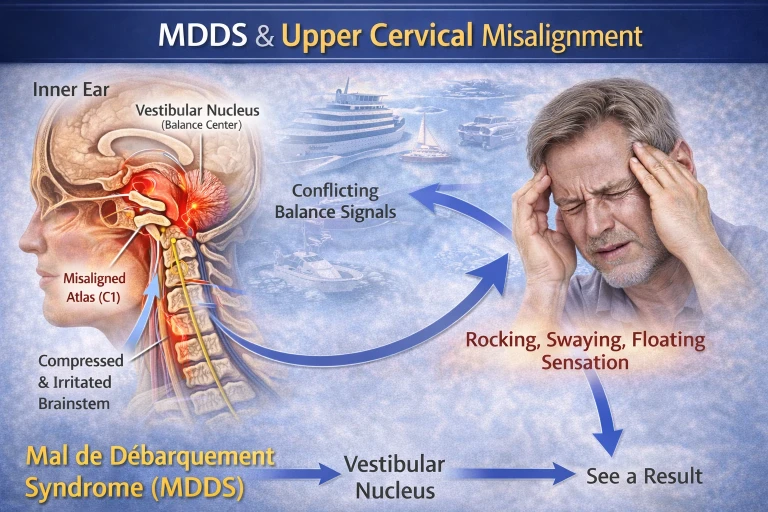
If you feel like you are constantly rocking, swaying, or floating even when standing still, you may be experiencing Mal de Débarquement Syndrome (MDDS).
Many patients describe it as feeling like they are still on a boat long after the trip has ended. Others feel as if the ground beneath them is unstable or that they are walking on a trampoline.
Schedule Your Appointment
Schedule appointmentFor individuals searching for MDDS treatment and relief in Sarasota, Bradenton, or Lakewood Ranch, it can be frustrating because traditional testing often comes back normal.
MRI scans may look normal.
Inner ear tests may appear normal.
Doctors may say nothing is wrong.
Yet the symptoms are very real.
One often overlooked factor in chronic balance disorders like MDDS is the role of the upper cervical spine and its influence on the brainstem balance centers.
👉 Schedule a FREE consultation by booking here.
What Is Mal de Débarquement Syndrome (MDDS)?
MDDS is a neurological balance disorder characterized by persistent sensations of motion when no motion is actually occurring.
Common symptoms include:
• Rocking or swaying sensation
• Feeling like you are still on a boat
• Disequilibrium when standing still
• Brain fog
• Visual sensitivity
• Fatigue
• Head pressure
• Sensitivity to busy environments
MDDS most commonly begins after:
• A cruise or boat trip
• Long airplane travel
• Extended car rides
• Train travel
• Motion exposure
Listen to one of our patients recovery from MDDS with upper cervical chirorpactic in our office. Click here to watch.
Normally, the brain adapts back to land quickly. But in MDDS patients, the brain fails to readapt properly, and the sensation of motion persists.
Understanding why this happens requires looking at how the brain processes balance.
The Brainstem and the Vestibular Nucleus
The brain’s primary balance centers are located in the brainstem, specifically in structures known as the vestibular nuclei.
The vestibular nuclei integrate information from three major sources:
The inner ear (vestibular system)
The eyes (visual input)
The joints and muscles of the neck (proprioception)
These three systems must work together perfectly to maintain balance.
If one system sends inaccurate information, the brain receives conflicting signals, which can create sensations of motion, dizziness, or instability.
One of the most powerful yet overlooked contributors to this system is the upper cervical spine.
Upper Cervical Proprioception and Balance
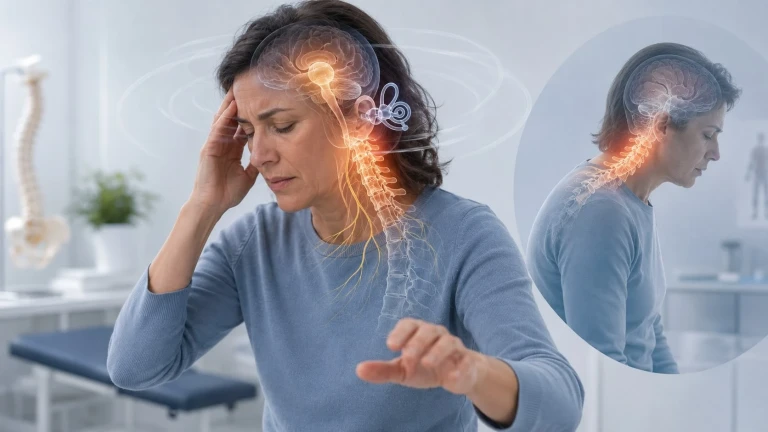
The upper cervical spine—particularly the atlas (C1) and axis (C2)—contains an extremely high density of proprioceptive receptors.
Proprioception is the body’s ability to sense position and movement.
These receptors constantly send signals to the vestibular nuclei in the brainstem about:
• Head position
• Neck movement
• Spatial orientation
This information helps the brain determine where the head is relative to the body and environment.
Because the head houses the inner ear and eyes, the brain relies heavily on accurate neck information to maintain equilibrium.
If the upper cervical joints are misaligned or unstable, the proprioceptive signals can become distorted.
This may contribute to the persistent sensation of motion seen in MDDS.
How Atlas Misalignment May Affect Balance
The atlas (C1) is the top bone of the spine and supports the skull. It sits directly beneath the brainstem.
Because of its location, even subtle misalignment can influence neurological communication.
Atlas misalignment may occur from:
• Car accidents
• Whiplash injuries
• Concussions
• Sports impacts
• Slip and falls
• Chronic forward head posture
When the joint capsule surrounding the atlas is injured, it may lead to:
• Abnormal proprioceptive signaling
• Muscle tension around the neck
• Altered sensory feedback to the brainstem
• Increased stress on balance centers
The vestibular nuclei rely on accurate neck information to maintain equilibrium.
If the signals from the neck are distorted, the brain may interpret that distortion as movement.
This can contribute to the rocking and swaying sensations characteristic of MDDS.
Why Traditional Tests Often Look Normal
One of the most frustrating aspects of MDDS is that conventional testing often fails to identify a cause.
Related article
Insomnia Treatment in Sarasota | The Brainstem, Sympathetic Tone, and the Upper Cervical Connection
Aug 13, 2026Inner ear function tests may be normal.
Brain scans may be normal.
Hearing tests may be normal.
This occurs because the issue may not be within the ear itself but rather in the integration of sensory signals in the brainstem.
If the vestibular nuclei are receiving conflicting information from the upper cervical spine, the balance system can remain in a state of confusion.
The Upper Cervical Approach
Upper cervical chiropractic focuses on the alignment and function of the top two vertebrae in the spine (C1 and C2).
The goal is not aggressive manipulation but precise correction of structural misalignment.
When the atlas alignment improves, it may help:
• Normalize proprioceptive signaling
• Reduce brainstem irritation
• Improve communication between the neck and balance centers
• Stabilize sensory integration in the vestibular nuclei
This approach focuses on restoring normal neurological communication rather than simply suppressing symptoms.
The Importance of Precision Imaging
Every person’s anatomy is unique, and no two misalignments are identical.
For that reason, upper cervical care relies heavily on 3D CBCT imaging (Cone Beam CT scans).
CBCT imaging allows doctors to precisely measure:
• The exact direction of atlas misalignment
• Rotational displacement
• Lateral deviation
• Angular misalignment
• Skull-to-atlas relationship
These measurements allow for a customized correction tailored to the individual patient.
Without imaging, adjustments can be generalized.
With imaging, care becomes extremely precise.
Gentle Corrections Without Twisting or Cracking
Many patients are hesitant about chiropractic because they fear aggressive neck manipulation.
Upper cervical chiropractic is very different.
Related article
The Complete Guide to TMJ/TMD and Its Connection to the Neck | TMJ treatment and relief Sarasota
Jun 14, 2026The corrections are:
• Gentle
• Specific
• Low-force
• Based on precise imaging
There is no twisting, cracking, or pulling of the neck.
The goal is simply to restore normal joint alignment so the nervous system can function properly.
Objective Testing to Determine When to Adjust
Upper cervical offices also use objective neurological testing to determine when an adjustment is needed.
Two common tools include:
Leg Balance Analysis
Subtle neurological imbalance can appear as asymmetry in leg length patterns.
Infrared Thermography
Thermal scanning detects differences in heat patterns along the spine that may indicate nervous system irritation.
These tools help determine when a patient is out of alignment and when the correction is holding.
This allows the body to stabilize and heal rather than being repeatedly manipulated.
MDDS Treatment and Relief in Sarasota, Bradenton & Lakewood Ranch
Living with MDDS can be incredibly frustrating.
Many patients feel like they are constantly searching for answers while being told that nothing is wrong.
If you are experiencing persistent rocking, swaying, or floating sensations, it may be worth evaluating the upper cervical spine and its influence on the brainstem balance centers.
Upper cervical chiropractic focuses on:
• Restoring alignment at the top of the spine
• Improving neurological communication with the brainstem
• Supporting the vestibular balance system
• Addressing the root cause rather than simply treating symptoms
If you are looking for MDDS treatment and relief in Sarasota, Bradenton, or Lakewood Ranch, we invite you to explore whether upper cervical care may be right for you.
👉 Schedule your FREE consultation by booking here.
Understanding how the neck influences balance may be the missing piece in restoring stability and helping your nervous system recalibrate.
Your body was designed to maintain balance naturally.
Sometimes the key to restoring that balance begins at the very top of the spine.
Our office serves sarasota, bradenton, lakewood ranch, northport, ruskin, apollo beach, punta gorda, venice , englewood, longboat key, and Myaka City.

Leave a comment