


You were in a fender-bender. Maybe it was minor — a rear-end tap at a red light on Fruitville Road, or a slow-speed collision in a Sarasota parking lot. The airbags didn't deploy, there was no visible damage to speak of, and you walked away feeling shaken but otherwise fine. Then, a few days later, the neck pain starts. Or the headaches. Or a strange dizziness that wasn't there before.
If this sounds familiar, you're not imagining it, and you're not alone.
Schedule Your Appointment
Schedule appointmentWhy Whiplash Symptoms Often Show Up Late
Whiplash is the rapid back-and-forth motion of the head and neck caused by a sudden acceleration-deceleration force — most commonly a rear-end or side-impact car collision, but it can also happen in sports impacts or falls. Research tracking whiplash patients has found that neck pain doesn't always appear immediately: many people don't notice symptoms for hours, and in some cases days, after the initial injury. That delay is part of why so many people leave the scene of a low-speed accident assuming they're fine.
The reason symptoms show up late has to do with what actually happens inside the neck during impact. In the first fraction of a second after a rear-end collision, the lower part of the cervical spine is compressed and forced into extension while the upper segments are momentarily flexed the opposite direction — an S-shaped curve that reverses the neck's normal movement pattern. That unnatural motion places disproportionate strain on the ligaments at the very top of the spine, particularly around the atlas (C1) and axis (C2), the two vertebrae that support the skull and protect the brainstem.

The Upper Cervical Spine Is Often the Real Story
Standard emergency room imaging after a car accident is designed to rule out fractures and major structural damage — and it's very good at that job. What it isn't designed to detect is a subtle positional shift of the atlas or axis, sometimes off by only a few millimeters, that doesn't show up as a fracture but can still create ongoing mechanical stress on the brainstem, the nerves branching from the upper neck, and the blood vessels supplying the brain.
This is one reason whiplash-associated disorder can produce such a wide symptom picture: neck pain and stiffness, headaches, dizziness, arm pain or tingling, and even difficulty concentrating. A case-control study cited in whiplash literature found that a large share of patients with chronic neck pain traced their symptoms back to a motor vehicle collision — meaning the "minor" accident from months or years ago may still be the root cause of pain that hasn't resolved.
Why Objective Imaging Matters After an Accident
Because upper cervical misalignment isn't reliably visible on standard X-rays and doesn't always correlate with how much pain someone reports, precision matters. Upper cervical doctors use CBCT (Cone Beam CT) imaging to get a detailed, three-dimensional view of exactly how the atlas and axis are positioned relative to the skull and the rest of the spine. Paired with objective neurological testing, this tells the doctor two things: precisely how to correct a misalignment if one is present, and — just as important — when not to adjust, because the segment is already stable.
Related article
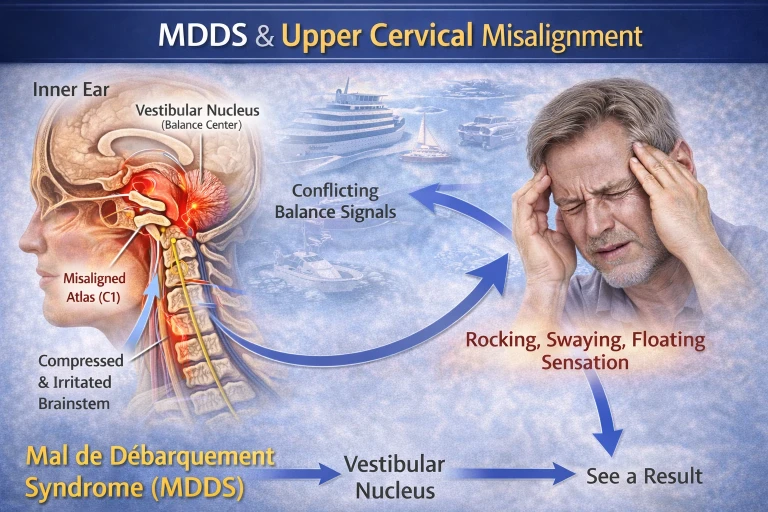
MDDS Treatment and Relief in Sarasota, Bradenton & Lakewood Ranch | Upper Cervical Chiropractor
Mar 18, 2026This kind of objective, before-and-after comparison also matters for tracking progress after an accident. Rather than relying only on how a patient feels day to day, follow-up scans give both doctor and patient measurable evidence of whether a correction is holding over time.
Healing After Whiplash Takes Time — and Alignment
Upper cervical correction isn't a quick fix for whiplash, and it isn't a substitute for appropriate emergency or medical evaluation right after an accident. But the underlying premise is straightforward: when mechanical stress on the brainstem and upper spinal cord is reduced, the nervous system is better positioned to regulate itself — including the inflammation, muscle guarding, and pain signaling that keep whiplash symptoms lingering. That process tends to unfold gradually over weeks and months as the upper cervical spine stabilizes, which is why consistent, objectively-guided care is emphasized over a single visit.
If you were in a car accident in the Sarasota, Bradenton, or Lakewood Ranch area — recently or years ago — and you're still dealing with neck pain, headaches, or dizziness that never fully went away, it's worth having the top of your neck specifically evaluated, not just the parts that show up on a standard X-ray.
This article is for informational purposes only and is not a substitute for professional medical advice, diagnosis, or treatment. Anyone involved in a car accident should be evaluated by a physician or emergency medical provider first to rule out fractures, concussion, or other serious injury.
Article written by Dr. Drew Ahall, Upper Cervical Chiropractor Locate an upper cervical chiropractor

Leave a comment