

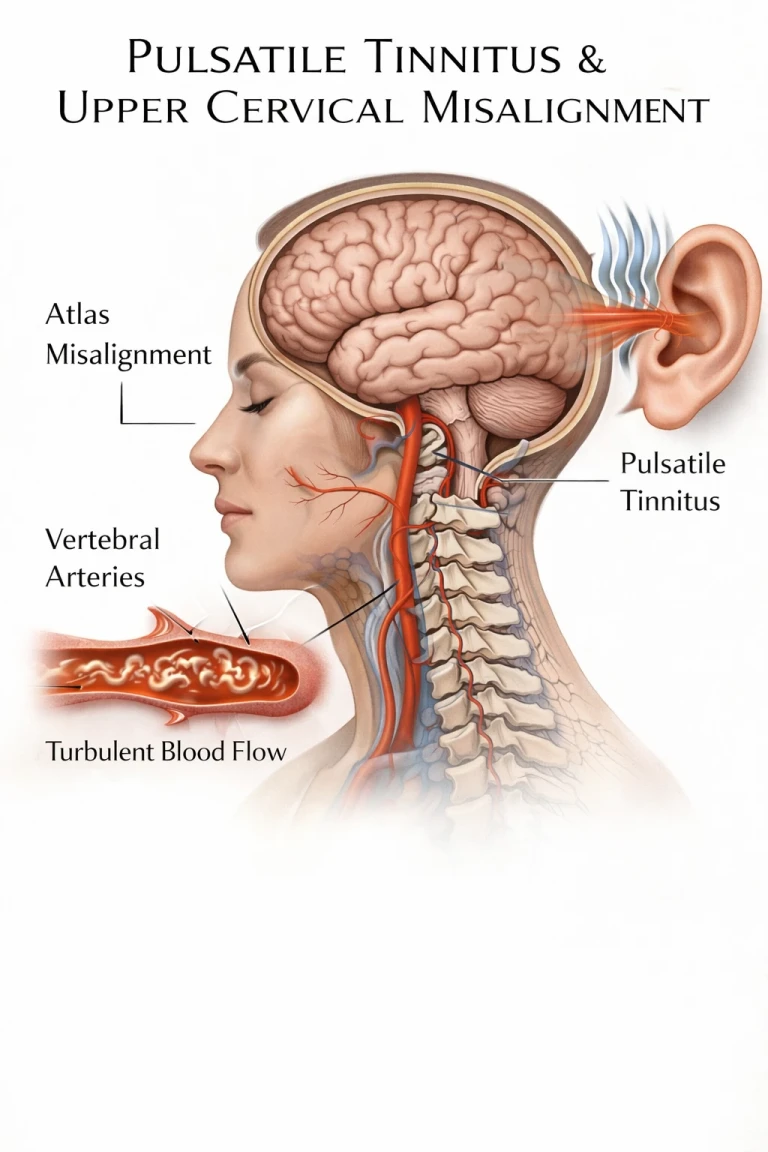
If you’re hearing a rhythmic whooshing, pulsing, or heartbeat sound in your ear, you’re not alone—and you’re not imagining it. This condition, known as pulsatile tinnitus, can be frustrating, distracting, and even anxiety-provoking. Unlike traditional ringing tinnitus, pulsatile tinnitus often has a mechanical or vascular component, meaning there may be a physical cause that can be addressed.
In Sarasota, more patients are discovering that upper cervical chiropractic care may play a key role in addressing the underlying factors contributing to whooshing and pulsatile tinnitus—especially when it’s connected to the alignment of the upper neck.
Schedule Your Appointment
Schedule appointment👉 If you’re dealing with whooshing or pulsatile tinnitus, schedule a free consultation today book here or call 941-259-1891 to see if you’re a candidate for care.
What Is Pulsatile Tinnitus?
Pulsatile tinnitus is typically described as:
A whooshing sound
A heartbeat or pulsing noise
A rhythmic sensation that often syncs with your pulse
Unlike standard tinnitus, which is often related to nerve or hearing damage, pulsatile tinnitus is frequently linked to blood flow changes in the head and neck.
That’s where the upper cervical spine becomes incredibly important.
The Atlas, Cervical Curve, and Blood Flow
The atlas (C1 vertebra) sits at the top of your spine, just beneath the skull. This region is a critical junction point for blood flow into and out of the brain, including the vertebral arteries and surrounding vascular structures.
When the atlas is misaligned, it can lead to:
Changes in the cervical curve
Altered biomechanics of the neck
Subtle compression or tension on arteries
Disruption in normal blood flow patterns
These changes can create turbulence in blood flow, which may be perceived as a whooshing or pulsatile sound in the ear.

How Turbulent Blood Flow Can Cause Whooshing Sounds
Blood is meant to flow smoothly through vessels. However, when alignment changes occur in the upper cervical spine, it can lead to:
Irregular vessel positioning
Changes in pressure gradients
Altered flow velocity
This can result in turbulent blood flow, which produces vibrations that can be picked up by the auditory system—leading to that characteristic pulsing or whooshing sound.
For some patients, this is the missing link.
Upper Cervical Care: Addressing the Root Cause
Upper cervical chiropractic focuses specifically on the alignment of the top two bones in the neck—the atlas (C1) and axis (C2).
By restoring proper alignment, upper cervical care aims to:
Improve cervical spine curvature
Reduce mechanical stress on blood vessels
Support normal blood perfusion to the brain
Decrease turbulence in vascular flow
As blood flow normalizes, many patients report a reduction or complete resolution of whooshing and pulsatile tinnitus symptoms.
👉 Find out if your tinnitus could be coming from your neck—schedule your free consultation today- book here - or call 941-259-1891.
Precision Matters: 3D Imaging and Customized Corrections
One of the most important aspects of upper cervical care is its precision.

Before any correction is made, detailed 3D imaging (CBCT scans) is used to:
Analyze your unique anatomy
Measure the exact misalignment of the atlas
Determine the precise angle and vector of correction
This is not guesswork—it’s a data-driven, highly individualized approach.
No Twisting, Popping, or Pulling
Many patients hesitate to seek chiropractic care because they’re concerned about forceful adjustments.
Upper cervical care is different.
Corrections are:
Gentle and specific
Performed with no twisting, popping, or cracking
Designed to allow the body to hold the correction over time
The goal is not repeated adjustments—it’s making the right correction and letting the body stabilize and heal.
Why Holding the Correction Is Key
When the atlas is properly aligned, the body can begin to:
Restore balanced muscle tone
Improve neurological communication
Normalize blood flow patterns
Holding that correction allows these changes to build over time, which is especially important in conditions like pulsatile tinnitus that may be linked to chronic vascular or mechanical stress.
Who Is a Candidate?
You may be a candidate for upper cervical care if you experience:
Related article
Head Pressure Relief and Treatment in Sarasota | Neck Misalignment Is Commonly the Missing Link
Mar 16, 2026Whooshing or pulsing sounds in one or both ears
Symptoms that change with head or neck position
Associated issues like neck pain, headaches, or dizziness
A history of injury, poor posture, or cervical spine issues
Each case is different, which is why a thorough evaluation is essential.
A Natural Approach to Relief
Many traditional approaches to tinnitus focus on:
Masking the sound
Medications
Waiting for symptoms to resolve
Upper cervical care offers a different path—one that focuses on identifying and correcting a potential structural cause.
By improving alignment and supporting proper blood flow, this approach works with your body rather than against it.
Take the First Step Toward Relief
If you’ve been living with whooshing or pulsatile tinnitus, you don’t have to keep guessing or managing symptoms without answers.
There may be a structural and correctable cause—and it may be coming from the upper neck.
👉 Schedule your free consultation today to see if upper cervical care is right for you.
👉 Book here or call 941-259-1891 to get started.
Final Thoughts
Pulsatile tinnitus can be complex, but in many cases, it’s not random. The connection between the atlas, cervical curve, and blood flow is often overlooked—and yet it can play a critical role in how symptoms develop.
With precise 3D imaging, gentle corrections, and a focus on restoring normal function, upper cervical care offers a targeted, non-invasive option for those seeking real answers.
👉 Don’t wait—schedule your free consultation today or call 941-259-1891 and take the first step toward quieting the noise and restoring balance. Book online here.


Leave a comment