

If you’ve ever caught yourself thinking, “Why does my head feel so heavy?”—you’re not alone. Many people describe a sensation where their head feels like a bowling ball or a pumpkin sitting on a stick, especially toward the end of the day. It can come with pressure at the base of the skull, tension headaches, brain fog, or even dizziness.
While many approaches focus on treating symptoms, there’s an often-overlooked cause that deserves attention: the relationship between the occipital muscles and the brainstem, and how misalignment in the upper neck can disrupt this delicate system.
Schedule Your Appointment
Schedule appointmentLet’s break this down in a way that actually makes sense.
The Hidden Role of the Occipital Muscles
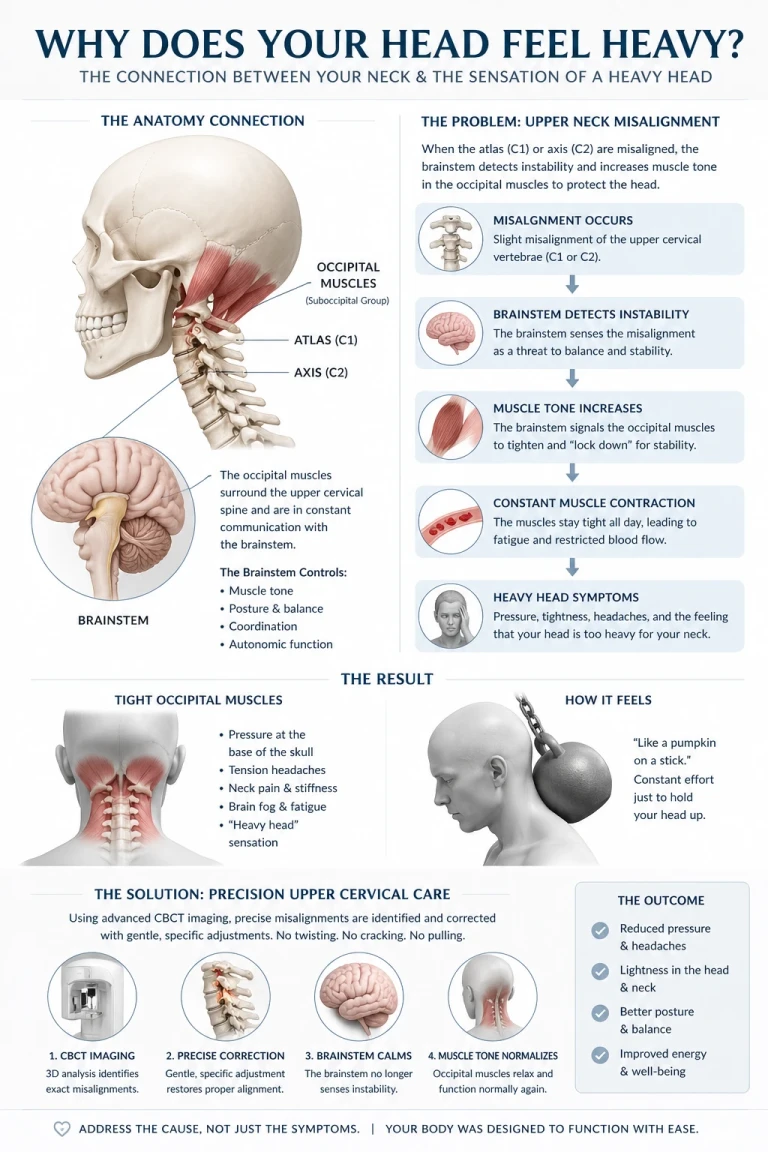
At the base of your skull sits a group of small but incredibly important muscles called the suboccipital (occipital) muscles. These muscles connect your skull to the top two bones in your neck (the atlas and axis).
They have two primary jobs:
Stabilize your head!
Provide constant feedback to your brain about head position
Unlike larger muscles, these are packed with proprioceptors, tiny sensors that communicate directly with your nervous system about posture and balance. In simple terms, these muscles are part of your body’s internal GPS system.
The Brainstem Connection
Just inches in front of these occipital muscles sits one of the most important structures in your body: the brainstem.
The brainstem controls:
Muscle tone throughout your body
Balance and coordination
Postural reflexes
Autonomic functions (heart rate, breathing, etc.)
The occipital muscles and brainstem are in constant communication. When everything is working properly, your head feels light, balanced, and easy to hold upright. But when that communication is disrupted, things change quickly.
What Happens When the Upper Neck Is Misaligned?
The top of your neck—specifically the atlas (C1) and axis (C2)—is uniquely designed for mobility and precision. However, this also makes it vulnerable.
When there is a misalignment in the upper cervical spine, several things can happen:
1. Increased Muscle Tone (Tightness)
The brainstem interprets the misalignment as instability and responds by increasing muscle tone in the surrounding area—especially the occipital muscles.
These muscles begin to:
Related article

Tighten
Shorten
“Lock down” to stabilize the head
2. Constant Muscle Contraction
Instead of relaxing and contracting normally, the occipital muscles can stay in a constant state of contraction.
This creates:
A pulling sensation at the base of the skull
Pressure in the back of the head
Tension headaches that don’t fully go away
3. The “Heavy Head” Sensation
When these muscles are overworking 24/7, your body has to fight gravity harder just to hold your head up.
This is when patients often say:
“My head feels too heavy for my neck”
“It feels like a pumpkin on a stick”
“I feel like I have to support my head all day”
This isn’t just in your head—it’s a neurological and mechanical issue.
Why Traditional Approaches Often Miss This
Many people try:
Massage therapy
Stretching
Pain medication
General chiropractic adjustments
While these can provide temporary relief, they often don’t address the root cause.
Why?
Because the issue isn’t just muscle tightness, it’s why the muscles are tight in the first place.
If the brainstem is signaling those muscles to stay tight due to a misalignment, then simply loosening the muscles won’t create lasting change.
The Importance of Precision: Enter CBCT Imaging
To truly understand what’s happening in the upper neck, precision matters.
This is where CBCT (Cone Beam Computed Tomography) imaging comes in.
Related article

Post-Viral POTS: Why Autonomic Symptoms Persist After Infection | Sarasota
Jul 28, 2026Unlike standard X-rays, CBCT provides:
A 3D view of the upper cervical spine
Exact measurements of misalignment
Detailed visualization of how the atlas and axis are positioned
This level of detail allows for a custom, patient-specific correction, rather than a one-size-fits-all approach.
Gentle, Precise Corrections (No Twisting or Cracking)
One of the biggest misconceptions is that correcting the neck requires aggressive manipulation.
In reality, upper cervical care focuses on:
Precision over force
Specificity over repetition
Corrections are:
Gentle
Targeted
Based entirely on imaging findings
There is no twisting, cracking, or pulling of the neck.
Instead, the goal is to make a small, accurate adjustment that allows the body to:
Restore proper alignment
Reduce abnormal brainstem signaling
Normalize muscle tone
What Happens After the Correction?
When the upper neck is properly aligned, something powerful happens:
1. The Brainstem Calms Down
With improved alignment, the brainstem no longer perceives instability.
2. Muscle Tone Normalizes
The occipital muscles begin to:
Relax naturally
Stop over-contracting
Return to normal function
3. The Head Feels Lighter
Patients often report:
Less pressure at the base of the skull
Reduced headaches
A noticeable decrease in the “heavy head” feeling
Many describe it as:
“My head feels like it’s floating again”
“I didn’t realize how much effort it took to hold my head up”
Why “Holding the Correction” Matters
A key principle in upper cervical care is not just making the correction—but helping it hold.
Related article

MCAS and POTS: Mast Cells, Neurogenic Inflammation, and the Upper Cervical Connection | Sarasota
Jul 28, 2026When the correction holds:
The nervous system has time to adapt
Muscles stay relaxed longer
Healing becomes more sustainable
This is why care is not about frequent adjustments, but about:
Checking objective indicators
Only adjusting when necessary
The body does the healing—the correction simply removes interference.
Could This Be the Cause of Your Symptoms?
If you’re experiencing:
A heavy head feeling
Pressure at the base of the skull
Chronic tension headaches
Neck tightness that never fully resolves
Brain fog or fatigue
There’s a good chance your upper neck and occipital muscles are involved.
Final Thoughts: Address the Cause, Not Just the Symptoms
Your head is not supposed to feel heavy.
Your muscles are not supposed to stay tight all day.
And your body is designed to function with ease—not constant tension.
By understanding the connection between the occipital muscles, brainstem, and upper cervical alignment, you can begin to see that these symptoms are not random—they are signals.
Signals that something deeper needs attention.
Looking for Answers in Sarasota?
If you’re searching for a Headache Doctor in Sarasota and want a different approach—one focused on precision, nervous system function, and long-term results—upper cervical care may be worth exploring.
A thorough evaluation, including advanced imaging like CBCT, can help determine if an upper neck misalignment is contributing to your symptoms.
Because when the cause is addressed, the body often does something incredible…
It heals.

Leave a comment