


It starts in your neck, but by lunchtime you are rubbing the top of your shoulder.
Maybe there is a knot beside the shoulder blade that never completely disappears. Turning your head toward traffic makes it worse. Sitting at the computer for an hour brings it back. Sometimes the pain stays between the neck and shoulder. Other days it seems to travel farther down the arm.
Schedule Your Appointment
Schedule appointmentSo which area actually has the problem?
The shoulder?
The neck?
Or both?
That distinction matters because pain does not always stay where it starts.
The Short Answer
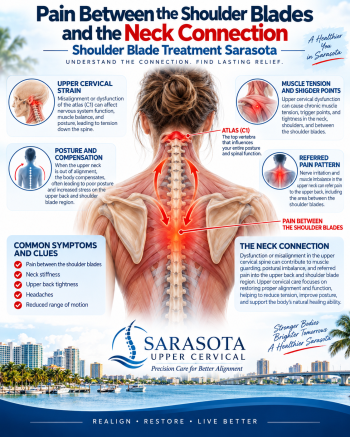
Pain from the cervical spine can be felt in the shoulder, upper back, shoulder blade, or arm.
Sometimes the source is muscular. Sometimes a cervical joint refers pain into a nearby region. In other cases, a cervical nerve root becomes irritated and produces pain, tingling, numbness, or weakness farther down the arm.
The reverse can also happen: a true shoulder condition can make the neck tighten as the body compensates.
That is why repeatedly rubbing the sore spot does not always solve the problem. The painful area and the source of the pain may not be the same place.
Why the Neck and Shoulder Are So Closely Connected
Your head does not sit on top of the spine by itself.
A network of muscles connects the skull and cervical spine with the shoulder blades, collarbones, and upper back. The trapezius, levator scapulae, sternocleidomastoid, and deeper cervical muscles all participate in controlling the head and shoulder girdle.
Imagine spending a long afternoon driving across Sarasota.
Your head gradually drifts forward. One arm stays on the steering wheel. You turn repeatedly to check mirrors and traffic. The muscles between the neck and shoulder remain active for a long time without much variation.
By the time you arrive, the shoulder may be where you feel the problem even though part of the mechanical stress began higher in the cervical spine.
For many patients, that is why massage gives temporary relief. The muscle relaxes, then tightens again because it is still compensating for the same movement pattern.
Three Common Reasons Neck Pain Reaches the Shoulder
Not all neck-and-shoulder pain is the same.
1. Muscular referral
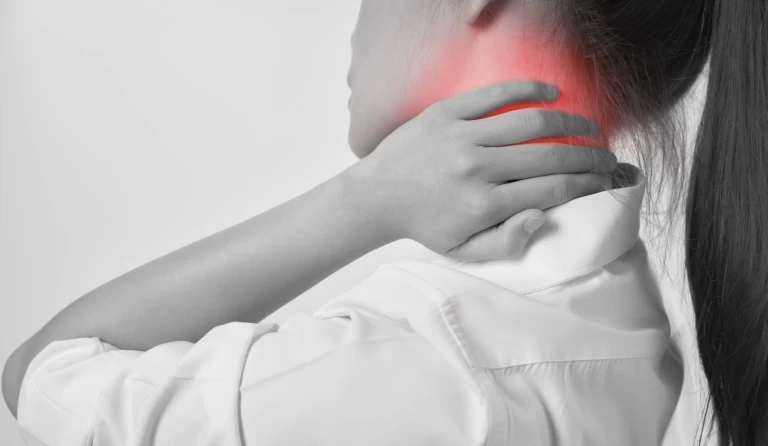
A tight or irritated neck muscle can create pain that extends beyond the muscle itself.
The levator scapulae is a common example. It runs from the upper cervical vertebrae down to the shoulder blade. When irritated, it can produce stiffness along the side of the neck and pain near the upper inside corner of the shoulder blade.
This pattern often becomes noticeable after prolonged sitting, driving, computer work, sleeping awkwardly, or suddenly turning the head.
2. Cervical joint referral
The small joints of the cervical spine can also produce referred pain.
Instead of feeling a sharp point directly over one vertebra, a person may experience a broader ache around the neck, shoulder, or scapular region.
One useful clue is movement.
If turning, extending, or tilting your neck reliably changes the shoulder pain, the neck deserves attention during the examination.
3. Cervical nerve irritation
This is different.
Cervical radiculopathy occurs when a nerve root in the neck is irritated or compressed. Depending on which nerve is involved, symptoms may extend from the neck toward the shoulder blade, shoulder, arm, hand, or fingers.
Possible signs include:
- Burning or electric pain down the arm
- Tingling or numbness
- Weakness in the shoulder, arm, hand, or fingers
- Symptoms that change with certain neck positions
- Altered reflexes
These symptoms warrant a neurological examination rather than assuming the problem is simply a tight muscle.
What Recent Research Adds
A 2024 observational study examined patients who presented primarily with shoulder pain and specifically tested whether the cervical spine contributed to their symptoms.
Researchers found that a cervical contribution was present in a portion of patients with shoulder pain. Two clues were particularly useful: a previous history of neck pain and centralization, meaning the shoulder symptoms moved closer toward the spine during cervical testing.
The study does not mean that most shoulder pain originates in the neck.
It reinforces something more practical: the neck should not automatically be ignored just because the patient points to the shoulder.
A good examination looks at both.
Where the Upper Cervical Spine Fits
At the top of the cervical spine are the atlas and axis—C1 and C2.
These vertebrae sit directly beneath the skull and participate heavily in head positioning and rotation. When movement in the upper neck becomes restricted or uncomfortable, the body may compensate by increasing muscle activity elsewhere.
That compensation can sometimes be seen as:
- One shoulder resting higher
- A persistent head tilt
- Difficulty turning toward one side
- Tightness beneath the skull
- Recurrent upper trapezius tension
- Headaches accompanying the shoulder discomfort
- A feeling that stretching helps briefly but the tightness quickly returns
These findings do not prove that C1 or C2 is responsible for shoulder pain.
They tell the chiropractor that the upper cervical region should be examined as part of the complete mechanical picture.

What About a Pinched Nerve?
Patients often use the phrase “pinched nerve” for any pain traveling from the neck toward the shoulder.
True nerve-root involvement tends to produce more neurological symptoms than ordinary muscle referral.
Pain going below the shoulder into the arm, especially when accompanied by numbness, tingling, weakness, or reflex changes, raises more concern for cervical radiculopathy.
In those cases, the goal is not merely to adjust the neck and see what happens.
The examination should determine whether additional medical evaluation or imaging is appropriate.
Progressive weakness is particularly important. If your hand is becoming weaker, you are dropping objects, or your arm strength is clearly changing, do not ignore it.
Is the Problem Actually Your Shoulder?
Possibly.
Rotator-cuff problems, arthritis, bursitis, frozen shoulder, and other shoulder conditions may produce pain that travels toward the neck.
A simple clue is how the symptoms behave.
If moving the shoulder produces the pain while neck movement has little effect, the shoulder becomes more suspicious.
If moving the neck repeatedly reproduces or changes the familiar shoulder pain, cervical involvement becomes more likely.
Some patients have both.
That is why the examination matters more than the location of the pain alone.
How Sarasota Upper Cervical Approaches the Problem
Sarasota Upper Cervical focuses specifically on the relationship between the skull and upper cervical spine.
Dr. Drew Hall has practiced the Blair Upper Cervical technique for many years. The practice describes Blair care as precise and gentle, without forceful pulling, popping, or twisting of the neck.
Rather than assuming every patient needs the same adjustment, the process begins with evaluation.
For someone with neck and shoulder pain, that may include looking at:
- Previous car accidents, falls, sports injuries, or concussions
- How far the neck comfortably rotates
- Whether movement changes the shoulder symptoms
- Head and shoulder position
- Muscle guarding
- Neurological function
- Upper cervical structure
Whether symptoms suggest involvement outside the upper cervical region

When clinically appropriate, Blair analysis uses individualized imaging to study the anatomy of the upper cervical joints and determine the direction of a correction.
The objective is specificity—not simply creating movement in a painful neck.
When Neck and Shoulder Pain Needs Medical Attention
Most episodes of neck-and-shoulder pain are musculoskeletal, but certain symptoms deserve quicker investigation.
Arrange prompt medical care for pain accompanied by significant or progressive weakness, persistent numbness, severe trauma, difficulty walking, loss of coordination, fever, or symptoms affecting both arms.
Sudden chest pressure, shortness of breath, sweating, nausea, or pain associated with exertion should also be treated as a medical concern rather than assumed to be a neck or shoulder problem.
Frequently Asked Questions
1. Can neck pain cause pain between my shoulder blades?
Yes. Cervical structures can refer pain into the scapular and upper-back region. Muscle tension and nerve irritation may also create pain around the shoulder blade.
2. Why does my shoulder hurt when I turn my head?
If neck rotation consistently reproduces your shoulder pain, the cervical spine or surrounding muscles may be contributing. It does not prove the exact diagnosis, but it is an important examination clue.
3. Can C1 or C2 cause shoulder tension?
Upper cervical dysfunction may influence head position and cervical muscle activity, which can contribute to compensatory tension through the neck and shoulder girdle. Shoulder pain can have many other causes, so an evaluation is needed before attributing symptoms to C1 or C2.
4. Does tingling mean I have a pinched nerve?
Not necessarily, but tingling raises more concern for neurological involvement. Cervical nerve roots, peripheral nerves in the arm, and conditions such as carpal or cubital tunnel syndrome can produce similar sensations.
Neck and Shoulder Pain Evaluation in Sarasota
There is a familiar cycle with this problem.
The shoulder tightens, so you massage it.
It loosens.
Two days later, the knot is back.
At that point, continuing to chase the sore muscle may not answer the more useful question: why does that muscle keep tightening?
For some people, the answer is the shoulder itself. For others, cervical joints, nerves, posture, or an old neck injury are part of the pattern.
And in a subset of patients, examining the upper cervical spine provides another piece of information that has been overlooked.
Sarasota Upper Cervical Chiropractic is located at 3920 Bee Ridge Road, Building D, Suite 101, Sarasota, Florida 34233, serving Sarasota and surrounding communities including Bradenton, Lakewood Ranch, Venice, Osprey, and Englewood.
The practice uses the Blair Upper Cervical technique and emphasizes a precise, low-force approach to the upper neck.
Phone: (941) 259-1891
If your neck and shoulder pain keep returning—especially when the symptoms change with head movement or began after an old injury—a focused examination can help determine whether the cervical spine is part of the problem.
Medical note: This article is educational and is not a diagnosis. Neck and shoulder pain can originate from the cervical spine, shoulder, nerves, or other medical conditions. Persistent or progressive neurological symptoms require appropriate medical evaluation.

Leave a comment