

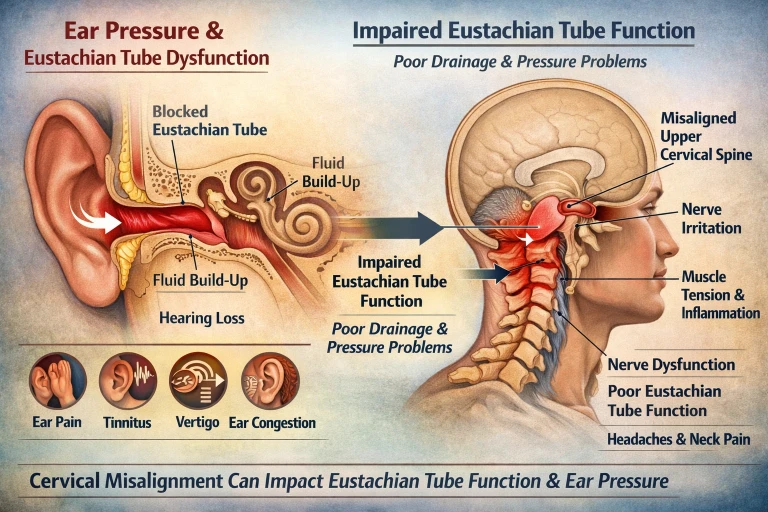
If you’ve ever felt like your ear is clogged, full, or simply won’t “pop,” you know how frustrating it can be. Many people in Sarasota and Bradenton experience Eustachian Tube Dysfunction (ETD) and are told the problem is allergies, sinus congestion, or inflammation.
While those factors can play a role, there is another often-overlooked cause — muscle tension and nerve control of the Eustachian tube, which may be influenced by the upper neck.
Schedule Your Appointment
Schedule appointmentUnderstanding how the Eustachian tube works can help explain why some people struggle with chronic ear pressure and why traditional treatments don’t always solve the problem. In a moment we will talk about how upper cervcial spine mialignement can be at the root cause of these issues.
What Is the Eustachian Tube?
The Eustachian tube is a narrow canal that connects the middle ear to the back of the throat. Its job is to:
Equalize pressure between the ear and the outside environment
Drain fluid from the middle ear
Maintain healthy ear function
Normally, the tube opens and closes when you swallow, yawn, or chew. This is what allows your ears to “pop” and equalize pressure.
But when the tube cannot open properly, pressure builds up inside the ear and fluid can become trapped.
Schedule a FREE consultation HERE.
The Muscles That Open the Eustachian Tube
The Eustachian tube does not open on its own. It relies on small muscles that line the walls of the tube to function properly.
Two of the most important muscles involved are:
Tensor Veli Palatini
Levator Veli Palatini
These muscles attach near the soft palate and the Eustachian tube. When they contract, they pull the tube open and allow air to move into the middle ear.
This opening process is essential for:
Releasing ear pressure
Draining fluid
Restoring normal hearing
If these muscles become overly tight or fail to activate properly, the tube may stay closed.
Related article

Post-Viral POTS: Why Autonomic Symptoms Persist After Infection | Sarasota
Aug 02, 2026
How the Brainstem Controls These Muscles
The muscles that control the Eustachian tube are not working independently — they are controlled by nerves that originate in the brainstem.
The brainstem acts as a communication hub between the brain and many structures in the head and neck. It helps regulate:
Muscle tone
Cranial nerve signaling
Ear and sinus function
Balance and coordination
If the brainstem signals to these muscles become disrupted, the muscles lining the Eustachian tube may tighten or fail to coordinate properly.
When that happens, the tube may remain closed — preventing pressure from equalizing and fluid from draining.
Schedule a FREE consultation HERE.
How Upper Cervical Misalignment May Interfere
The upper cervical spine — specifically the atlas (C1) — sits directly beneath the skull and surrounds the lower portion of the brainstem.
When this area becomes misaligned due to injury, posture, or long-term stress, it can create irritation or mechanical stress around the brainstem and surrounding nerves.
Because the brainstem controls muscle tone and cranial nerve function, this irritation may affect the muscles responsible for opening the Eustachian tube.
When those muscles become excessively tight or dysfunctional:
The Eustachian tube may remain closed
Pressure cannot equalize
Fluid may become trapped in the middle ear
This can lead to the familiar sensation that your ear simply will not pop.
What Happens When the Tube Stays Closed?
When the Eustachian tube remains locked down due to muscle tension, several problems can develop.

Air cannot properly move into the middle ear, and fluid drainage may slow or stop. This pressure imbalance can affect hearing and balance.
Over time, patients may experience symptoms such as:
Ear pressure or fullness
Hearing loss or sounds like hearing underwater
Tinnitus (ringing in the ears)
Vertigo or dizziness
Brain fog
TMJ or jaw discomfort
Difficulty popping the ears
Crackling or clicking sounds
Because the ear and balance systems are closely connected, Eustachian tube dysfunction can sometimes trigger dizziness or vertigo as well.
Why Traditional Treatments Sometimes Fall Short
Most conventional treatments focus on reducing inflammation or congestion. Common approaches include:
Decongestants
Antihistamines
Nasal sprays
Antibiotics
While these treatments may temporarily reduce swelling, they don’t always address why the Eustachian tube muscles are not functioning normally.
If muscle tone and nerve signaling are disrupted, simply reducing inflammation may not restore proper tube function.
A Structural Approach to Eustachian Tube Dysfunction
Because the brainstem and cranial nerves play such an important role in regulating the muscles of the Eustachian tube, some patients benefit from evaluating the upper cervical spine.
Upper cervical chiropractic focuses on the alignment of the top bones in the neck, particularly the atlas.
When alignment in this region improves, it may help reduce irritation around the brainstem and support more normal nerve communication to the muscles that control the Eustachian tube.
As muscle tone improves, the tube may open more normally, allowing pressure to equalize and fluid to drain.
Why Precision Matters
Upper cervical care is very different from traditional chiropractic adjustments.
Related article
Thoracic Outlet Syndrome Treatment and Relief Sarasota | Sarasota Upper Cervical
Apr 28, 2026Rather than generalized manipulation, this approach focuses on precise correction of the atlas misalignment.
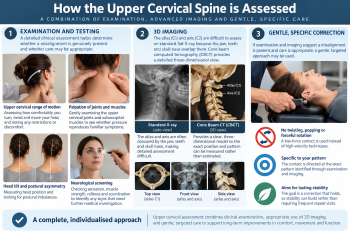
Our office uses advanced 3D imaging to measure the exact direction and degree of misalignment before delivering a gentle correction.
The adjustment itself typically involves:
No twisting
No cracking
No forceful manipulation
Instead, the goal is to deliver a highly specific correction that allows the body to restore better neurological balance.
Could Your Neck Be Affecting Your Ears?
If you have persistent Eustachian tube dysfunction and nothing seems to help, it may be worth considering whether structural stress in the upper neck is contributing to the problem.
This is especially true if you also experience:
Chronic ear pressure
Tinnitus
Vertigo
Brain fog
TMJ symptoms
Neck stiffness or past neck injury
Because the ear, brainstem, and upper cervical spine are so closely connected, addressing alignment in this area may help support better function of the Eustachian tube muscles.
Finding Help in Sarasota and Bradenton-Eustachian Tube Dysfunction
If you live in Sarasota or Bradenton and struggle with chronic ear pressure, recurring Eustachian tube dysfunction, or symptoms that don’t seem to resolve, exploring a neurological and structural approach may provide new answers.
Your ears may not just be a sinus issue.
They may be responding to signals coming from the nervous system and the upper neck.
When those signals improve, the body often has a better chance to restore normal function — helping your ears finally equalize pressure and feel clear again.
Our office serves Sarasota, Bradenton, Parish, Lakewood Ranch, Northport, Port Charlotte, Osprey, Longboat Key, Venice, Englewood, Arcadia, and Myaka City.


Leave a comment