

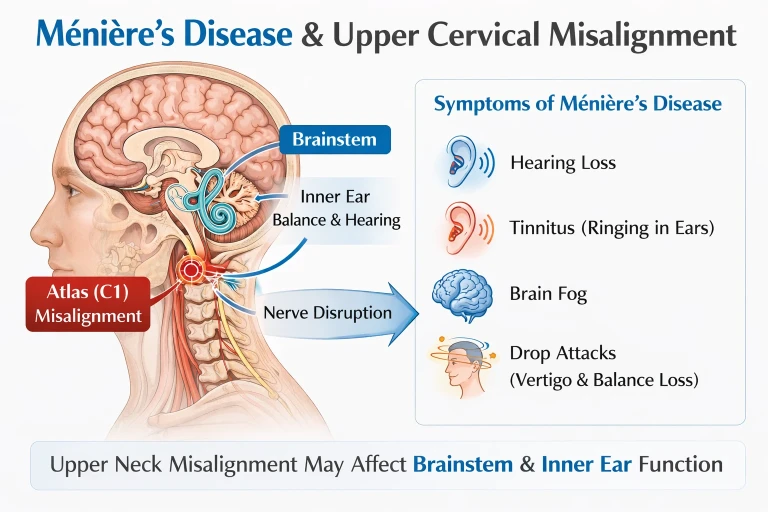
If you’ve been diagnosed with Meniere’s disease, you know how disruptive and unpredictable it can be. The sudden vertigo attacks. The ear pressure that won’t go away. The ringing that never seems to stop. The brain fog that makes it hard to focus. The gradual hearing changes that feel scary and uncertain.
Many patients in Sarasota and Lakewood Ranch are told the same thing: manage the symptoms, reduce salt, take medications, and hope flare-ups become less frequent. While symptom management can help, many people are left wondering:
Schedule Your Appointment
Schedule appointment“Why is this happening in the first place?”
If you’re searching for a natural, structural solution rather than just temporary relief, it may be time to look beyond the inner ear alone — and consider the role of the upper neck.
Understanding Meniere’s Disease
Meniere’s disease is traditionally associated with abnormal fluid dynamics in the inner ear (endolymphatic hydrops). The classic symptoms include:
Recurrent vertigo attacks
Tinnitus (ringing or buzzing in the ear)
A feeling of fullness or pressure in the ear
Fluctuating or progressive hearing loss
But what many people don’t realize is that the inner ear does not function in isolation. It is intimately connected to:
The brainstem
Cranial nerves
Eustachian tube function
Jaw mechanics (TMJ)
Blood flow and venous drainage from the skull
This is where a deeper neurological and structural evaluation becomes essential.
The Upper Neck–Brainstem Connection
The top bone in your neck — the atlas (C1 vertebra) — sits directly beneath the skull and surrounds the lower brainstem. This region controls vital neurological processes, including:
Balance (vestibular nuclei)
Autonomic nervous system regulation
Fluid circulation between the brain and spinal canal
Cranial nerve signaling
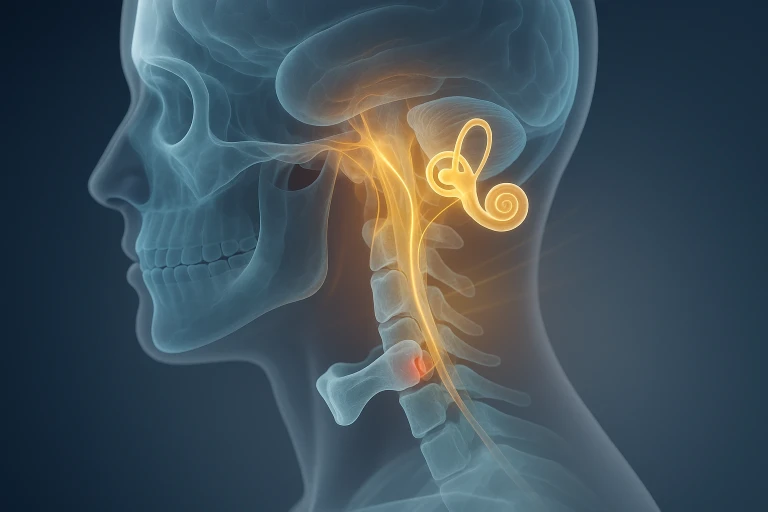
Even a subtle misalignment in this area can create mechanical stress on the brainstem and alter nerve signaling.
When this happens, patients may experience symptoms that closely resemble — or worsen — Meniere’s disease.
Eustachian Tube Dysfunction & Ear Pressure
Many Meniere’s patients report persistent ear fullness or pressure. While this is often attributed solely to inner ear fluid buildup, the Eustachian tube plays a crucial role in pressure regulation.
The muscles that help open and close the Eustachian tube are influenced by cranial nerve function. If upper cervical misalignment affects brainstem signaling, it can contribute to:
Difficulty equalizing pressure
Chronic ear fullness
Recurrent popping or inability to “pop” the ear
Fluid retention sensation
Addressing the neurological input to these structures can improve how the ear regulates pressure naturally.
Tinnitus: When the Ringing Won’t Stop
Tinnitus is one of the most frustrating symptoms associated with Meniere’s disease. It can sound like:
Ringing
Buzzing
Roaring
Hissing
The auditory nerve communicates directly with brainstem nuclei. When irritation or altered signaling occurs at the upper cervical–brainstem junction, abnormal sensory firing patterns can develop.
In some patients, restoring structural balance to the upper neck reduces neurological irritation and decreases the intensity or frequency of tinnitus episodes.
Brain Fog & Cognitive Fatigue
Many people with Meniere’s report something rarely discussed in traditional ENT appointments: brain fog.
You may feel:
Mentally slow
Forgetful
Easily overwhelmed
Fatigued after simple tasks
The brainstem plays a critical role in blood flow regulation and autonomic balance. If upper cervical misalignment interferes with vascular flow to and from the brain, it can affect clarity and cognitive performance.
Improving structural alignment may help support healthier neurological function — which often translates into clearer thinking and better energy.
Hearing Loss & Circulation
Hearing loss in Meniere’s disease is often described as fluctuating at first, then progressively worsening.
The inner ear depends on delicate blood supply and fluid regulation. Mechanical stress at the cranio-cervical junction can potentially influence:
Arterial inflow
Venous drainage
Cerebrospinal fluid (CSF) dynamics
While no one can promise restoration of lost hearing, improving structural stability in this region may help support healthier circulation and reduce recurring inflammatory stress.
TMJ & Jaw Tension: The Overlooked Connection
It’s common for patients with Meniere’s disease to also struggle with:
TMJ pain
Jaw clicking
Teeth grinding
Facial tension
The trigeminal nerve — responsible for facial sensation and jaw muscle control — has strong connections to the brainstem.
Upper cervical instability can influence trigeminal nucleus activity. When that occurs, patients may experience both jaw dysfunction and ear symptoms simultaneously.
This is why addressing only the ear, without considering the neck and jaw relationship, can leave underlying drivers uncorrected.
A Natural, Precise Approach in Sarasota & Lakewood Ranch
Unlike traditional chiropractic methods that involve twisting or cracking the neck, upper cervical care focuses on:
Detailed neurological testing
3D imaging to determine exact misalignment direction
Gentle, highly specific corrections
Monitoring how well the correction holds over time
There is no aggressive manipulation. The goal is structural precision and stability.
When the atlas is properly aligned and holding its correction, the body often has a greater ability to regulate itself — including balance, pressure control, and neurological signaling.
Why Holding the Correction Matters
Temporary changes are not enough. The key to meaningful improvement is holding the correction.
When alignment remains stable:
Brainstem stress decreases
Nervous system regulation improves
Muscular compensation patterns reduce
Fluid dynamics can normalize more effectively
Healing is not about repeated force — it’s about restoring stability so the body can do what it was designed to do.
Is This Right for You?
If you live in Sarasota or Lakewood Ranch and struggle with:
Vertigo attacks
Ear pressure
Tinnitus
Brain fog
Hearing changes
TMJ discomfort
…and you feel like you’ve tried everything without lasting results, it may be time for a different conversation.
Related article
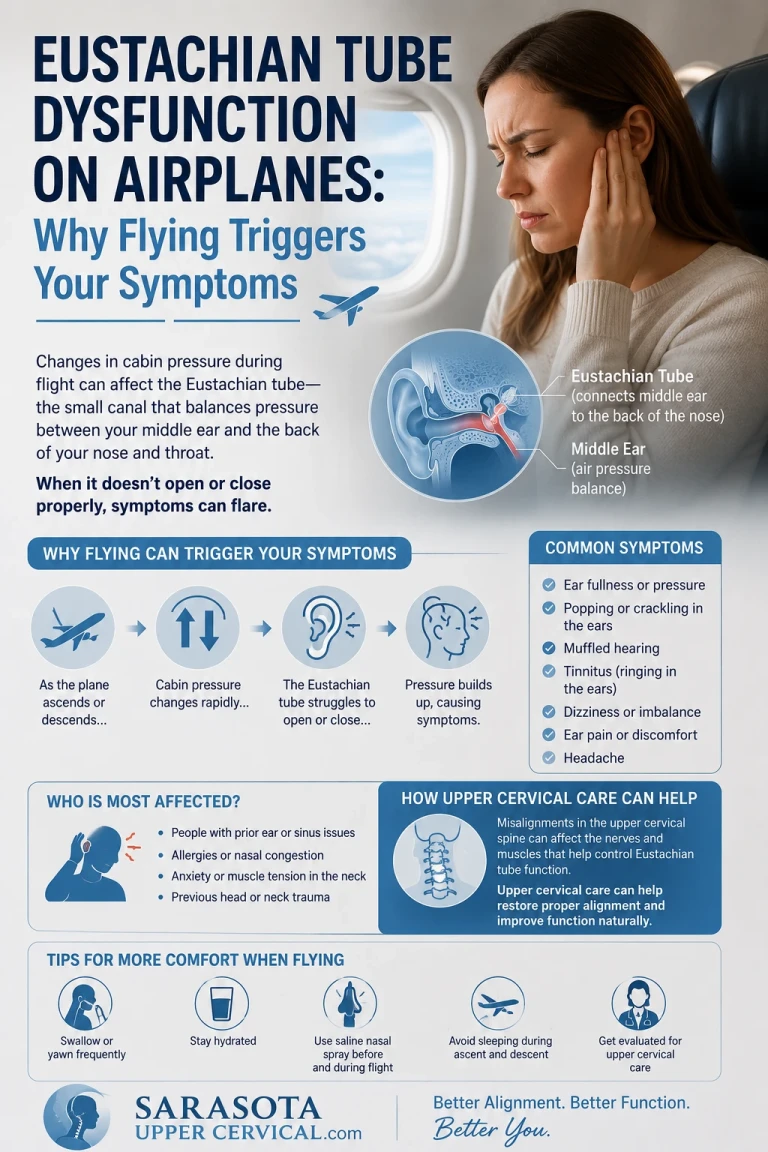
Eustachian Tube Dysfunction on Airplanes: Why Flying Triggers Your Symptoms
Jun 08, 2026You deserve to know whether your upper neck could be playing a role.
Schedule a free consultation today to discuss your case and see if upper cervical care may be the missing piece. Call 941-259-1891 to reserve your spot.
Don’t Settle for Symptom Management Alone
Medications and dietary strategies can be helpful tools. But if structural imbalance is contributing to your condition, addressing it directly may change your trajectory.
Imagine fewer vertigo episodes.
Less ringing.
Clearer thinking.
More stable hearing.
Less jaw tension.
It starts with an evaluation.
If you’re ready to explore a natural solution for Meniere’s disease in Sarasota or Lakewood Ranch, call 941-259-1891 and schedule your free consult today.
Take the First Step Toward Stability
Living with Meniere’s disease can feel unpredictable and isolating. But you are not broken — and your body is not failing you. It may simply be compensating for structural stress that hasn’t yet been addressed.
Our focus is not masking symptoms.
Our focus is restoring balance.
Click here or call 941-259-1891 to schedule your free consultation and find out if upper cervical care is right for you.
You don’t have to wait for the next attack.
You don’t have to accept brain fog as normal.
You don’t have to live in fear of dizziness.
Take control today — schedule your free consultation in Sarasota or Lakewood Ranch by calling 941-259-1891 and discover a natural path forward.


Leave a comment