

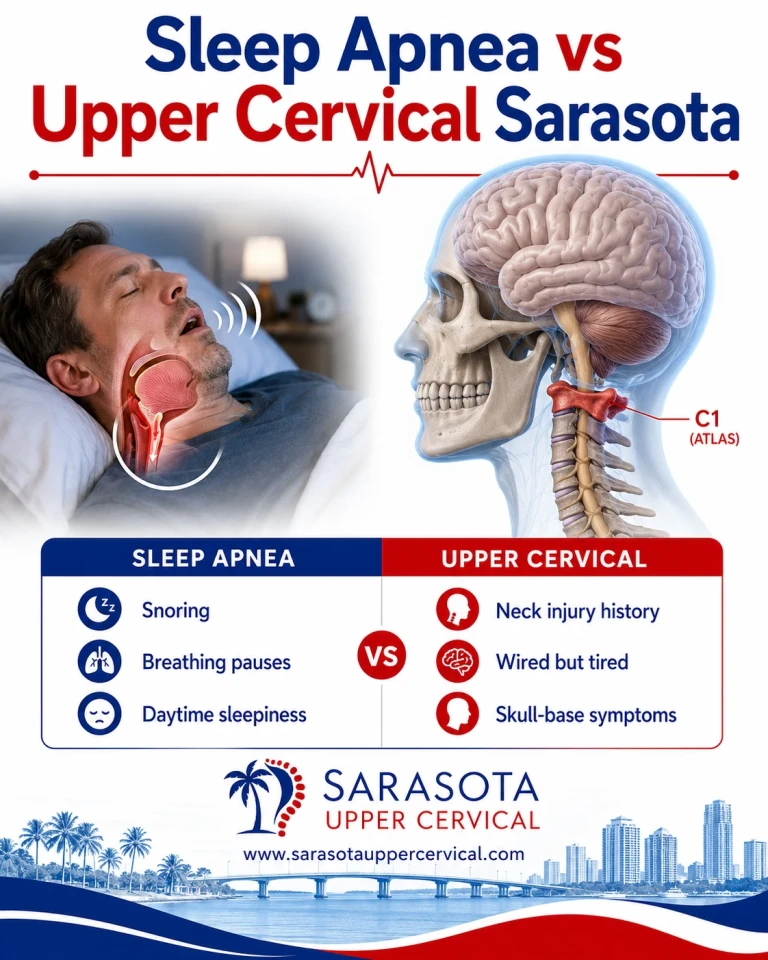
Sleep apnea is the first thing that should be ruled out when exhaustion persists despite a full night in bed, and in Sarasota it is ruled out far less often than it should be. It is also the condition most likely to be sitting underneath a sleep complaint that someone is trying to explain structurally. This article is about how to tell the two apart — and about the uncomfortable fact that a meaningful number of people have both, which is why framing this as a choice between them is usually the wrong starting point.
Why This Question Matters More Than It Sounds
Schedule Your Appointment
Schedule appointment
Obstructive sleep apnea is common and badly underdiagnosed. Prevalence estimates for the general adult population vary widely by definition and population, commonly cited in the range of nine to twenty-five percent, and it has been estimated that up to eighty percent of individuals with moderate-to-severe disease remain undiagnosed. Those are not people who never had symptoms. They are people whose symptoms were attributed to something else.
The reason it produces unrefreshing sleep is mechanical and straightforward. Repetitive partial or complete collapse of the upper airway causes breathing to reduce or stop, and each event terminates in a brief arousal — usually too short to remember. Repeated dozens or hundreds of times a night, this fragments sleep architecture while leaving total sleep duration looking entirely normal. The person reports eight hours and total exhaustion, which is exactly the presentation that also brings people to an upper cervical office.
Untreated, apnea is associated with hypertension, cardiovascular disease, stroke, metabolic dysfunction, cognitive decline, and increased all-cause mortality. This is not a condition to work around while pursuing a structural theory.
Sleepiness Is Not the Same as Fatigue
The single most useful discriminator in the history is one most people collapse into a single word. Sleepiness means the propensity to actually fall asleep — nodding off in a meeting, at a traffic light, in front of the television at seven in the evening. Fatigue means depleted energy without that propensity: you feel wrung out, but if you lay down you would stare at the ceiling.
Untreated apnea characteristically produces sleepiness. The classic picture also includes loud habitual snoring, breathing pauses witnessed by a partner, waking with a gasp or a choking sensation, morning headaches, dry mouth, nocturia, and often hypertension that is difficult to control.
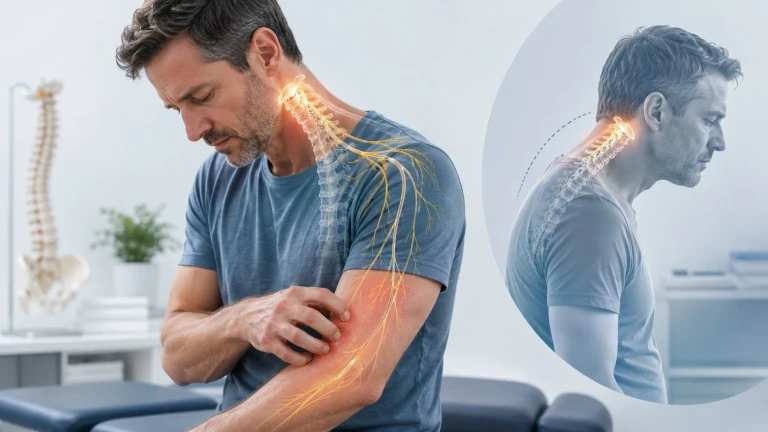
The presentation more consistent with the autonomic hyperarousal pattern is the opposite. Wired but tired. Difficulty falling asleep or returning to sleep after waking. A racing mind at night. Fatigue without genuine sleepiness — often accompanied by a paradoxical inability to nap despite exhaustion, which is a fairly specific finding. Where that pattern follows a documented craniocervical trauma, and particularly where it comes alongside headaches originating at the skull base, dizziness with head position change, or unilateral symptoms, the structural question becomes reasonable. The mechanism is covered in our pillar article on the brainstem, sympathetic tone, and the upper cervical connection.
This discriminator is genuinely useful, but it is not diagnostic. Plenty of apnea patients report fatigue rather than sleepiness, particularly women, in whom the classic presentation is less consistently seen.
What Screening Can and Cannot Tell You
The STOP-Bang questionnaire is the most widely used screening instrument. It scores eight items: snoring, tiredness, observed apneas, high blood pressure, body mass index, age, neck circumference, and male sex. A score of three or higher has a sensitivity around ninety-three percent for moderate-to-severe apnea and approaching one hundred percent for severe disease.
Here is the part that gets left out. Specificity is poor — the United States Preventive Services Task Force review reported specificity ranging from essentially zero to thirty-eight percent depending on the threshold used. In plain terms: STOP-Bang is good at telling you apnea is unlikely and bad at telling you it is present. A low score is reassuring. A high score means you need a sleep study, not that you have apnea.
Diagnosis requires either in-laboratory polysomnography, which remains the reference standard, or a home sleep apnea test. Home testing is more accessible and appropriate for many patients, but it has a meaningful false-negative rate, so a negative home study in someone with a convincing history should be followed by in-lab testing rather than treated as an all-clear.
When Someone Has Both
This is the scenario most often mishandled, and it is not rare. Apnea and a structural upper cervical finding are not mutually exclusive; they are separate problems that can occupy the same patient and produce overlapping symptoms.
Related article
Why do my ears always feel full? |Find a Natural Solution for Meniere's Disease
Mar 10, 2026The sequencing is not a close call. Apnea is treated first, because it carries cardiovascular and mortality risk that a cervical misalignment does not, and because until it is controlled you cannot interpret anything else. If someone is having their sleep fragmented a hundred times a night, no structural intervention will make them feel rested, and any conclusion drawn about whether upper cervical care helped will be worthless.
Treat the apnea, give it several months, and then reassess what remains. What is left is the honest question.
Still Exhausted on CPAP
Which brings us to the group this article is really for. Some patients use CPAP faithfully, their pressure is optimised, their apnea-hypopnea index is well controlled — and they still feel unrefreshed.
This is a documented phenomenon called residual excessive sleepiness. A French multicentre study of 502 CPAP-adherent patients at one-year follow-up found a raw prevalence of twelve percent, falling to six percent after excluding restless legs syndrome, major depression, and narcolepsy as confounders. Data from the European Sleep Apnea Database found residual sleepiness in roughly thirteen to nineteen percent of patients at follow-up beyond four months, and Weaver and colleagues found that around twenty percent remained subjectively sleepy despite eight hours of nightly use. Reported figures across the literature span roughly six to twenty-two percent depending on definitions and confounder handling.
Two honest points about what that means. First, most residual sleepiness is explained by something identifiable — periodic limb movements, insufficient sleep, depression, or medication — and those should be worked through before anything else is considered. Second, and I want to be unambiguous here, there is no evidence that upper cervical care treats sleep apnea, and nobody should tell you otherwise. Apnea is an airway problem. What is reasonable is the narrower proposition that a patient whose apnea is genuinely controlled, whose other causes have been excluded, and who has a documented craniocervical trauma history may have a second, separate contributor to their unrefreshing sleep. That is a reasoned hypothesis, not a demonstrated one.
What CBCT Does and Does Not Show
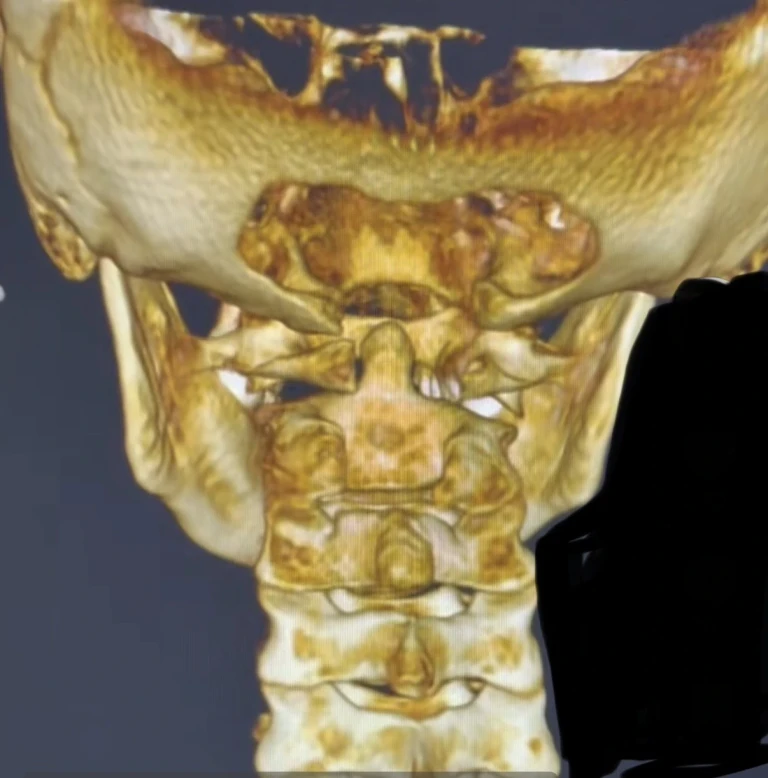
Cone beam imaging of the craniocervical junction does visualise the nasopharyngeal airway, and you will see practices make more of that than the evidence supports. So, precisely: CBCT shows airway dimensions at a single moment, in one position, while you are awake. Apnea is a dynamic collapse occurring during sleep, with muscle tone reduced. A narrow airway on imaging does not diagnose apnea, and a normal-looking airway does not exclude it. CBCT cannot measure an apnea-hypopnea index, and no imaging study substitutes for a sleep study.
Related article
Chiari Malformation Healing After Surgery: A Sarasota Upper Cervical Success Story
Apr 14, 2026What CBCT is useful for in this context is the structural question — the alignment of the craniocervical junction — not the respiratory one.
When It Is Neither
Several other conditions produce this exact presentation. Periodic limb movement disorder fragments sleep by a different mechanism and requires a sleep study to identify. Narcolepsy causes profound sleepiness and is frequently misdiagnosed for years. Hypothyroidism, iron deficiency, fibromyalgia, chronic fatigue syndrome, depression, uncontrolled pain, and a long list of medications all belong on the list. Central sleep apnea, which is a brainstem signalling problem rather than an airway obstruction, requires different management from the obstructive form.
Seek urgent medical evaluation rather than adjustment for severe sudden headache unlike any you have had, progressive weakness or numbness, changes in bowel or bladder control, difficulty swallowing or speaking, or any suspicion of craniocervical instability.
Evaluation in Sarasota, Bradenton, and Lakewood Ranch
If you have never had a sleep study and you are exhausted despite adequate time in bed, that study is the correct next step and not an upper cervical evaluation. If you have had one, your apnea is controlled or excluded, and you are still waking unrefreshed — particularly following a car accident, fall, concussion, or sports injury — then the structural question is worth asking. To learn more or to schedule, visit www.neckwise.com.
Medical Disclaimer
This article is provided for general educational purposes only and does not constitute medical advice, diagnosis, or treatment, and does not establish a doctor-patient relationship. Upper cervical chiropractic care is not a treatment for obstructive sleep apnea, insomnia, or any other named condition, and no guarantee of any particular result is made or implied. Sleep apnea is a serious medical condition requiring diagnosis and management by a qualified physician; do not discontinue CPAP or any prescribed therapy without consulting the prescribing physician. Individual results vary, and the mechanisms described include both established physiology and hypotheses not demonstrated in clinical trials, as indicated in the text. In accordance with Florida Administrative Code Rule 64B2-15.001, this content is offered without any claim of superiority of one method of treatment over another and without any promise of cure or guaranteed outcome.
Written by Dr. Drew Hall, upper cervical chiropractor, Sarasota Upper Cervical / Hall Upper Cervical Chiropractic PC, serving Sarasota, Bradenton, and Lakewood Ranch, Florida.
Leave a comment