

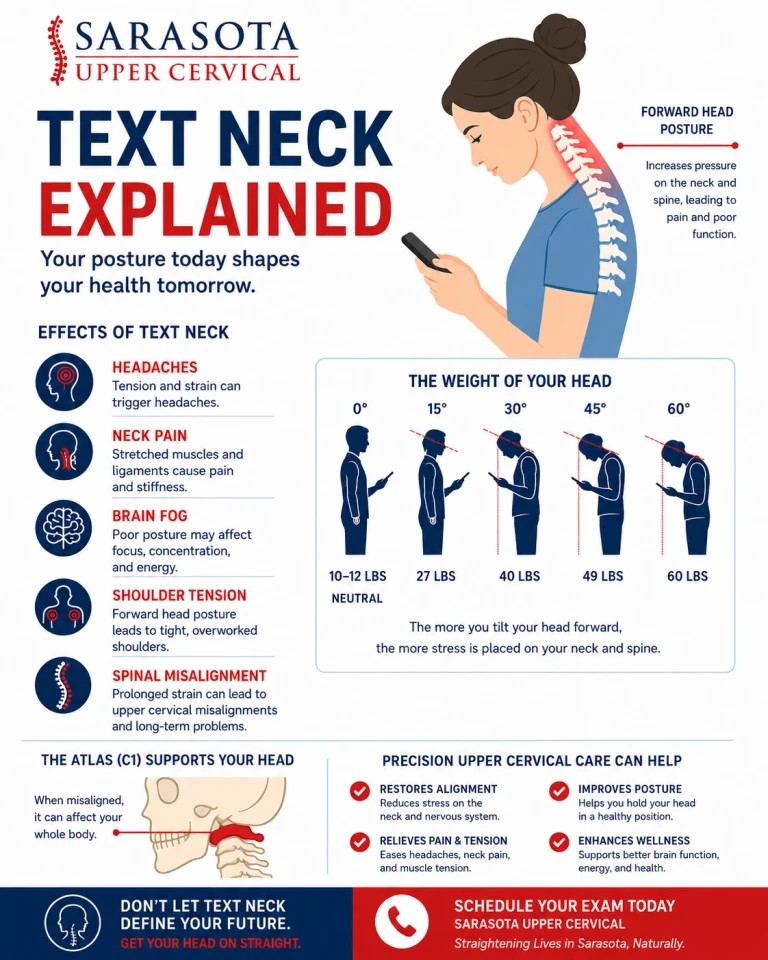
"Text neck" has become one of the most repeated phrases in health media, and one of the least examined. The standard version goes like this: people look down at phones, the head weighs more when tilted, the cervical spine wears out, and a generation is destroying its neck one message at a time.
The mechanics in that story are broadly correct. The conclusion is not.
Schedule Your Appointment
Schedule appointmentWhat text neck actually describes
Text neck is not a diagnosis. It is a description of a position — sustained cervical flexion while looking down at a handheld screen, usually with the lower neck bent forward and the upper neck compensating into extension to keep the eyes level.
The load argument comes from a widely quoted 2014 mathematical model by spine surgeon Kenneth Hansraj, which calculated that the counterbalancing demand on the neck rises from the head's neutral weight of ten to twelve pounds to roughly sixty pounds at sixty degrees of flexion. That model is worth understanding accurately: it was a static computer simulation by a single author, its own author noted it became unreliable past sixty degrees, and the figures describe the muscular demand created by the lever arm, not compressive pressure crushing the discs.
Why the research does not support the panic
If sustained phone flexion were straightforwardly damaging necks, the evidence would be obvious. It is not.
Damasceno and colleagues measured actual cervical flexion angles in young adults using smartphones and found no association between those angles and neck pain prevalence, frequency or intensity. Richards and colleagues studied more than eleven hundred Australian adolescents, identified distinct clusters of sitting neck posture, and found no association between which cluster a teenager fell into and whether they had neck pain or headaches. A 2024 systematic review pooling four low-risk-of-bias studies covering over a thousand participants concluded that no association was identified between text neck and the onset of neck pain.
Related article
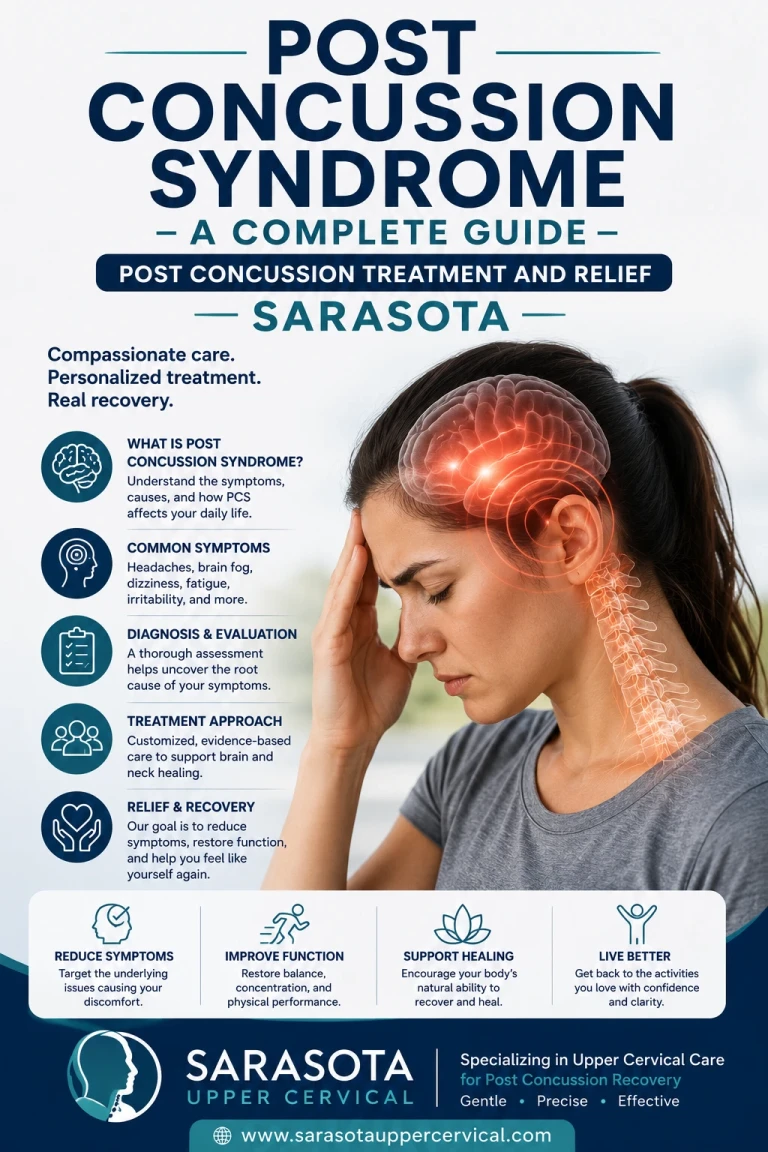
Post-Concussion Syndrome and the Upper Neck: The Missing Piece in Cases That Don't Recover
Jun 16, 2026Billions of people use phones heavily. Most never develop persistent neck pain, headaches or dizziness. Something separates the people who do from the people who don't — and it is not how many degrees they tilt their head.
Posture is a nervous system output
Here is the piece the standard story leaves out entirely.
You do not choose your posture. Your nervous system generates it. Standing upright requires continuous unconscious correction, driven by postural control centers in the brainstem and cerebellum that integrate three streams of information: vestibular input from the inner ear, visual input, and proprioceptive input from mechanoreceptors in joints, ligaments and muscles.
The upper cervical spine is disproportionately important in that third stream. The small suboccipital muscles at the base of the skull contain some of the highest densities of muscle spindles found anywhere in the human body. These are not primarily movers. They are sensors, reporting to the brainstem exactly where the head sits on the neck — the reference frame the brain needs to interpret everything the eyes and inner ear are telling it.
The output side of that system is muscle tone: the baseline tension the nervous system maintains in each postural muscle, delivered through descending pathways from the brainstem and adjusted moment to moment without your involvement.
Change the quality of the input and the tone settings change. Change the tone settings and posture changes, whether or not you decide anything.
Where atlas misalignment enters
Related article
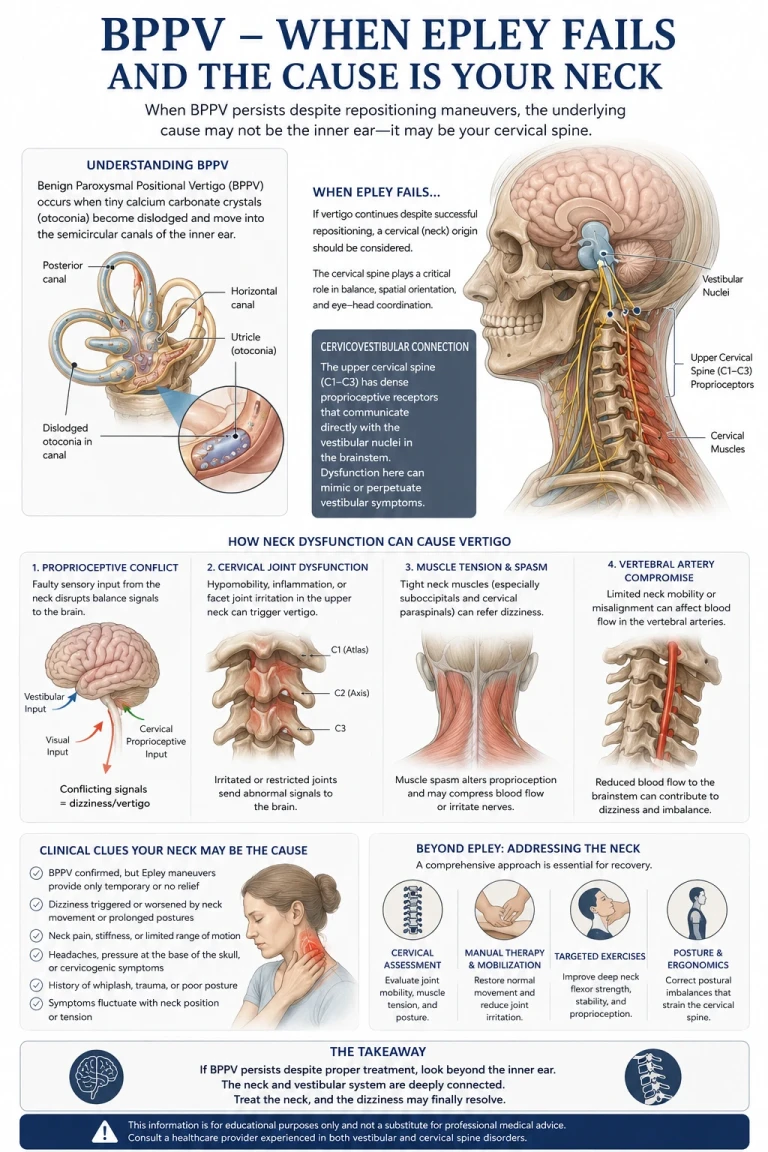
BPPV Treatment and Relief When the Epley Maneuver Has Failed to Bring Relief | Sarasota
May 10, 2026
When the atlas — the first cervical vertebra, carrying the skull directly — sits misaligned relative to the skull and the vertebra below it, the mechanoreceptors in that region report from a distorted starting position. The brainstem receives a skewed account of where the head is and sets muscle tone accordingly.
Two related models describe why this would matter beyond local stiffness. Seaman and Winterstein proposed dysafferentation: that abnormal mechanoreceptor input from dysfunctional spinal joints alters central processing, muscle tone and autonomic regulation more broadly. Separately, the anatomical work of Gary Hack and colleagues established the myodural bridge, a dense connective tissue connection between the suboccipital muscles and the spinal dura. Both are worth knowing. Dysafferentation is a theoretical framework that has not been validated in controlled trials. The myodural bridge is anatomically well confirmed, but its proposed clinical role in producing headache through sustained dural tension remains a preliminary mechanism rather than an established one.
This matters for symptoms that reach the head. Sensory fibers from the upper cervical nerve roots converge with trigeminal fibers onto shared second-order neurons in the trigeminocervical complex, established neurophysiology which means the brain cannot always distinguish where a signal originated. Dreyfuss, Michaelsen and Fletcher mapped this directly, provoking upper cervical joints in healthy volunteers and recording referral into the occiput and head. It is why neck input is so often felt as headache.
Michael Flanagan has proposed further that the craniocervical junction acts as a choke point where misalignment could affect cerebrospinal fluid circulation, venous drainage, arterial supply and brainstem signaling. This is a single-author hypothesis that has not been validated in controlled trials. It raises testable questions about an under-studied region; it is not a proven mechanism and should not drive a treatment decision.
The reframe that actually fits the evidence
A cervical spine with intact alignment, functioning deep stabilizers and clean proprioceptive signaling has reserve. It tolerates hours of flexion, redistributes load, recovers during breaks and returns to neutral without difficulty. For that person, repetitive posture is largely a non-event.
A cervical spine already compensating for an atlas misalignment has spent that reserve. The deep stabilizers are underactive, the suboccipital muscles are held short in chronic extension, and the brainstem is working from degraded information.
Text neck does not create that problem. It accelerates and exacerbates it. The added flexion load lands on a system with nothing left to absorb it, which is why symptoms so often appear during a period of heavy screen use even though the screen use is not the origin. The underlying deficit was already there.
What to do about it
Raising the phone toward eye level and varying position every twenty to thirty minutes genuinely helps, because it removes load rather than asking you to resist it. If that is enough, it was a loading problem.
If it is not enough — particularly if neck symptoms come alongside headaches, dizziness, visual difficulty or a sense that your body sits unevenly — the useful step is finding out what the postural control system is responding to.
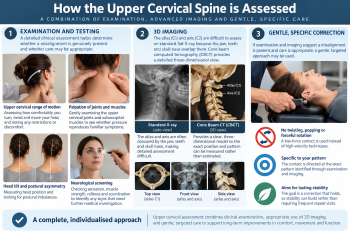
An upper cervical evaluation begins with specific testing to determine whether a misalignment is actually present, since not everyone with neck pain has one. Where testing indicates it, cone beam CT three-dimensional imaging locates the exact misalignment pattern on that individual's anatomy, because the atlas varies considerably from person to person. The correction that follows is gentle and precisely directed, made without popping, twisting or yanking the neck. The philosophy is oriented toward holding the correction, with follow-up testing determining whether an adjustment is needed rather than delivering one by default.
Honestly stated: this approach has not been shown superior to other conservative care in head-to-head randomized trials. The anatomy underlying it is real; the comparative evidence is limited.
Medical Disclaimer
This article is educational and does not constitute medical advice, diagnosis or treatment. Seek emergency care immediately for sudden severe headache unlike any before, sudden vision loss, double vision, slurred speech, facial drooping, one-sided weakness, progressive weakness or loss of coordination, changes in bowel or bladder control, or neck pain with fever, stiffness and confusion.
Learn more about upper cervical evaluation and care at neckwise.com.
Written by Drew Hall, D.C., Upper Cervical Chiropractor.

Leave a comment