

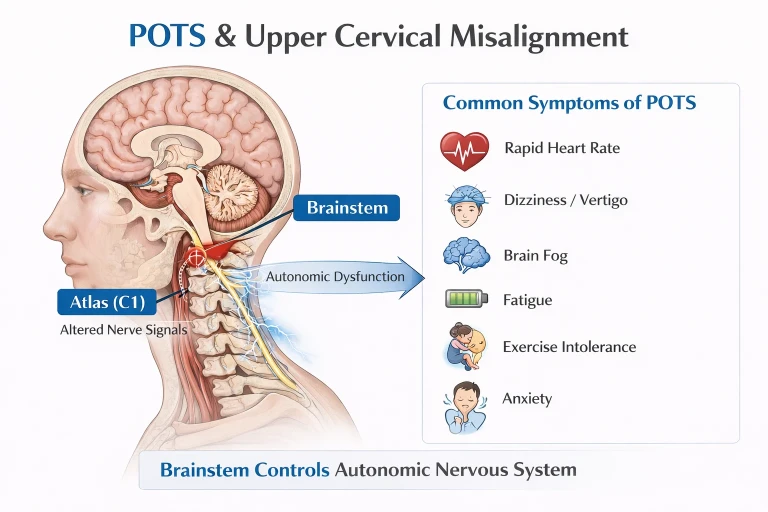
POTS is a disorder of the autonomic nervous system (ANS). The autonomic nervous system controls the body’s automatic functions that occur without conscious thought.
These include:
Schedule Your Appointment
Schedule appointmentHeart rate regulation
Blood pressure control
Breathing patterns
Digestion
Temperature regulation
Circulation
Hormone release
In this article we will discuss how an upper cervical cpine misalignment can affect the autonomics and is often at the root cause of POTS.
In healthy individuals, when a person stands up, the autonomic nervous system automatically adjusts blood vessel tone and heart rate to maintain stable blood flow to the brain.
In individuals with POTS, this regulation becomes impaired.
Instead of maintaining balance, the heart rate often increases dramatically — sometimes 30 beats per minute or more within the first few minutes of standing.
This can cause symptoms such as:
Rapid heart rate or palpitations
Dizziness when standing
Lightheadedness
Chronic fatigue
Brain fog
Exercise intolerance
Head pressure
Nausea
Anxiety-like symptoms
While the symptoms can be severe and life-disrupting, the underlying cause of POTS often remains unclear.
This is why many patients continue searching for deeper explanations for their condition.
The Brainstem: Control Center of the Autonomic Nervous System
At the center of autonomic regulation lies one of the most vital structures in the human body: the brainstem.
The brainstem sits at the base of the brain and connects the brain to the spinal cord. It consists of three major components:
The midbrain
The pons
The medulla oblongata
These structures contain specialized nuclei responsible for controlling autonomic functions throughout the body.
The brainstem regulates:

Heart rate and cardiac rhythm
Blood pressure through baroreceptor reflexes
Breathing patterns
Digestive activity
Sympathetic and parasympathetic balance
Vagus nerve output
The medulla oblongata, located at the lowest portion of the brainstem, houses cardiovascular control centers that regulate both heart rate and blood pressure.
When functioning properly, these systems maintain stable circulation regardless of whether you are sitting, standing, or exercising.
However, if the brainstem becomes irritated, stressed, or unable to properly communicate with the body, autonomic instability may develop.
This is where the relationship between the upper cervical spine and brainstem function becomes important.
The Upper Cervical Spine and the Brainstem
Directly beneath the brainstem sits the upper cervical spine, which includes the first two vertebrae of the neck:
Atlas (C1)
Axis (C2)
This region is known as the craniocervical junction, where the skull meets the spine.
It is one of the most neurologically sensitive areas in the body because it contains:
The brainstem
The upper spinal cord
The vertebral arteries supplying blood to the brain
Cerebrospinal fluid pathways
Critical nerve pathways involved in autonomic regulation
The atlas vertebra (C1) plays a particularly important role because it supports the head and allows it to balance over the spine.
Unlike other vertebrae, the atlas has a unique ring-like shape and allows a large range of motion.
However, this mobility also makes it vulnerable to misalignment following trauma or repetitive stress.
How Atlas Misalignment May Influence Autonomic Function
Traumas such as:
Car accidents
Whiplash injuries
Sports impacts
Falls
Concussions
Related article
Hearing Loss Treatment in Sarasota | Understanding Eustachian Tube Dysfunction
Mar 23, 2026
Poor posture over time can cause subtle misalignments of the atlas vertebra.
When the atlas shifts out of its optimal position, it may create biomechanical stress at the craniocervical junction.
This stress can potentially affect several important neurological mechanisms that regulate autonomic function.
Brainstem Mechanical Stress
Because the brainstem sits directly above the atlas, abnormal alignment of the upper cervical spine may influence the biomechanics surrounding this vital neurological structure.
Mechanical stress in this region may disrupt the brainstem’s ability to properly regulate autonomic output.
Altered Sensory Signaling to the Brainstem
The upper cervical spine contains thousands of proprioceptive nerve receptors that constantly send information to the brainstem about head position and movement.
If the atlas becomes misaligned, abnormal sensory signals may be transmitted to the brainstem.
This phenomenon is sometimes referred to as dysafferentation, meaning distorted nerve input reaching the brain.
When the brainstem receives inaccurate sensory information, it may lead to disturbances in autonomic regulation.
Increased Sympathetic Nervous System Activity
Many POTS patients appear to have a sympathetic nervous system that is overactive.
This can result in symptoms such as:
Rapid heart rate
Anxiety
Poor sleep
Cold hands and feet
Exercise intolerance
Abnormal signaling from the upper cervical spine may contribute to this imbalance between the sympathetic and parasympathetic nervous systems.
Common Symptoms of POTS
Patients with POTS often experience a wide variety of symptoms that may affect multiple systems in the body.
Related article
Feeling Faint Upon Standing and Tachycardia? | Dysautonomia Specialist Sarasota
May 03, 2026These may include:
Rapid heart rate when standing
Dizziness or lightheadedness
Brain fog and difficulty concentrating
Chronic fatigue
Head pressure or headaches
Exercise intolerance
Nausea or digestive disturbances
Temperature regulation problems
Anxiety or panic sensations
Fainting or near-fainting episodes
Because these symptoms overlap with many other conditions, individuals with POTS often spend years searching for answers.
Evaluating the health and alignment of the upper cervical spine may provide additional insight into the neurological factors contributing to autonomic dysfunction.
Upper Cervical Chiropractic and POTS
Upper cervical chiropractic care focuses specifically on restoring proper alignment to the atlas (C1) and axis (C2) vertebrae.
Unlike traditional chiropractic adjustments, upper cervical care emphasizes precision and minimal force.
Doctors utilize:
Detailed neurological examinations
Specialized imaging such as 3D CBCT scans
Precise measurements of spinal alignment
The goal of care is not to treat a specific condition like POTS directly, but rather to restore proper structural alignment so the nervous system can function optimally.
When the upper cervical spine is properly aligned, potential benefits may include:
Improved communication between the brainstem and body
Reduced neurological stress at the craniocervical junction
Improved autonomic balance
Better circulation and nervous system regulation
Many patients report improvements in symptoms such as dizziness, fatigue, brain fog, and heart rate instability after restoring proper upper cervical alignment.
Finding a POTS Specialist in Sarasota
If you suffer from symptoms consistent with Postural Orthostatic Tachycardia Syndrome, evaluating the health of the brainstem and upper cervical spine may be an important step in understanding the root cause of your condition.
Because the brainstem regulates the autonomic nervous system, structural stress in this region may influence the body’s ability to control heart rate, blood pressure, and circulation.
Through precise imaging and gentle corrections, upper cervical chiropractic care aims to restore proper alignment and support the nervous system’s natural ability to regulate itself.
Schedule a Free Consultation
If you experience symptoms such as:
Rapid heart rate when standing
Chronic fatigue
Brain fog
Dizziness or vertigo
POTS or dysautonomia
you may benefit from an evaluation of your upper cervical spine.
Schedule a Free Consultation Today
Leave a comment