

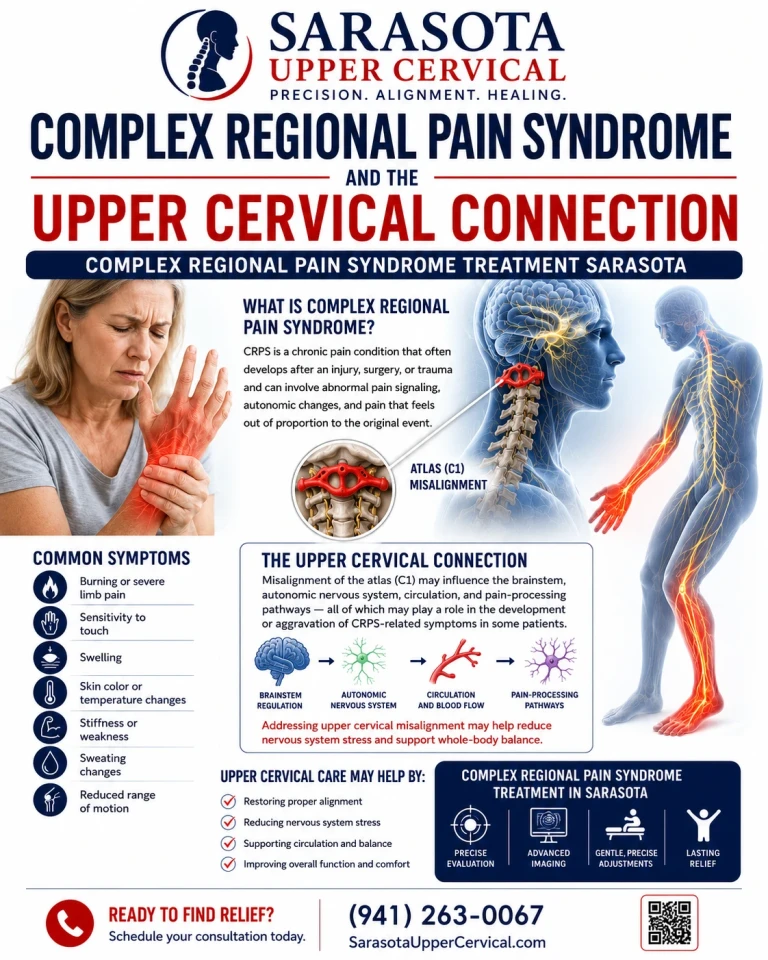
Complex regional pain syndrome is one of the conditions in Sarasota, Bradenton, and Lakewood Ranch that most reliably outruns its explanation. A wrist is fractured, or an ankle sprained, or a minor surgery performed. The injury heals. The pain does not — it spreads beyond the original site, becomes disproportionate to anything visible, and brings with it changes that make no sense for a simple injury: the limb changes colour and temperature, swells, sweats abnormally, the hair and nails grow differently, and light touch becomes unbearable.
That combination of sensory, autonomic, motor, and trophic change in one limb is what defines complex regional pain syndrome, and it is what makes it a nervous system disorder rather than a tissue one.
Schedule Your Appointment
Schedule appointmentHow it is diagnosed
There is no blood test and no scan that confirms it. Diagnosis rests on the Budapest criteria, which require continuing pain disproportionate to the inciting event, plus symptoms and examination findings distributed across four categories.
The sensory category covers hyperalgesia and allodynia — pain from stimuli that should not hurt, such as clothing or a light breeze. The vasomotor category covers temperature asymmetry between limbs and changes in skin colour. The sudomotor and oedema category covers swelling and altered sweating. The motor and trophic category covers reduced range of motion, weakness, tremor, dystonia, and changes to hair, nail, or skin texture. The diagnosis also requires that no other condition better explains the picture.
Two types are distinguished. Type I follows an injury with no identifiable nerve lesion and accounts for the majority. Type II follows a confirmed nerve injury.
The single most useful thing to know is that early recognition matters enormously. Outcomes are substantially better when treatment starts within the first months, and the most common reason it does not is that the diagnosis is not considered.
What is happening in the nervous system
The mechanism is multi-layered, and the honest summary is that no single explanation accounts for the whole picture.
Peripheral sensitisation occurs first. Injury triggers release of neuropeptides including substance P and calcitonin gene-related peptide from sensory nerve terminals, producing neurogenic inflammation — the warmth, redness, and swelling of the early phase.
Central sensitisation follows. Sustained nociceptive input increases the excitability of dorsal horn neurons, so that the same peripheral signal produces a larger central response. This is the mechanism behind allodynia and behind pain spreading beyond the injured territory.
Cortical reorganisation is one of the more striking findings. Imaging studies have shown that the representation of the affected limb in the primary somatosensory cortex becomes distorted, and the degree of that distortion correlates with pain severity. Patients often report that the limb feels foreign, larger or smaller than it is, or not quite theirs. This is a real perceptual change, not a description of distress.
Autonomic involvement is definitional but its role is contested. The older framing of complex regional pain syndrome as "reflex sympathetic dystrophy" implied that sympathetic overactivity drove the pain. That model has not held up well. Sympathetic blocks, which would be the obvious treatment if it were correct, have limited and inconsistent supporting evidence. Current understanding treats the autonomic features as part of the syndrome rather than as its engine.
There is also an emerging autoimmune thread, with reports of autoantibodies directed against adrenergic and muscarinic receptors in a subset of patients. It is an active area of research and not yet a basis for treatment decisions.
Where the neck fits, stated carefully
I want to handle this section with more restraint than this condition usually receives, because complex regional pain syndrome attracts confident claims from a lot of directions and desperate patients are exactly the wrong people to sell certainty to.
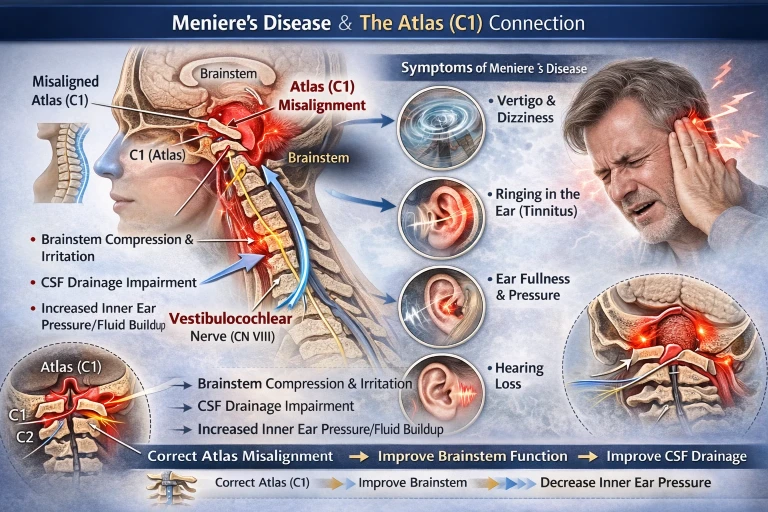
There is no evidence that upper cervical misalignment causes complex regional pain syndrome, and I am not going to imply otherwise. The condition follows a peripheral injury, and its mechanisms are peripheral sensitisation, spinal cord sensitisation, and cortical reorganisation.
What can reasonably be said involves the same principle that applies to any centrally sensitised pain state. A nervous system in a sensitised condition responds to the total burden of input reaching it, not to one source in isolation. Where a person with complex regional pain syndrome also has an unaddressed source of persistent nociceptive input — and the upper cervical spine is a common one, particularly after trauma — reducing that input is a coherent aim within a broader plan. That is a contributing-factor argument about overall load, not a treatment for the syndrome.
There is a second and narrower point specific to upper limb cases. Complex regional pain syndrome of the arm or hand frequently coexists with cervical and shoulder girdle dysfunction, sometimes from guarding and disuse of the affected limb over months. That secondary dysfunction is genuinely treatable and worth addressing, and it is not the same as treating the syndrome itself.
No clinical trial of upper cervical chiropractic exists for this condition. Anyone claiming to resolve complex regional pain syndrome with adjustments is describing something the evidence does not support.
What the evidence supports for treatment
The interventions with the best support are, perhaps counterintuitively, movement-based. Graded motor imagery and mirror therapy, developed substantially through the work of Lorimer Moseley and colleagues, target the cortical reorganisation directly, progressing from laterality recognition through imagined movement to mirror-box work. Graded exposure and desensitisation, and early functional use of the limb, are central. Prolonged immobilisation makes the condition worse.
Medically, bisphosphonates have supporting trial evidence, particularly in early disease. Neuropathic pain agents are widely used. Multidisciplinary programmes combining physical therapy, pain management, and psychological support have the strongest overall support. Ketamine and spinal cord stimulation are used in refractory cases.
The consistent theme across all of it is early, active, movement-based rehabilitation. Anything that encourages a patient to protect and immobilise the limb runs against the direction of the evidence.
Related article
Why Is My Face Drooping on One Side? | Natural Bell’s Palsy Treatment and Relief in Sarasota
Apr 26, 2026How care is delivered here
Upper cervical correction involves no twisting, no popping, no cracking, and no pulling of the neck. That matters more than usual in this population, because a person with allodynia may find ordinary handling painful, and forceful technique is neither necessary nor appropriate.
Cone beam computed tomography measures the three-dimensional position of the atlas and axis against your own anatomy so that any correction is calculated rather than estimated. Objective measures — leg length assessment, cervical range of motion, postural and balance measurement, and thermographic pattern tracking — determine whether a correction is indicated and whether it is holding. When they show it is holding, no adjustment is given. In a sensitised nervous system, less input is the point.
Red flags
Signs of infection — spreading redness, fever, warmth with systemic illness — require urgent medical assessment rather than being attributed to the syndrome. So does a sudden change in limb colour or temperature with loss of pulse, which may indicate vascular compromise. Progressive weakness, new numbness in a defined nerve distribution, or symptoms spreading to other limbs warrants neurological reassessment, as does any suggestion that a different diagnosis fits better. Deep vein thrombosis can mimic the swollen, discoloured limb of early complex regional pain syndrome and needs excluding.
Because chronic severe pain carries real psychological burden, distress in this population should be taken seriously and supported rather than treated as a diagnostic explanation for the symptoms.
An evaluation in Sarasota
If you are living with complex regional pain syndrome and have persistent neck or upper back involvement alongside it, or your symptoms began after an injury that also involved your neck, an upper cervical evaluation may identify one contributor to the overall input burden on a sensitised nervous system. It sits alongside your pain management, rehabilitation, and medical care as one component of a broader plan, and it is not a treatment for the syndrome. To arrange a consultation call 941 259-1891.
Dr. Drew Hall, Upper Cervical Chiropractor
Serving Sarasota, Bradenton, and Lakewood Ranch, Florida
This article is for general educational purposes only and is not medical advice, a diagnosis, or a treatment recommendation for any individual. Complex regional pain syndrome requires diagnosis and management by qualified medical providers, and early multidisciplinary treatment substantially affects outcome. Upper cervical chiropractic is an area of focus within chiropractic; it is not a board-recognized specialty, and no claim of specialization or superiority is made or implied. No clinical trial evidence exists for upper cervical chiropractic care in complex regional pain syndrome, it is not a treatment for the condition, and no such claim is made here. Active, movement-based rehabilitation is central to management and should not be delayed or replaced by manual care. Cone beam computed tomography is used as a precision measurement and analysis tool, not as a stand-alone diagnostic device. Individual results vary and no specific outcome is guaranteed. Seek prompt medical attention for signs of infection, sudden loss of pulse or limb colour change, progressive weakness, or symptoms spreading to other limbs. Always consult a qualified healthcare provider regarding diagnosis and treatment.
Leave a comment