

Convergence insufficiency after concussion is one of the most common and most under-recognised reasons that recovery stalls in Sarasota, Bradenton, and Lakewood Ranch. Someone sustains a head injury, the imaging is clean, the acute symptoms settle, and then reading becomes impossible. Words double or overlap. Screens produce headache within minutes. Concentration collapses at near distance while distance vision feels fine.
That pattern is not a cognitive problem, though it is routinely mistaken for one. It is a failure of the eyes to work together at close range, and it is measurable and treatable.
Schedule Your Appointment
Schedule appointmentWhat convergence insufficiency is
To focus on something near, the eyes must turn inward together — converge — while simultaneously adjusting focus through accommodation and constricting the pupils. This is coordinated by brainstem circuitry, principally through the oculomotor nuclei and the midbrain near-response system.
In convergence insufficiency, the eyes cannot sustain that inward turn. One eye drifts outward, the brain receives two slightly different images, and it compensates with effort. The effort is what the patient feels: eyestrain, headache, blur, intermittent doubling, loss of place while reading, words appearing to move or swim, and fatigue that builds with sustained near work rather than being present from the start.
The symptom-worsens-with-duration pattern is characteristic and distinguishes it from a refractive problem, which is present immediately.
Convergence insufficiency exists in the general population, but its prevalence rises substantially after concussion, and it is among the most frequently identified visual findings in post-concussion assessment.
Why concussion produces it
Ocular alignment at near requires precisely coordinated activity across several brainstem nuclei and their interconnections. Diffuse axonal injury from acceleration-deceleration forces disrupts exactly the kind of long, thin, widely distributed connections these circuits depend on. Convergence is metabolically demanding and dependent on fine coordination, which makes it vulnerable to a level of disruption too subtle to show on structural imaging.
Related article
Post-Viral POTS: Why Autonomic Symptoms Persist After Infection | Sarasota
Aug 02, 2026This is why a normal CT or MRI does not exclude the diagnosis. The imaging is looking for structural lesions. The problem is functional.
The cervical contribution, and why it is usually ignored
Here is the point that matters most for this article.
No mechanism produces a concussion without also loading the neck. The forces required to accelerate the brain within the skull are transmitted through the cervical spine, and the head weighs roughly ten to twelve pounds sitting on a mobile column. Whiplash and concussion are not separate injuries that sometimes co-occur; they are usually the same event described from two vantage points.
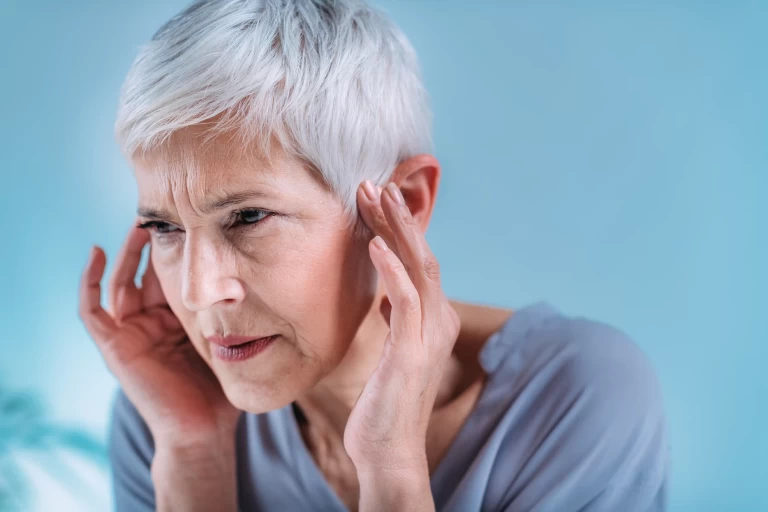
The symptom lists overlap almost completely. Headache, dizziness, fatigue, difficulty concentrating, visual disturbance, and light sensitivity appear on both. Distinguishing which component drives which symptom is genuinely difficult and frequently not attempted at all, with everything attributed to the brain injury by default.
The cervical spine contributes to visual function directly. Afferents from the C1 to C3 roots project into the vestibular nuclei and cerebellum and contribute to the cervico-ocular reflex, which generates compensatory eye movement in response to neck position. Cervical proprioception is what allows the brain to distinguish head-on-neck movement from whole-body movement, and the suboccipital muscles supplying most of that signal carry one of the highest muscle spindle densities in the body — an estimate derived substantially from anatomical specimen studies including fetal material, which is worth stating since it is often quoted without the caveat.
The smooth pursuit neck torsion test demonstrates the connection objectively. Julia Treleaven and colleagues at the University of Queensland compared eye-tracking performance with the trunk rotated beneath a stationary head, isolating cervical afferent influence while holding vestibular and visual input constant. In 100 people with persistent whiplash against 50 controls, tracking difference between positions averaged 0.11 in those with dizziness and 0.07 in those without, against 0.01 in controls. Notably the abnormality appeared even in patients not reporting dizziness. A published case report has described smooth pursuit abnormalities in cervical rotation resolving alongside treatment of cervicogenic dysfunction after whiplash.
Findings across research groups have not been uniform, and reviewers attribute some of that to inconsistent protocol and equipment. The test is a useful measure with real supporting evidence, not a settled standard.
Stating the claim honestly
Convergence insufficiency is a vergence disorder of brainstem oculomotor control. Cervical dysfunction does not cause it, and treating the neck does not train convergence.
What can reasonably be said is that a patient recovering from concussion frequently has both a vergence problem and a cervical sensorimotor problem, that each contributes to overlapping symptoms, and that treating only one leaves the other in place. Where visual therapy has produced partial improvement and symptoms persist, an unaddressed cervical component is a reasonable thing to look for.
There is no clinical trial of upper cervical chiropractic for convergence insufficiency, and I am not going to suggest that an adjustment fixes vergence. The claim here is about identifying a coexisting problem, not about treating this one.
What actually treats it
This matters, and it should not be buried.
Office-based vergence and accommodative therapy, supervised by an optometrist with training in vision therapy and supported by prescribed home reinforcement, has the strongest evidence for convergence insufficiency. It has been studied in randomised trials and outperformed home-based approaches alone. Prism correction is used in some cases.
If you have convergence insufficiency, that is the treatment, and it should not be delayed for anything offered here. The appropriate referral is to an optometrist who performs vision therapy, and a proper assessment includes near point of convergence measurement, vergence range testing, accommodative testing, and a validated symptom questionnaire.
Precision and knowing when not to adjust
Related article
Hashimoto's Thyroiditis Treatment Support in Sarasota | The Autonomic and Upper Cervical Connection
May 14, 2026
Upper cervical correction involves no twisting, no popping, no cracking, and no pulling of the neck — which matters in a recently concussed patient, where forceful handling is inappropriate on its own terms.
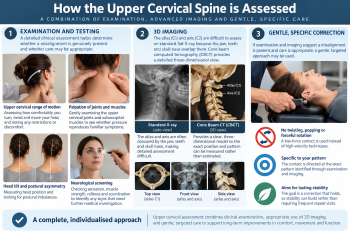
Cone beam computed tomography measures the three-dimensional position of the atlas and axis against your own anatomy so a correction is calculated rather than estimated. Objective measures — leg length assessment, cervical range of motion, joint position error testing, balance measurement including tandem stance with eyes closed, and thermographic pattern tracking — determine whether a correction is indicated and whether it is holding. When it is holding, no adjustment is given. Cone beam imaging measures cervical alignment and tells you nothing about vergence function.
Red flags
After any head injury, worsening headache, repeated vomiting, increasing drowsiness or confusion, seizure, weakness or numbness, slurred speech, unequal pupils, or clear fluid from the nose or ears requires emergency evaluation.
New double vision that persists with one eye covered, sudden-onset double vision, a drooping eyelid with pupil change, or double vision with headache requires urgent neurological assessment rather than management as convergence insufficiency. Sudden vision loss, a curtain across the visual field, or flashes with new floaters requires emergency ophthalmological care. Neck pain after head injury with numbness, weakness, or electric shock sensations down the spine requires imaging before any manual treatment.
An evaluation in Sarasota
If reading has become difficult since a concussion, the first step is assessment by an optometrist who performs vision therapy. If you are already in vision therapy and progress has stalled, or if you also have neck pain, headache, or dizziness that has never been separately evaluated, an upper cervical assessment can determine whether a cervical component of the same injury is still contributing. This works alongside your vision therapy and concussion care rather than in place of them. To arrange a consultation call 941 259-1891.
Dr. Drew Hall, Upper Cervical Chiropractor
Serving Sarasota, Bradenton, and Lakewood Ranch, Florida
This article is for general educational purposes only and is not medical advice, a diagnosis, or a treatment recommendation for any individual. Convergence insufficiency should be diagnosed and treated by a qualified optometrist or ophthalmologist, and office-based vergence and accommodative therapy has the strongest supporting evidence; it should not be delayed or replaced by manual care. Concussion requires appropriate medical evaluation and management. Upper cervical chiropractic is an area of focus within chiropractic; it is not a board-recognized specialty, and no claim of specialization or superiority is made or implied. No clinical trial evidence exists for upper cervical chiropractic in convergence insufficiency, upper cervical care does not train vergence function, and no such claim is made here; the role described is limited to identifying and addressing a coexisting cervical component. Findings on the smooth pursuit neck torsion test have not been uniform across research groups. Suboccipital muscle spindle density figures derive substantially from anatomical specimen studies including fetal material. Cone beam computed tomography is used as a precision measurement and analysis tool, not as a stand-alone diagnostic device. Individual results vary and no specific outcome is guaranteed. Seek emergency care after head injury for worsening headache, repeated vomiting, increasing drowsiness or confusion, seizure, weakness, slurred speech, unequal pupils, or fluid from the nose or ears. Always consult a qualified healthcare provider regarding diagnosis and treatment.

Leave a comment