

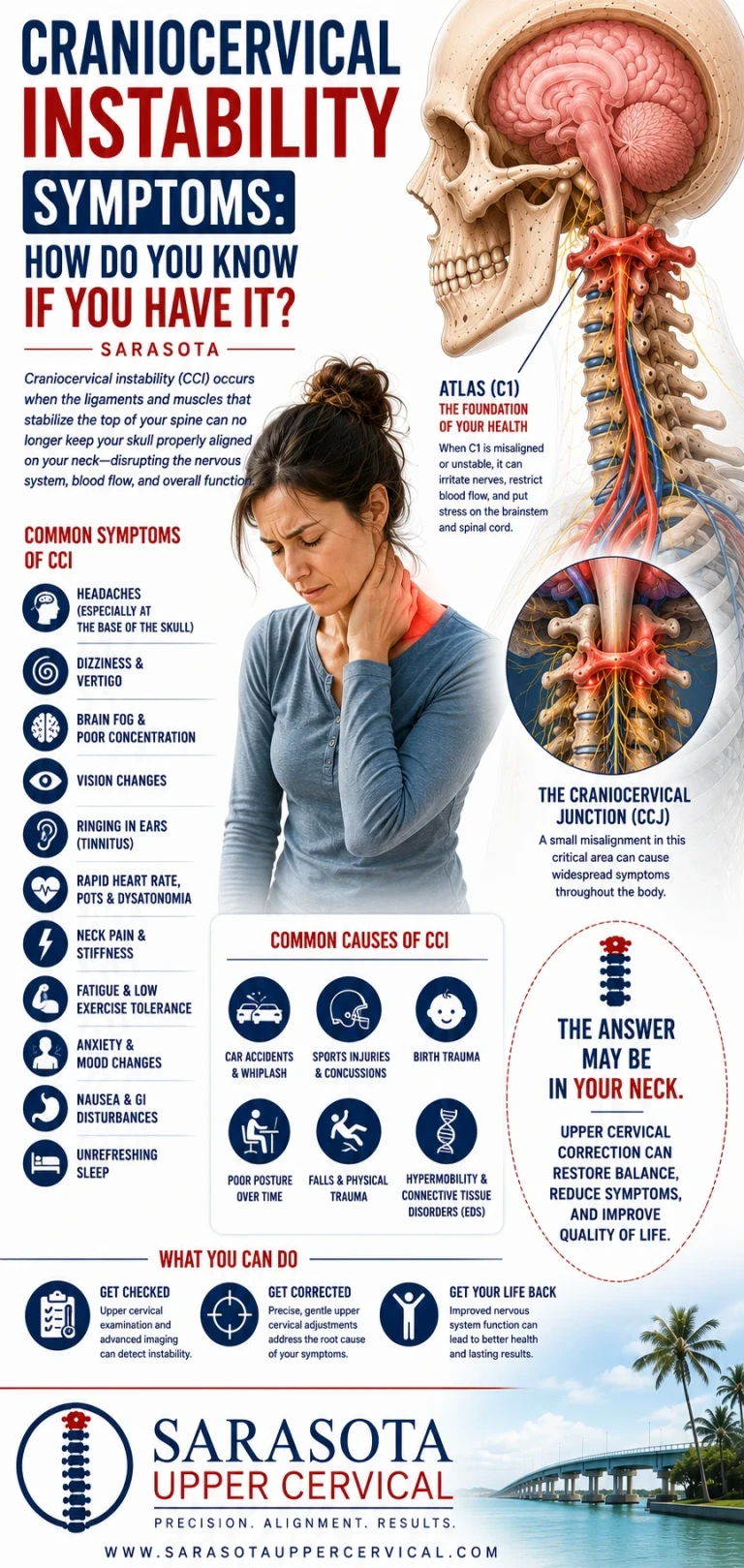
Craniocervical Instability Symptoms: How Do You Know If You Have It?
Most people do not arrive at craniocervical instability by name. They arrive by symptom, and usually by a strange one.
Schedule Your Appointment
Schedule appointmentThe head starts to feel heavy — not sore, heavy, as though the neck is struggling to hold it up. Reading becomes exhausting because looking down is exhausting. There is a headache that lives at the base of the skull and gets worse the longer you stay upright. Then the odd things start collecting: ringing in the ears, blurry or doubled vision, a swallow that does not feel quite right, dizziness that comes on when you turn your head a certain way, brain fog that lifts when you lie down.
Lying down is the tell. In a great many of these cases, the person has already worked out on their own that being horizontal helps and being vertical does not, and nobody has been able to explain why.
This article describes what craniocervical instability is, what its symptom pattern actually looks like, why it takes so long to identify, and — importantly — what else produces the same picture, because several things do and some of them are serious.
What craniocervical instability is
The craniocervical junction is where the skull meets the atlas, the first cervical vertebra, and where the atlas meets the axis, the second. It is the most mobile region of the spine, and it achieves that mobility by giving up bony stability.
Everywhere else in the spine, interlocking facet joints and substantial bony architecture limit motion mechanically. At the top of the neck, that architecture is largely absent — replaced by ligament. The transverse ligament runs behind the odontoid process of C2 and holds it snugly against the anterior arch of C1, preventing the atlas from sliding forward. The alar ligaments run from the odontoid up to the occipital condyles, checking rotation and side bending. The tectorial membrane adds posterior restraint. These structures are what stop the head from moving further on the neck than it should.
Craniocervical instability means those restraints are no longer doing their job adequately, and the skull moves relative to the upper cervical spine beyond physiological range. Atlantoaxial instability is the related condition occurring specifically at the C1-C2 level.
This matters far more than excess motion elsewhere in the spine because of what sits at that junction. The brainstem passes through the foramen magnum and becomes the spinal cord right there. The vertebral arteries loop around the atlas. The jugular veins drain the cranium through the jugular foramina immediately alongside. Cranial nerves nine through twelve exit in that same territory. Cerebrospinal fluid moves between the cranial and spinal compartments through the same opening. Excess motion in this region is not merely a joint problem — it is a joint problem occurring in a space crowded with structures that do not tolerate deformation.
The symptom pattern
The cluster of complaints attributed to upper cervical instability from ligament laxity includes headaches, vertigo, tinnitus, vision changes, syncope, radiculopathy, neck pain, and difficulty swallowing. That is a broad and strange-looking list, and its breadth is the reason patients get bounced between specialists.
But the pattern has internal logic, and it is worth walking through by category.
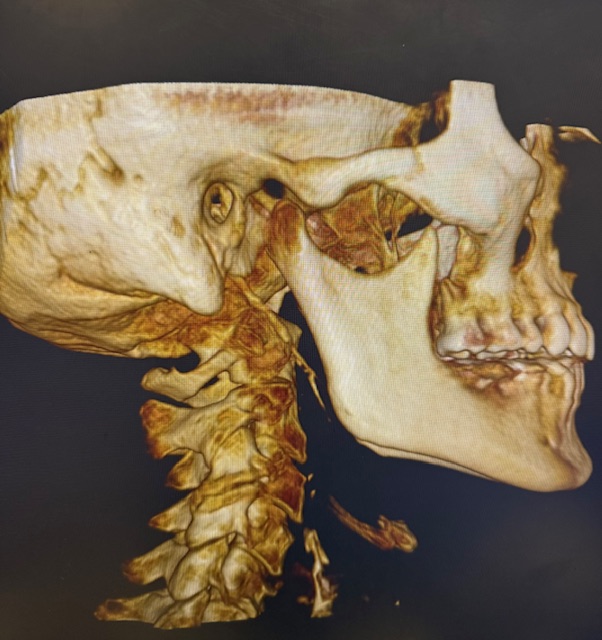
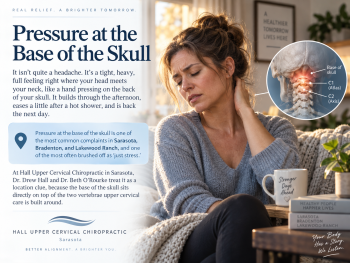
The headache is positional and it is located at the base of the skull. This is the most consistent single feature. It is typically occipital or suboccipital, often described as pressure rather than throbbing, and it characteristically worsens with upright posture, with sustained looking down, and with activity — then eases on lying flat. Some people describe it as a band or a weight rather than a pain.
The heavy head sensation is distinctive enough to be diagnostically useful. Patients describe needing to support the head with a hand, propping the chin, or feeling that the neck muscles are working constantly just to keep the head in position. Some sleep with unusual pillow arrangements they have engineered themselves. This complaint appears in very few other conditions and when someone volunteers it unprompted, it is worth taking seriously.
Cranial nerve symptoms cluster. Difficulty swallowing, a sensation of something in the throat, voice changes, tinnitus, hearing changes, and altered facial sensation all reflect the ninth through twelfth cranial nerves exiting in this crowded region. Any one of these alone means little. Several together, alongside the positional headache, is a pattern.
Visual and vestibular symptoms are common. Blurred vision, double vision, difficulty tracking moving objects, light sensitivity, vertigo, and imbalance. Some of this reflects vestibular and oculomotor pathways in the brainstem; some reflects the fact that the upper cervical spine feeds the postural control system directly.
Autonomic symptoms overlap heavily with POTS. Racing heart on standing, lightheadedness, presyncope, fainting, temperature dysregulation, and exercise intolerance. This overlap is substantial and it is not coincidental — the brainstem nuclei governing autonomic regulation sit directly above this junction. Henderson and colleagues published a study in World Neurosurgery in 2021 describing patients with atlantoaxial instability whose syncope and presyncope had persisted despite maximal medical management, and whose autonomic symptoms improved following surgical stabilization of that junction. That work is important because it demonstrates that the structural integrity of this region can meaningfully affect autonomic function.
Cognitive symptoms are real and are usually dismissed. Brain fog, word-finding difficulty, poor concentration, and mental fatigue that tracks with time spent upright. Patients report this constantly and it is routinely attributed to depression or stress.
Neurological signs are the ones that change urgency. Weakness, numbness or tingling in the arms or legs, clumsiness of the hands, gait disturbance, changes in bowel or bladder function, or symptoms that are progressively worsening. These suggest possible spinal cord or brainstem involvement and they require prompt medical evaluation — not chiropractic care, not physical therapy, medical evaluation.
Why it takes years to identify
Several structural reasons, and they compound.
The symptoms cross every specialty boundary. Neurology sees the headaches. ENT sees the swallowing and tinnitus. Ophthalmology sees the visual changes. Cardiology sees the syncope. Each evaluates their own territory, finds it structurally normal, and discharges. Nobody assembles the picture because the picture does not live in any single specialty.
Standard imaging frequently misses it. Supine MRI and neutral X-ray are taken in the position where an unstable joint appears entirely normal — because instability manifests under load and at end range, not lying still. Being told your imaging is clear is not the same as being told you do not have instability, and this single fact accounts for an enormous amount of the diagnostic delay in this condition.
The population most affected is the population least likely to be believed. Craniocervical instability is disproportionately common in people with hypermobile Ehlers-Danlos syndrome and hypermobility spectrum disorders — predominantly young women, frequently already carrying diagnoses of POTS, chronic fatigue, or fibromyalgia, and frequently already having had symptoms attributed to anxiety. Adding an unusual-sounding structural complaint to that history does not typically improve how it is received.
Related article
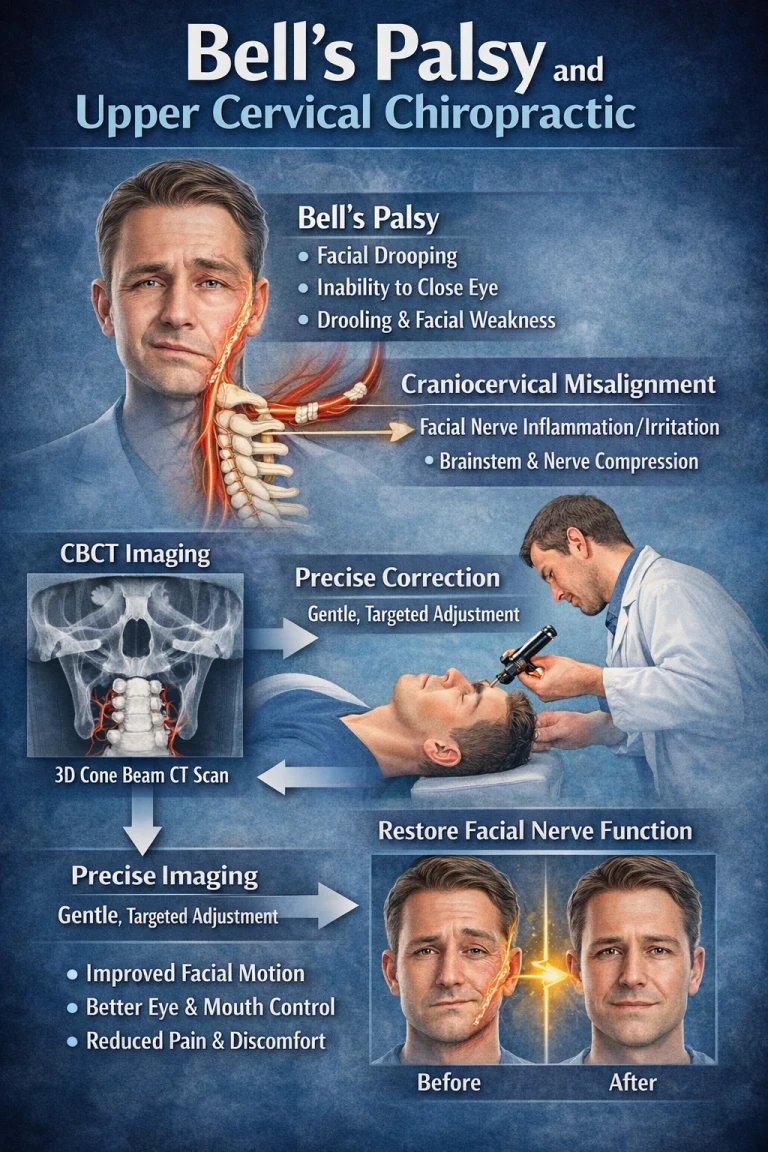
Bell’s Palsy Treatment in Sarasota & Bradenton | Upper Cervical Chiropractor Sarasota and Lakewood
Mar 18, 2026And the field itself is genuinely contested. Mao and colleagues published a paper in The Spine Journal in 2022 framed explicitly around controversies in the diagnosis and management of craniocervical instability in EDS. Lohkamp, Marathe and Fehlings published a systematic review in Global Spine Journal in 2022 that found only sixteen qualifying articles covering seventy-eight surgical patients, and concluded there is a lack of high-quality prospective evidence for evaluating suspected CCI in EDS patients. Physicians who are cautious about this diagnosis are not necessarily being dismissive; some of them are reading the same literature and finding it thin.
What else looks like this
This section matters, because the symptom cluster above is not specific to instability and several alternatives are consequential.
Chiari malformation type I, in which cerebellar tonsils descend below the foramen magnum, produces a strikingly similar picture and frequently coexists with instability in connective tissue disorders. Milhorat and colleagues described precisely this overlap in 2007, characterizing a syndrome of occipitoatlantoaxial hypermobility, cranial settling, and Chiari type I in patients with hereditary disorders of connective tissue.
Spontaneous intracranial hypotension from a cerebrospinal fluid leak produces the same positional headache — worse upright, better lying flat — and is treatable once identified. It is worth ruling out specifically, because the positional pattern is often taken as confirming instability when it may indicate a leak.
Idiopathic intracranial hypertension produces headache, visual disturbance, and tinnitus through the opposite pressure mechanism. Cervical myelopathy from degenerative disease produces the neurological signs. Vestibular disorders produce the dizziness. POTS and dysautonomia produce the autonomic picture and frequently coexist. Tethered cord syndrome co-occurs with cervical instability in hEDS and, as Gensemer and colleagues noted in 2024, is often radiographically occult and not always detectable on standard imaging.
The point is not to be discouraging. The point is that a symptom checklist is a reason to investigate, not a diagnosis, and self-diagnosing craniocervical instability from an online symptom list is how people end up pursuing the wrong thing for another two years.
What to do with a suspicion
Take it seriously if you have the positional headache at the skull base, the heavy head sensation, and clustered cranial nerve or autonomic symptoms — particularly if you have a connective tissue diagnosis, documented hypermobility, or a history of significant head or neck trauma.
Seek medical evaluation urgently rather than routinely if you have progressive neurological signs — weakness, numbness, hand clumsiness, gait change, or bowel or bladder symptoms. That combination warrants neurology or neurosurgery, promptly, and nothing in this article should delay that.
Understand what imaging you have actually had. If your MRI was supine and your X-rays were neutral, instability has not been meaningfully assessed. Upright and dynamic imaging with flexion and extension views is what the specialists in this field use, along with specific craniometric measurements including the clivo-axial angle, the Harris measurements, and the Grabb-Mapstone-Oakes measurement.
Be clear about who diagnoses what. Structural craniocervical instability is a medical diagnosis made by physicians, radiologists, and neurosurgeons using dynamic imaging and defined measurement criteria. It is not something an upper cervical chiropractor diagnoses, and any practice claiming otherwise is overstepping.
Where an upper cervical practice fits
Related article
Honestly and narrowly.
What we do is evaluate upper cervical alignment and mechanics with our own in-office assessment, including three-dimensional cone beam CT imaging of the alignment relationship between the skull, atlas, and axis, alongside history and postural assessment. That tells us about your alignment. It does not diagnose structural instability, and we do not present it as though it does.
Where that evaluation is genuinely useful is in sorting people. Some people with this symptom picture have upper cervical dysfunction that is mechanical rather than unstable, and they may respond well to precise, low-force upper cervical care. Others have findings or a symptom pattern that warrant medical referral before anyone puts hands on their neck — and in frank instability, high-velocity cervical manipulation is contraindicated, which makes identifying that group the most important thing a clinician in this space does.
If you are somewhere in the middle of this and nobody has been able to give you a straight answer, an evaluation that includes an honest assessment of whether we are the right people to help is worth having.
Read what one of our patients as to say after went through chiari malformation decompression surgery(verifiable google review on saraota upper cervical google places):
"For the past five years, I’ve been suffering from a range of difficult and overwhelming symptoms. From Severe neck pain, tinnitus, constant pressure in my head, headaches at the base of my skull, and muscle tension that radiated through my shoulders and upper body.
Eventually, I was diagnosed with Chiari malformation and decided to undergo decompression surgery, believing it was the only option that might help. But even after the surgery, I continued to experience many of the same symptoms. Looking back now, I wish I had more knowledge about what was truly going on with my body before going through with such a major procedure.
After years of researching on my own and trying to get to the root cause of my issues, I stumbled across a video of Dr. Drew Hall on TikTok. I flew out to Sarasota Florida to see him, and I can honestly say the results have been life changing. Immediately after the adjustment I felt instant relief.
I truly wish I had found this place sooner. If you’re out there struggling with unexplained symptoms and if you are considering surgery, take the time to explore options because the right kind of care might make all the difference.
Without you, Dr. Drew Hall, I would still be stuck in the same cycle of pain and confusion.
Thank you so deeply for giving me my life back."
If you have symptoms suggesting craniocervical instability and want a careful upper cervical evaluation — including a frank assessment of whether medical referral is the right next step — schedule a free consultation or call 941-259-1891.
Medical disclaimer: This article is for educational purposes only and does not constitute medical advice, diagnosis, or treatment. Craniocervical instability is a medical diagnosis requiring evaluation by qualified physicians using appropriate imaging, and cervical manipulation may be contraindicated in its presence. Progressive neurological symptoms require prompt medical evaluation. Upper cervical chiropractic care is a complementary approach and is not a substitute for medical or surgical management. Individual results vary. Always consult your physician before making changes to your care.
Dr. Drew Ahall, Upper Cervical Chiropractor [www.neckwise.com](https://w

Leave a comment