

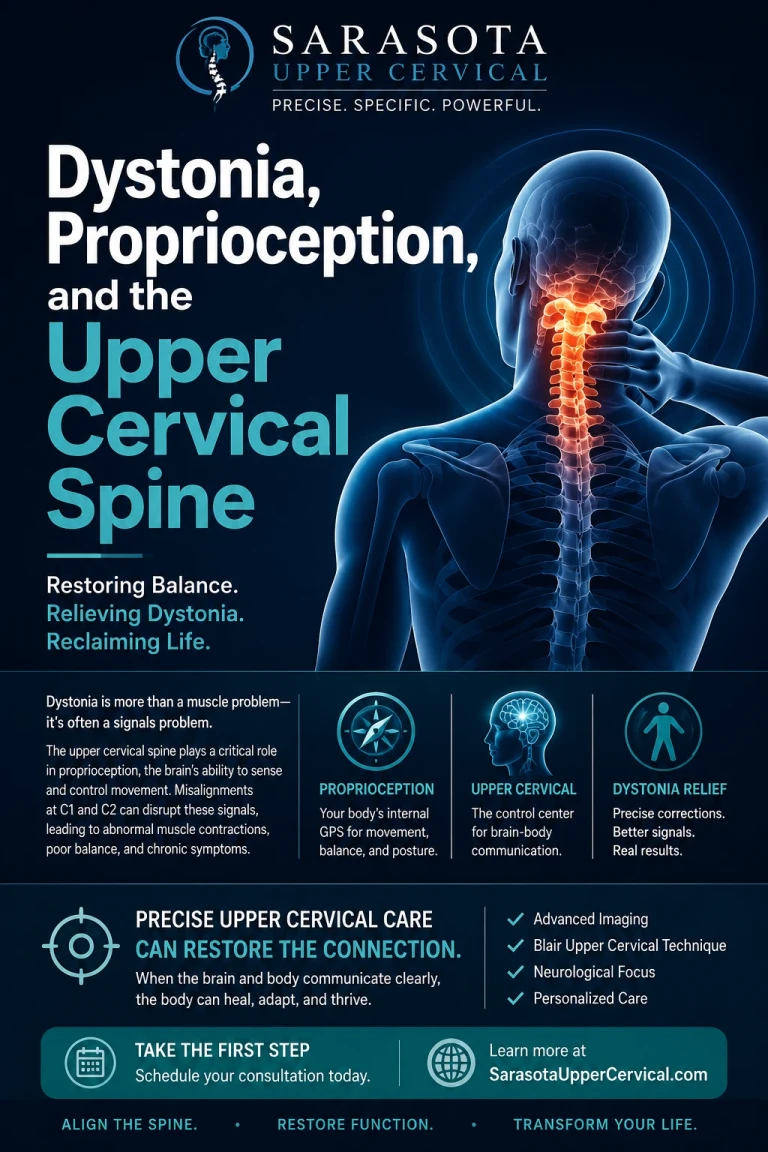
Dystonia is one of the most frustrating movement disorders to live with, involuntary muscle contractions that pull the body, often the head and neck, into abnormal postures the person cannot consciously override. For a long time it was treated as purely a "muscle" problem. Modern neuroscience tells a different and more useful story: dystonia is a disorder of how the brain processes sensory information, especially position sense, or proprioception. And the single richest source of proprioception in the body is the upper cervical spine. This guide explores that connection, the role of craniocervical injury, and carefully and honestly, where upper cervical care may fit as one supportive piece of a much larger picture.
The most important sentence in this article comes first: dystonia is a serious neurological condition that must be diagnosed and managed by a neurologist. Upper cervical chiropractic is not a treatment for dystonia and cannot cure it. What it focuses on is one modifiable input to the sensory system — proprioception from the upper neck — as a possible complement to proper neurological care, never a replacement for it.
Schedule Your Appointment
Schedule appointmentInvoluntary contractions as an aberration of normal neurological function
To understand the proprioception connection, it helps to see what dystonia actually is at the level of the nervous system. Normal movement depends on a constant, balanced conversation: the brain sends motor commands out, and sensory signals — including proprioception from muscles and joints — flow back in, telling the brain what actually happened so it can fine-tune the next movement. Dystonia is a breakdown in that conversation.
Neurologically, dystonia is characterized by impaired sensorimotor integration, a loss of inhibitory control at several levels of the central nervous system, and changes in synaptic plasticity, which collectively impair the gating function of the basal ganglia, resulting in insufficient suppression of noisy activity and excessive activation of cortical motor areas. In plain terms: the system that's supposed to filter out unwanted signals and hold back unwanted movement isn't filtering properly, so muscles fire that shouldn't. The involuntary contraction isn't a random spasm, it's the motor system carrying out a distorted plan built on faulty information. As one clinical framework puts it, the contraction is the motor system's rigid attempt to execute a motor plan based on a degraded internal body map.
That reframing, from "the muscle is broken" to "the information the nervous system is acting on is distorted" — is the entire reason proprioception, and therefore the upper neck, becomes relevant.
Dystonia is a sensory problem as much as a motor one
This is the shift in understanding that changed the field. Cervical dystonia — the most common adult focal dystonia, affecting the neck — is now understood not as a pure motor disorder but as a sensorimotor integration disorder. Research outlines that while dystonia is clearly a motor problem, sensory aspects are also fundamental, especially those related to proprioception, with experimental evidence of proprioceptive dysfunction ranging from intrinsic sensory abnormalities to impaired sensorimotor integration.
The neck's own position sense sits at the center of this. A conceptual framework for cervical dystonia describes the disorder as arising from an abnormal dialogue between the head neural integrator and its inputs — among which proprioception, the cerebellum, and basal ganglia are key. And the neck-specific evidence is direct: 2025 research shows that tactile and proprioceptive dysfunction distinguishes cervical dystonia subtypes, and that manipulating neck sensory input changes the disorder's expression — vibro-tactile stimulation of the neck can induce head-righting in people with cervical dystonia. The neck's proprioceptive signal isn't incidental to cervical dystonia; it's woven into the mechanism.
Related article
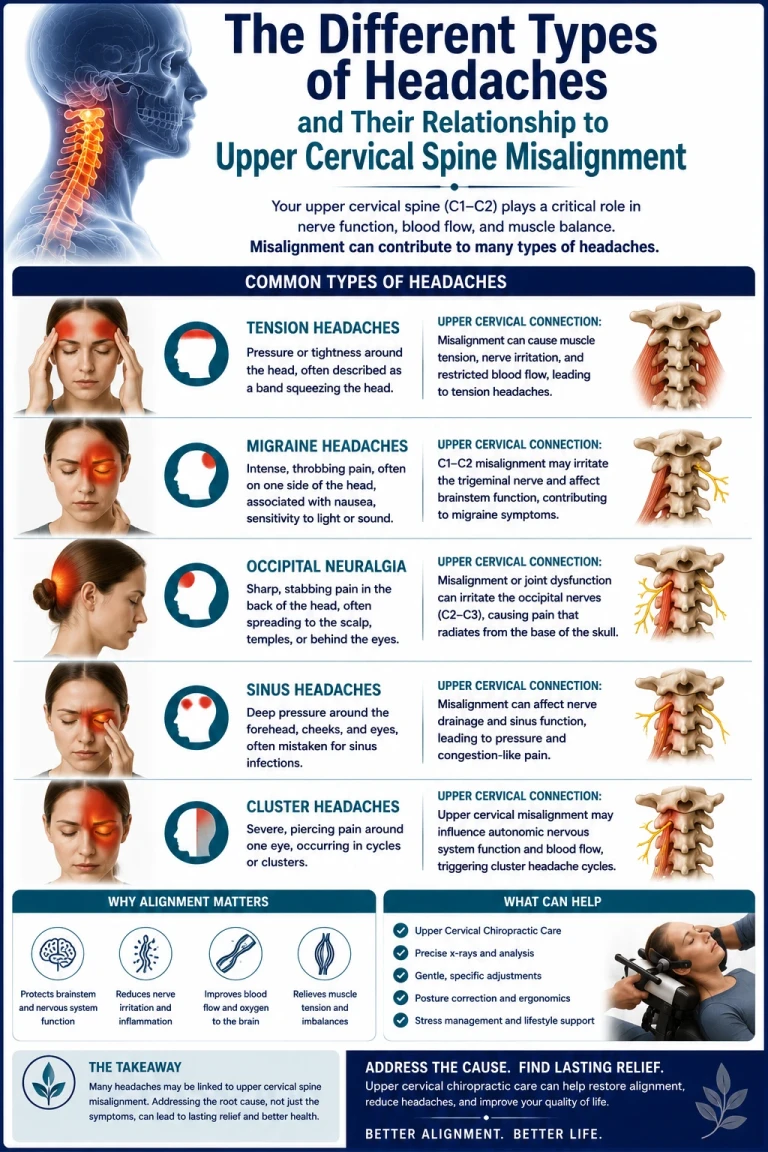
The Different Types of Headaches and Their Relationship to Upper Cervical Spine Misalignment
May 23, 2026The key concept: If dystonia is the nervous system acting on a distorted "body map," and neck proprioception is a major source of the data that builds that map, then the quality of the proprioceptive signal coming from the upper neck is a legitimate variable worth attention — not as a cure, but as one input feeding a struggling system.
The upper cervical spine: the body's richest proprioceptive source
Here is why the top of the neck specifically matters. The suboccipital muscles at the base of the skull carry one of the highest densities of muscle spindles in the body, the sensory organs that report muscle length and movement, and the upper cervical spine as a whole holds one of the highest concentrations of proprioceptive receptors anywhere in the body, making it a key contributor to postural control and motor coordination. This region is, in effect, the nervous system's primary instrument for sensing where the head sits on the neck.
That proprioceptive stream feeds directly into the same networks implicated in dystonia, the brainstem, cerebellum, and basal ganglia circuits that integrate sensory information to plan and refine movement. So when the quality of upper cervical proprioception degrades, the effect isn't local; it's an altered input into the very integration system that, in dystonia, is already struggling to gate and process signals correctly.
The myodural bridge: a physical link to the central nervous system
One anatomical structure deepens this connection. The myodural bridge is a band of connective tissue that physically connects the deep suboccipital muscles — chiefly the rectus capitis posterior minor — to the dura mater surrounding the spinal cord and brainstem. This is a literal mechanical link between the small, spindle-rich muscles at the base of the skull and the covering of the central nervous system. Its existence means the state of these suboccipital muscles — their tension, their proprioceptive output, and any dysfunction from injury — is coupled directly to the brainstem region where sensory integration begins, and whiplash-type forces transmit traction through this bridge to the cervical dura. It's part of why the upper neck has such an outsized influence on the sensory signals reaching the brain.
Craniocervical injury and aberrant proprioception
Now the injury piece — which you may recognize from your own history if your symptoms followed a trauma. When the upper cervical spine is injured, whiplash, a fall, a concussion, or other trauma to the craniocervical junction — the normal motion and sensory function of these joints and muscles can be disrupted. In chronic cervical dysfunction, the cervical afferents transmit impaired proprioceptive signals, with these patients often having a history of neck pain, whiplash, or concussion. The injured region sends the brain a distorted position report.
For a nervous system that is already struggling to integrate sensory information, as in dystonia, this distorted proprioceptive input is, at minimum, an additional source of noise in a system that is failing to filter noise properly. The trauma connection is also recognized in the movement-disorder literature: a large case-control study of 202 patients found a positive association between trauma and cervical dystonia, and neck injury such as whiplash is listed among the recognized antecedents of trauma-induced cervical dystonia.
Related article
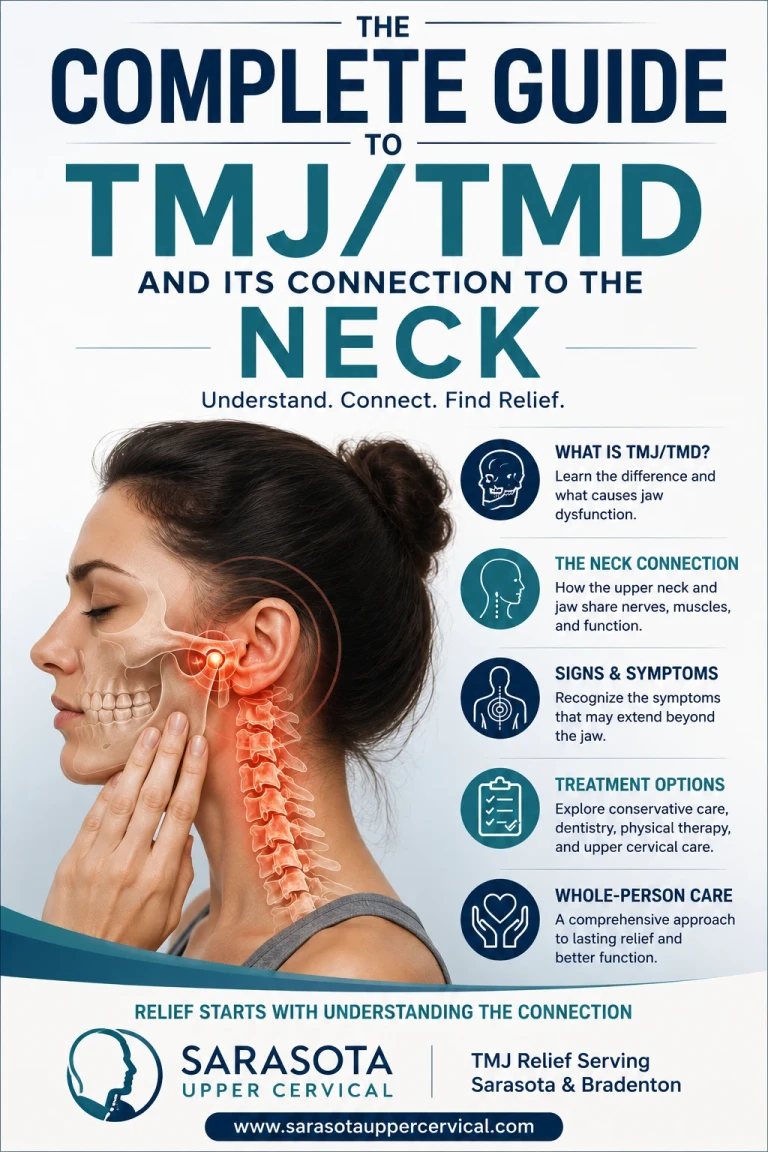
The Complete Guide to TMJ/TMD and Its Connection to the Neck | TMJ treatment and relief Sarasota
Jun 14, 2026Two honest caveats on the trauma link. First, the relationship between trauma and dystonia is an association that remains medically debated, it is well documented in clinical reports but has not been proven to be causal, and it carries medical and legal complexity. Second, there is a specific entity called acute-onset post-traumatic cervical dystonia that neurologists recognize as often resistant to standard treatments including botulinum toxin. None of this means the neck should be ignored, but it does mean no one should promise that addressing the neck will resolve dystonia. The honest position is that upper cervical proprioception is a plausible, modifiable contributor worth evaluating, not a proven lever.
Where upper cervical care may fit, as a complement, not a treatment
Let me be completely clear about the claim, because on a serious neurological disorder precision matters. Dystonia is managed medically. The mainstays are botulinum toxin injections (the first-line treatment for cervical dystonia), oral neuroactive medications, and, in refractory cases, deep brain stimulation — real, evidence-based neurological treatments overseen by a neurologist. Upper cervical chiropractic is none of these. It does not treat dystonia, does not cure it, and must never replace neurological care.
What upper cervical care can reasonably focus on is the quality of proprioceptive input from the upper neck. By restoring more normal alignment and motion at the atlas and axis, the aim is to improve the accuracy of the position signal that region sends into the sensorimotor integration networks — cleaning up one input to a system that, in dystonia, is struggling to process its inputs. For a person whose symptoms followed craniocervical trauma, or who has clear upper cervical dysfunction alongside their dystonia, this is a reasonable, low-risk avenue to evaluate as a complement to their neurological care. It is best understood as supporting the sensory environment the nervous system has to work within — a supporting role in a comprehensive, physician-led plan, not a standalone answer.
It's worth adding that the broader dystonia field increasingly values sensory and proprioceptive approaches, proprioceptive training, sensory-motor retraining, and related rehabilitation are active areas of research precisely because the disorder is now understood as sensorimotor. Optimizing upper cervical proprioceptive input fits within that same logic of supporting the sensory system, and is best pursued alongside, and in communication with, the patient's neurologist.
Why CBCT imaging matters here
Because any upper cervical analysis must be precise, we use cone beam computed tomography (CBCT) as a precision measurement tool to see the true three-dimensional position of the atlas and axis, tailoring the assessment to the individual's anatomy. (CBCT is a measurement and analysis tool; dystonia itself is a clinical neurological diagnosis made and managed by a neurologist.)
When to seek — and stay with — neurological care
If you have or suspect dystonia, a neurologist (ideally a movement-disorders specialist) should lead your care. Seek prompt medical attention for rapidly progressive symptoms, dystonia spreading to new body regions, difficulty swallowing or breathing, or any new neurological deficit. Continue your prescribed treatment — including botulinum toxin and medications — and never stop or change it in favor of any complementary approach without your neurologist's guidance. Upper cervical care, if pursued, should be one coordinated part of a physician-led plan.
Questions and Answers
Related article
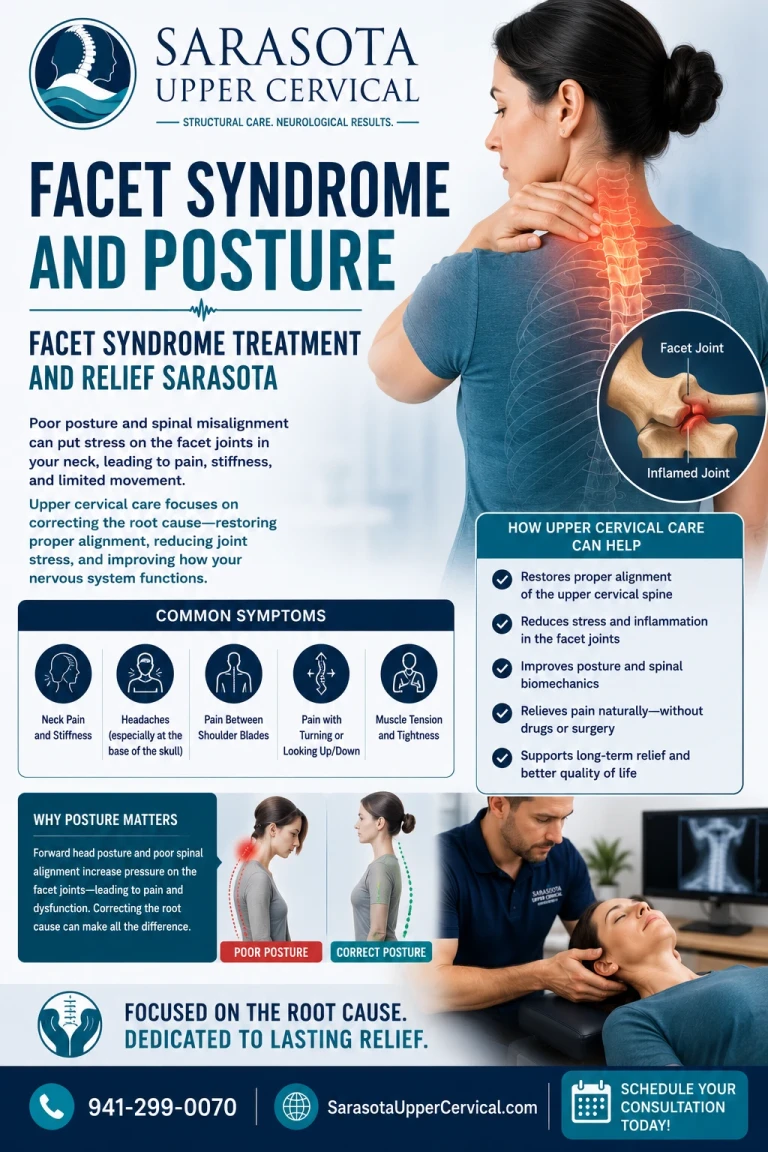
Facet syndrome and posture | Facet syndrome treatment and relief Sarasota
Jun 24, 2026
Can upper cervical chiropractic treat or cure dystonia?
No. Dystonia is a serious neurological movement disorder that must be diagnosed and managed by a neurologist, with treatments such as botulinum toxin, oral medications, and in some cases deep brain stimulation. Upper cervical chiropractic does not treat or cure dystonia. What it focuses on is the quality of proprioceptive (position-sense) input from the upper neck, as a possible complement to neurological care — supporting the sensory system, not treating the disease.
Why is proprioception relevant to dystonia?
Modern neuroscience understands dystonia not as a pure muscle problem but as a sensorimotor integration disorder — the nervous system produces involuntary contractions while acting on a distorted internal "body map." Proprioception, the body's position sense, is a major source of the information that builds that map. Because abnormal proprioceptive processing is part of the disorder, the quality of position-sense input is a legitimate area of interest, including the proprioception that comes from the neck.
Why the upper cervical spine specifically?
The upper cervical spine is the body's richest source of proprioception — the suboccipital muscles carry one of the highest densities of muscle spindles anywhere, and the region is a primary instrument for sensing head position. It's also physically linked to the covering of the brainstem through the myodural bridge. So the position signal from the upper neck feeds directly into the same sensorimotor networks involved in dystonia, which is why its quality is worth evaluating.
My dystonia started after a neck injury. Is that connected?
It may be relevant. Neck trauma such as whiplash is recognized among the antecedents of cervical dystonia, and a large case-control study found a positive association between trauma and cervical dystonia. Honestly, though, this is an association that remains medically debated and not proven to be causal, and some post-traumatic cervical dystonia is resistant to standard treatments. A trauma history is a reasonable reason to have the upper cervical spine evaluated — alongside your neurological care, not instead of it.
Should I stop my botulinum toxin or medications if I try upper cervical care?
No — never stop or change prescribed dystonia treatment without your neurologist's guidance. Botulinum toxin and medications are evidence-based treatments for dystonia; upper cervical care is at most a complementary, supportive approach addressing proprioceptive input. If you pursue it, it should be one coordinated part of a physician-led plan, in communication with your neurologist.
Upper cervical evaluation in Sarasota — supporting the sensory system
If you have dystonia with a history of head or neck trauma, or clear upper cervical dysfunction, a focused upper cervical evaluation can help determine whether the proprioceptive input from your upper neck is worth addressing — as one coordinated part of your neurologist-led care.
This article is for general educational purposes only and is not medical advice, a diagnosis, or a treatment recommendation for any individual. Dystonia is a serious neurological movement disorder that must be diagnosed and managed by qualified physicians, ideally a neurologist or movement-disorders specialist, with evidence-based treatments such as botulinum toxin, oral medications, and deep brain stimulation. Upper cervical chiropractic does not treat, cure, or manage dystonia and is not a substitute for neurological care; it focuses on proprioceptive and mechanical contributors at the craniocervical junction as a possible complement to physician-led care. Patients should never stop or alter prescribed treatment without their neurologist's guidance. Upper cervical chiropractic is an area of focus within chiropractic; it is not a board-recognized specialty, and no claim of specialization or superiority is made or implied. The relationship between trauma and dystonia is an association that remains medically debated and unproven as causal. Cone beam CT is used as a precision measurement and analysis tool, not as a diagnostic device for dystonia. The mechanisms and research described are presented for education, not as proof of treatment outcomes; individual results vary, and no specific outcome is guaranteed. Seek prompt medical attention for rapidly progressive or spreading symptoms, difficulty swallowing or breathing, or new neurological deficits. Always consult a qualified neurologist regarding diagnosis and treatment of dystonia.
Leave a comment