

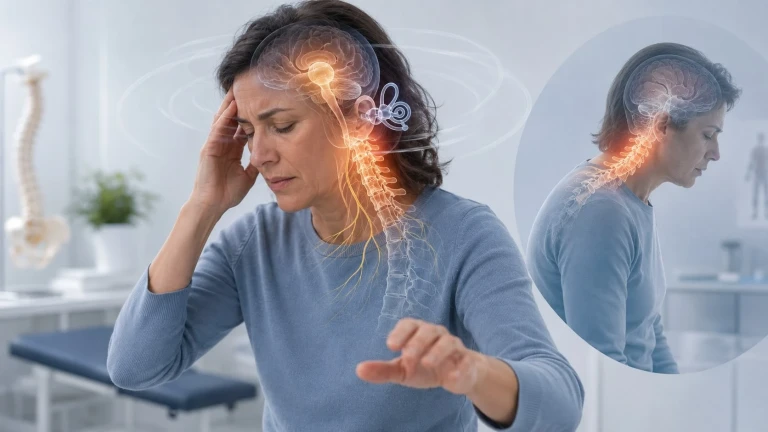
Vestibular migraine is one of the most common causes of recurrent vertigo, and one of the most misunderstood. The dizziness, spinning, motion sensitivity, and visual disturbance can arrive with or without a headache, which is why so many people never connect it to migraine at all. But to understand where the upper neck fits, you have to go to the place where vestibular migraine actually lives: the brainstem. There, two systems that are supposed to work separately, the migraine (trigeminal) system and the balance (vestibular) system — sit side by side and talk to each other. And the upper cervical spine plugs directly into both.
This pillar is a deep look at the brainstem neurology of vestibular migraine and the specific, anatomically grounded role of the craniocervical junction — the atlas (C1), axis (C2), and the base of the skull. We'll trace how a misalignment there can feed aberrant input into the exact circuit that generates the vertigo, bring in the myodural bridge, and examine how a flattened cervical curve distorts the proprioception the brainstem depends on. One boundary first: vestibular migraine is a medical condition with genetic and neurochemical drivers, and upper cervical chiropractic does not cure it. What it focuses on is one modifiable mechanical contributor feeding the system.
Schedule Your Appointment
Schedule appointmentWhat vestibular migraine is — and why it's a brainstem disorder
Vestibular migraine (VM) is a migraine-related disorder in which the dominant symptom is vertigo or dizziness rather than head pain. Attacks can last minutes to days and often include sensitivity to motion, light, and sound, visual disturbance, and imbalance. Critically, it is understood as a disorder of central sensory processing — not a problem of the inner ear alone. The pathophysiology implicates a convergence of central and peripheral mechanisms involving the trigeminovascular system, cortical spreading depression, and brainstem vestibular nuclei dysfunction, and functional imaging shows altered connectivity in the vestibular cortex, thalamus, and brainstem, supporting a central sensitization model.
In other words, VM is fundamentally about how the brain and brainstem process and integrate balance and pain signals — and about a nervous system that has become hypersensitive in doing so. That framing is the key that unlocks the neck connection, because the brainstem is where the neck's signals arrive.
The heart of it: where migraine and balance converge in the brainstem
Here is the central mechanism, and it's worth understanding precisely. Two brainstem structures sit at the core of vestibular migraine: the spinal trigeminal nucleus (the brainstem hub of the migraine/pain system) and the vestibular nuclei (the brainstem hub of the balance system). In a person without VM, these do their separate jobs. In vestibular migraine, they cross-talk abnormally.
The anatomy makes this possible. In the brainstem, both direct and indirect connections exist between the spinal trigeminal nucleus and the vestibular nuclei, which also express CGRP — the same neuropeptide that drives migraine attacks. So when the trigeminovascular (migraine) system is activated and floods the area with CGRP, it doesn't stay in its lane; it spills into the neighboring vestibular nuclei and produces vertigo. Reciprocal connections between the vestibular nuclei and the brainstem centers that modulate trigeminal pain — the rostral ventromedial medulla, periaqueductal gray, locus coeruleus, and nucleus raphe magnus — are critical to understanding the pathophysiology of VM. Animal work confirms the direction of influence: inhibiting the trigeminal nucleus caudalis simultaneously calms activation of the vestibular nucleus.
The core concept: Vestibular migraine happens because the migraine system and the balance system are neighbors in the brainstem that talk to each other through shared CGRP-expressing connections. Anything that adds excess, aberrant input into that shared neighborhood can help tip a sensitized system into an attack. That's the door the upper neck opens.
The upper cervical spine plugs directly into that exact circuit
This is where the craniocervical junction stops being "adjacent" and becomes anatomically central. The upper cervical spine doesn't just sit near this brainstem circuit — it sends sensory input directly into both of its hubs.
Into the trigeminal system: The upper cervical nerve roots and the trigeminal nerve converge on the same pool of brainstem neurons, an integrated structure often called the trigeminocervical complex. The main source of afferents to the spinal trigeminal nucleus is through the upper cervical structures, especially C2 and C3, and cervical and trigeminal afferents converge on the same dorsal horn neurons — thought to explain why migraine pain is often felt in the territories of both nerves. Input from the upper neck and input from the trigeminal system become, functionally, the same signal.
Related article
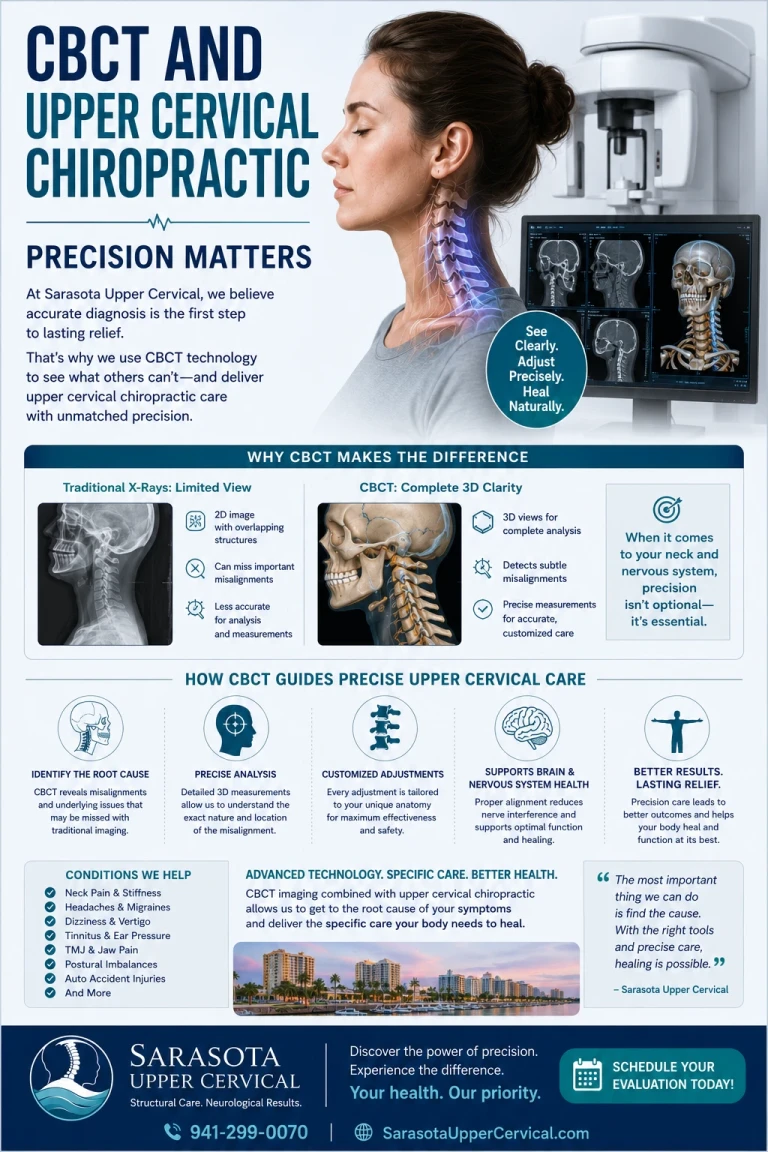
Seeing the Whole Picture: CBCT, the Blair Analysis, and Why Precision Changes Outcomes
Jun 20, 2026Into the vestibular system: The connection is just as direct. Anatomical tracing shows that upper cervical segments (C2 and C3) send projections to the vestibular nuclei, and clinical reviews list cervical spine afferents, especially from C1–C3, as one of the primary sources of information entering the vestibular nucleus to initiate the sensation of vertigo. This cervico-vestibular link was demonstrated experimentally decades ago: injecting irritant into the deep tissues of the upper cervical spine was shown to create the sensation of vertigo in healthy volunteers.
Put those two facts together and the significance is hard to overstate: the upper cervical spine is a direct afferent source into both the trigeminal nucleus and the vestibular nuclei — the precise two structures whose abnormal crosstalk produces vestibular migraine. The neck isn't a bystander to this circuit; it's wired into it.
How craniocervical junction misalignment irritates the system
Now the causative pathway comes together. When the atlas or axis is misaligned and the upper cervical joints lose normal motion — commonly after whiplash, concussion, a fall, or sustained postural strain — the dense sensory apparatus of the region begins generating abnormal, excessive afferent input. Because that input feeds directly into the trigeminocervical complex and the vestibular nuclei, it becomes a source of ongoing irritation to the very circuit that, in a migraine-susceptible brain, generates vertigo.
The proposed mechanism runs like this:
Step 1 — CCJ misalignment generates aberrant afferent input. A misaligned atlas/axis and dysfunctional upper cervical joints produce distorted, excessive sensory signaling from the most receptor-dense region of the spine.
Step 2 — That input floods the trigeminocervical complex. Because upper cervical (C1–C3) and trigeminal afferents converge on the same brainstem neurons, aberrant neck input effectively adds to trigeminal-system activation — the migraine side of the circuit.
Step 3 — It simultaneously drives the vestibular nuclei. The same C1–C3 segments project directly to the vestibular nuclei, so the aberrant input also perturbs the balance side — the vertigo generator.
Step 4 — A sensitized brainstem tips into symptoms. In a migraine-susceptible nervous system already primed for excitability, this sustained dual irritation can lower the threshold for attacks and feed the abnormal trigeminal-vestibular crosstalk that produces vestibular migraine's vertigo, motion sensitivity, and head symptoms.
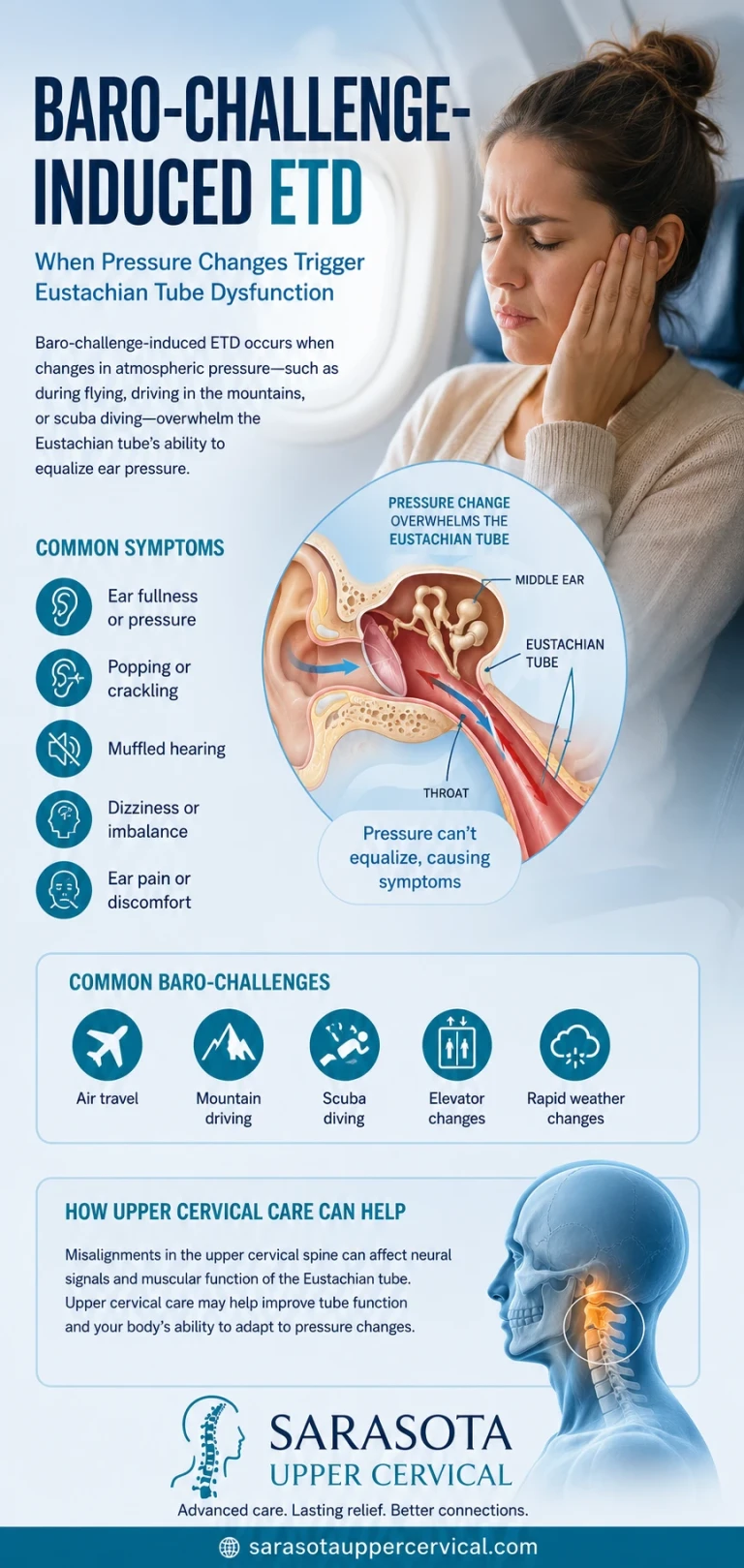
The craniocervical junction, in this model, is a modifiable trigger and contributor — a source of aberrant afferent load that a sensitized system doesn't need. It is not the sole cause of vestibular migraine, and correcting it doesn't remove the underlying genetic or neurochemical susceptibility. But it may be one of the few contributors that is mechanically addressable.
The myodural bridge: a physical link to the brainstem's covering
One anatomical structure makes the upper neck's influence even more direct. The myodural bridge is a band of connective tissue that physically connects the deep suboccipital muscles — chiefly the rectus capitis posterior minor — to the dura mater surrounding the spinal cord and brainstem. This is a literal mechanical cable between the small muscles at the base of the skull and the covering of the central nervous system, right at the level of the vestibular and trigeminal nuclei.
Its relevance to vestibular migraine is twofold. First, it means suboccipital muscle tension — which rises with upper cervical dysfunction and forward-head posture — is transmitted directly to the cervical dura at the brainstem, and whiplash-type hyperflexion-extension injuries transmit traction forces through this bridge to the cervical dura. Second, the bridge participates in normal cerebrospinal fluid dynamics with head movement. So a dysfunctional craniocervical junction doesn't only send aberrant nerve signals into the brainstem circuit — through the myodural bridge it also creates abnormal mechanical tension at the brainstem's doorstep, another form of irritation to an already-sensitized region.
Flattened cervical curve, distorted proprioception, and aberrant neurology
There's a further layer that ties posture into the picture. The upper cervical spine is the most proprioceptively dense region in the body — the suboccipital muscles carry one of the highest densities of muscle spindles anywhere — and this proprioceptive stream is one of the three inputs (with vision and the inner ear) that the brainstem fuses to know where the head is in space. When those three inputs agree, you feel stable. When they conflict, the result is dizziness and disorientation.
A flattened or reversed cervical curve degrades this system. Loss of the normal lordosis alters the length-tension relationships of the deep neck muscles and the mechanics of the upper cervical joints, distorting the proprioceptive signal they generate. The nervous system then receives a neck-position report that conflicts with what the eyes and inner ear are reporting — a sensory mismatch fed straight into the vestibular nuclei. In chronic cervical dysfunction, the cervical afferents transmit impaired proprioceptive signals, with these patients often having a history of neck pain, whiplash, or concussion. For a brain already prone to vestibular migraine, this distorted proprioceptive input is one more source of the aberrant neurology the condition feeds on — and it compounds the direct afferent irritation described above. Restoring a healthier curve and normal upper cervical motion aims to clean up that signal, reducing the sensory conflict reaching the brainstem.
Where upper cervical care fits — honestly
What upper cervical care focuses on is the one part of this system that is mechanically modifiable: the aberrant afferent input from the craniocervical junction. By restoring normal alignment and motion at C1–C2 and improving the proprioceptive signal, the aim is to reduce the abnormal neck-derived input feeding the trigeminocervical complex and vestibular nuclei — lowering one contributor to a sensitized circuit. For a vestibular migraine patient with a clear upper cervical component — especially after head or neck trauma, or with a history of neck pain accompanying attacks — this is a reasonable, low-risk avenue to evaluate alongside medical care. It works best as part of a comprehensive plan, not as a standalone cure.
Vestibular migraine and cervicogenic dizziness are related but distinct
It's worth noting that "vestibular migraine" and "cervicogenic (cervical) dizziness" are separate diagnoses that can overlap and can coexist in the same person. The shared thread is the upper cervical spine's input into the vestibular system. A careful evaluation helps sort out how much of a given patient's picture is migraine-driven, how much is neck-driven, and how the two interact — which is exactly why coordinated care matters.
Related article
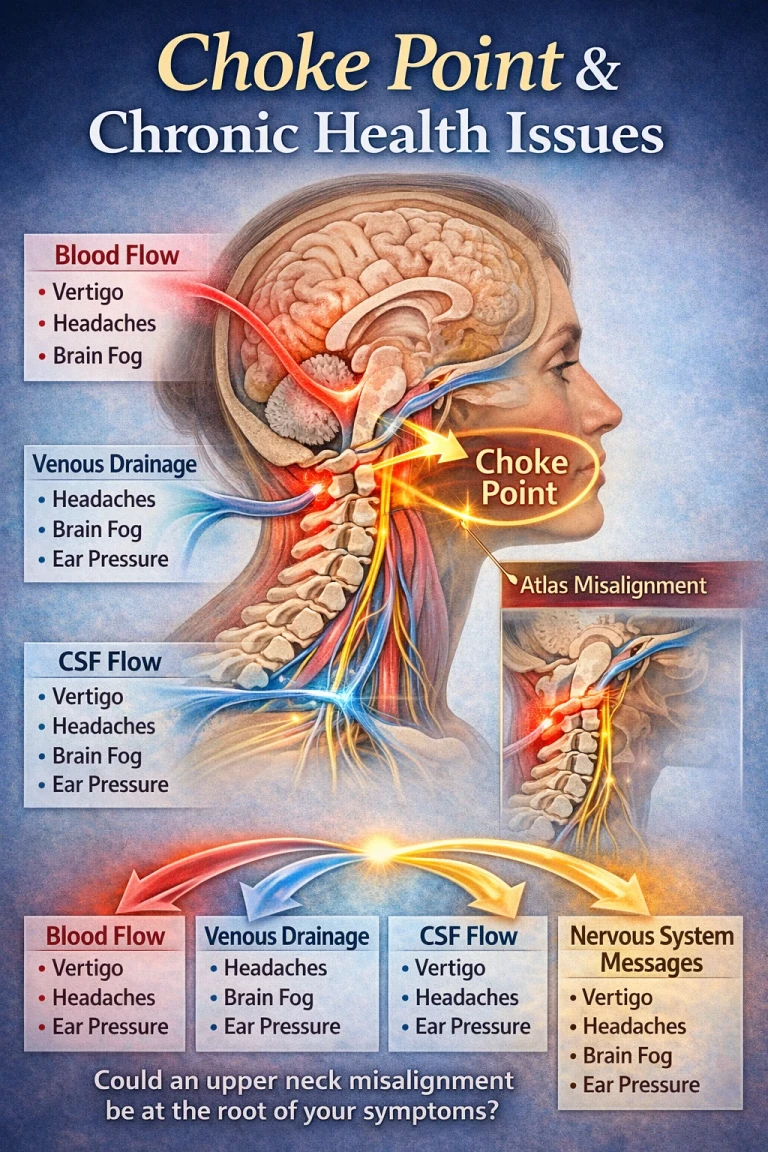
The Upper Neck as a Choke Point: Vertigo, Headaches, Brain Fog, and Ear Pressure
Apr 21, 2026Why CBCT imaging matters here
Because any upper cervical correction is precise, the analysis must be precise. We use cone beam computed tomography (CBCT) as a precision measurement tool to see the true three-dimensional position of the atlas and axis, so an assessment is tailored to the individual's anatomy. (CBCT is a measurement and analysis tool; vestibular migraine itself is a clinical diagnosis made by appropriate medical evaluation.)
Questions and Answers
How can my neck cause vertigo if vestibular migraine is a brain condition?
Because the upper cervical spine feeds directly into the brain structures that generate vestibular migraine. The C1–C3 nerve segments project into both the spinal trigeminal nucleus (the migraine hub) and the vestibular nuclei (the balance hub) — the exact two structures whose abnormal crosstalk produces vestibular migraine. When the craniocervical junction is misaligned, it sends aberrant input into that circuit, which in a migraine-susceptible nervous system can help trigger and sustain attacks. The neck isn't separate from the brain circuit; it's wired into it.
Can upper cervical chiropractic cure my vestibular migraine?
What upper cervical care focuses on is the one mechanically modifiable contributor — the aberrant afferent input from a misaligned craniocervical junction — with the aim of reducing one source of irritation to the sensitized brainstem circuit. It's a complement to medical care, especially valuable when there's a clear neck component, not a cure.
What is the trigeminocervical complex, and why does it matter here?
It's the pool of brainstem neurons where the trigeminal nerve (the migraine/pain system) and the upper cervical nerve roots (C1–C3) converge and become functionally integrated. Because neck input and trigeminal input merge here, irritation from the upper neck effectively adds to migraine-system activation. This convergence is why upper cervical dysfunction can influence a condition that seems purely "migraine," and why the same neurons connect to the vestibular nuclei that produce vertigo.
How does a flattened cervical curve contribute?
The upper neck is one of three systems — with vision and the inner ear — that the brainstem uses to sense head position. A flattened or reversed curve distorts the proprioceptive signal the neck sends, creating a mismatch with what the eyes and inner ear report. That sensory conflict is fed into the vestibular nuclei and, in a brain prone to vestibular migraine, adds to the aberrant neurology driving symptoms. Restoring a healthier curve and normal motion aims to clean up that signal.
Is vestibular migraine the same as cervicogenic dizziness?
No, but they're related and can coexist. Vestibular migraine is migraine-driven; cervicogenic (cervical) dizziness is driven by the neck's input to the balance system. They share the upper cervical spine's connection to the vestibular system, which is why they overlap and why a careful evaluation is needed to sort out how much of a person's dizziness is migraine-driven versus neck-driven, and how the two interact.
Vestibular migraine and the upper cervical connection — Sarasota
If you have recurrent vertigo or dizziness with a migraine history — especially alongside neck pain or after a head or neck injury — a focused upper cervical evaluation can help determine whether a craniocervical contributor is feeding your symptoms, working alongside your medical care.
This article is for general educational purposes only and is not medical advice, a diagnosis, or a treatment recommendation for any individual. Vestibular migraine is a medical condition with genetic and neurochemical components that must be diagnosed and managed by qualified medical providers. Upper cervical chiropractic does not cure vestibular migraine and is not a substitute for medical care; it focuses on mechanical and proprioceptive contributors at the craniocervical junction that may feed the brainstem circuit involved in the condition, as a complement to appropriate medical management. Upper cervical chiropractic is an area of focus within chiropractic; it is not a board-recognized specialty, and no claim of specialization or superiority is made or implied. Cone beam CT is used as a precision measurement and analysis tool, not as a diagnostic device for vestibular migraine. The mechanisms described connect established neuroanatomy but are presented for education rather than as proof of causation or treatment outcomes; individual results vary, and no specific outcome is guaranteed. Vertigo can have serious causes — seek prompt medical attention for sudden severe vertigo, new neurological symptoms, sudden hearing loss, an unusually severe headache, or symptoms following head trauma. Always consult a qualified healthcare provider regarding diagnosis and treatment of vestibular migraine.

Leave a comment