

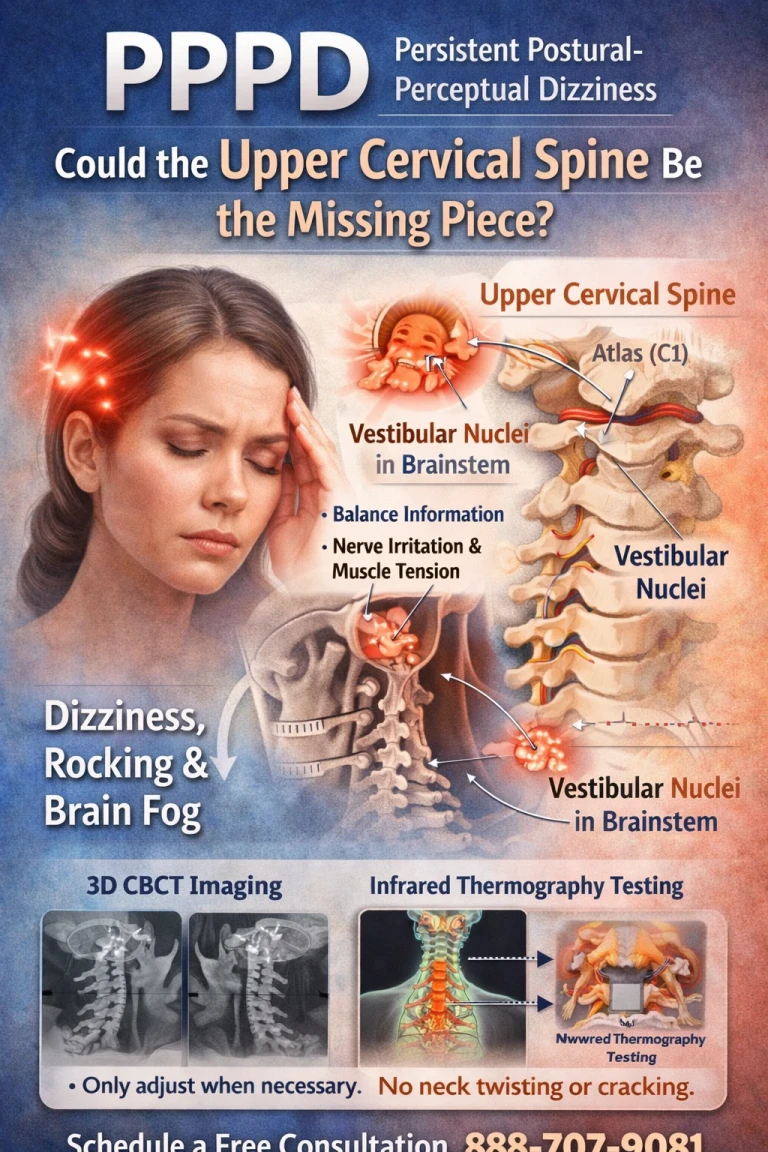
Persistent Postural-Perceptual Dizziness (PPPD) is a challenging condition that affects thousands of people each year. Many patients describe it as a constant sensation of rocking, swaying, or imbalance that worsens when standing, walking, or being in visually busy environments. While medications and vestibular therapy can sometimes help manage symptoms, many individuals continue searching for answers when their dizziness persists.
One often overlooked factor in chronic balance disorders like PPPD is the upper cervical spine, the delicate area where the head meets the neck. In Sarasota, upper cervical chiropractic care is helping patients explore whether structural misalignment at the top of the neck may be contributing to ongoing dizziness and balance problems.
Schedule Your Appointment
Schedule appointment
What is Persistent Postural-Perceptual Dizziness (PPPD)?
PPPD is considered a functional vestibular disorder. It often develops after a triggering event such as:
A concussion
Whiplash injury
Vestibular neuritis
Severe vertigo attack
Chronic migraine
Inner ear infections
After the initial event, the brain’s balance system can remain in a maladapted state, leaving patients with persistent symptoms even after the original injury or illness has resolved.
Common symptoms of PPPD include:
Constant rocking or swaying sensation
Feeling unsteady when standing or walking
Increased dizziness in busy visual environments (stores, traffic, crowds)
Brain fog and difficulty concentrating
Sensitivity to motion
Anxiety related to balance problems
For many patients, the symptoms seem mysterious because imaging and traditional tests often appear normal.
The Brain’s Balance Center: The Vestibular Nuclei
To understand PPPD, it helps to look at the vestibular nuclei, which sit in the brainstem. These nuclei act as a central processing hub for balance information.
They receive signals from several systems:
Inner ear (vestibular system) – detects motion and head position
Eyes (visual system) – provides spatial orientation
Proprioception from the neck and body – tells the brain where the head and body are in space
The vestibular nuclei integrate these signals to maintain balance, posture, and spatial awareness.
When these signals become distorted or mismatched, the brain can perceive constant instability, even when a person is physically stable.
The Upper Cervical Spine and Balance
The upper cervical spine, specifically the atlas (C1) and axis (C2), plays a crucial role in balance.
This region is unique because it contains an extremely high concentration of proprioceptive nerve receptors that communicate directly with the brainstem and vestibular nuclei.
If the atlas becomes misaligned due to trauma or chronic stress, several things can occur:
Abnormal proprioceptive signals from neck muscles and joints
Increased tension in muscles surrounding the upper cervical spine
Distorted input to the vestibular nuclei
Altered head-neck positioning that affects balance processing
This mismatch of sensory information can contribute to the persistent dizziness experienced in PPPD.
Many PPPD patients report that their symptoms began after events that commonly cause upper cervical misalignment, such as:
Car accidents or whiplash injuries
Sports impacts
Falls
Concussions
Repetitive postural stress
How an Upper Cervical Misalignment Can Affect the Vestibular System
Because the vestibular nuclei sit in the lower brainstem, they are closely connected to structures that receive input from the upper neck.
When a misalignment occurs at the head-neck junction, it may influence the balance system through several mechanisms:
1. Distorted Proprioceptive Input
The brain relies heavily on signals from neck muscles to determine head position. If these signals are abnormal due to misalignment, the vestibular nuclei may interpret motion incorrectly.
2. Muscle Tension and Reflex Changes
Upper cervical misalignment can create abnormal muscle tension patterns that interfere with normal head-eye coordination.
3. Sensory Mismatch
When signals from the eyes, inner ear, and neck don’t match, the brain may remain stuck in a “threat detection” state, contributing to chronic dizziness.
Over time, the nervous system may become hypersensitive, reinforcing the PPPD cycle.
Evaluating the Upper Cervical Spine in Sarasota
At specialized upper cervical chiropractic offices in Sarasota, doctors focus on identifying structural problems in the upper neck that may be interfering with normal nervous system function.

Two advanced diagnostic tools are often used:
3D CBCT Imaging
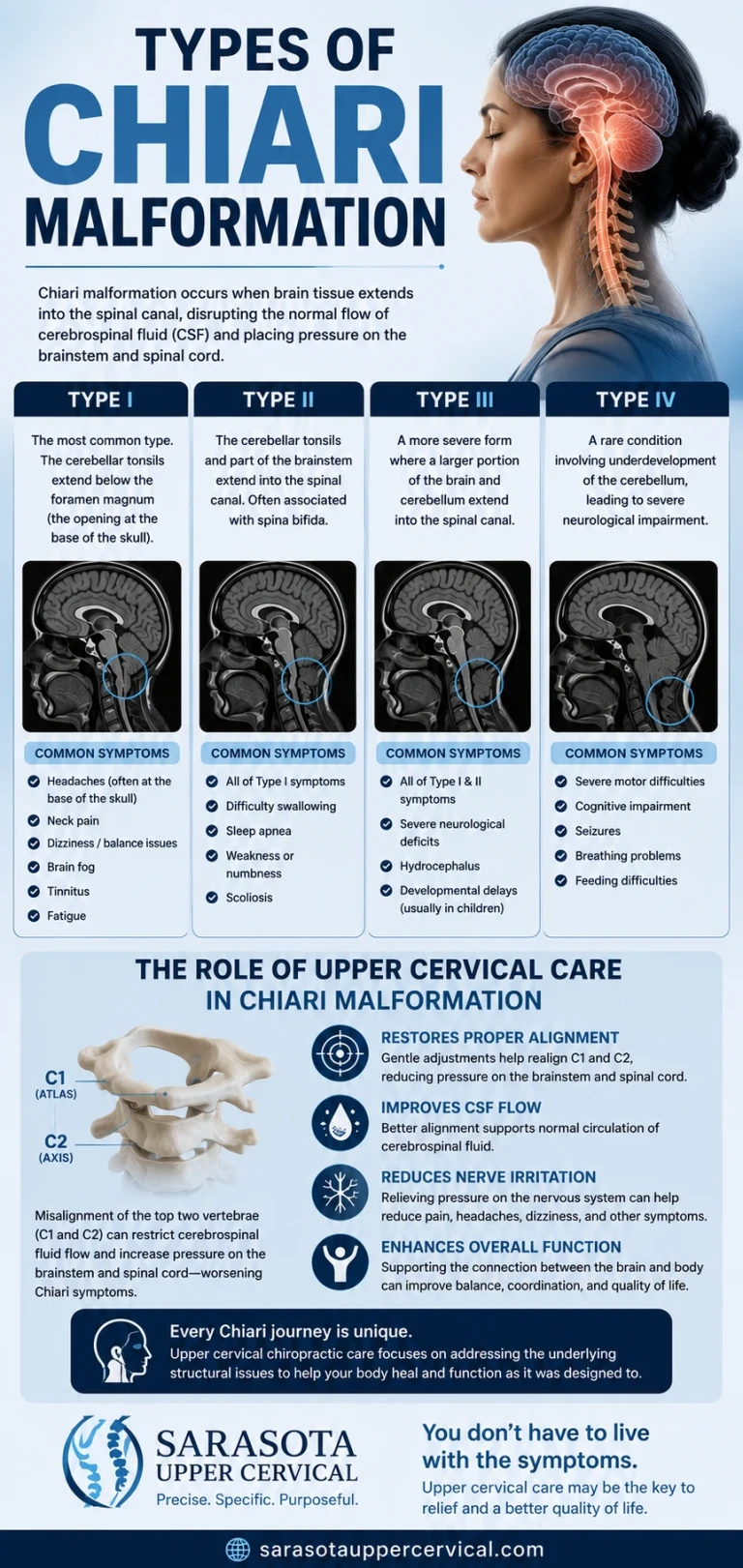
Cone Beam CT (CBCT) imaging allows doctors to view the exact alignment of the skull, atlas, and axis in three dimensions.
This advanced imaging helps determine:
Whether a misalignment exists
The precise direction of the misalignment
The safest and most accurate correction strategy
Because the upper cervical spine is such a delicate area, precision imaging is essential.
Infrared Thermography
Infrared thermography is a non-invasive test that measures temperature differences along the spine.
These temperature patterns can indicate changes in nervous system activity and may help doctors determine whether the upper cervical spine is affecting neurological function.
The goal of this testing is not guesswork—it is to gather objective data to determine if a correction is needed.
A Different Chiropractic Approach
Upper cervical chiropractic care differs significantly from traditional chiropractic techniques.
The goal is not to repeatedly manipulate the spine.
Instead, the focus is on:
Restoring normal alignment and allowing the body to stabilize.
This means:
Patients are only adjusted when necessary
If the spine is holding alignment, no correction is performed
The body is given time to adapt and heal
This approach helps avoid unnecessary adjustments and focuses on long-term structural stability.
Gentle Corrections — No Twisting or Popping
One concern many patients have is whether neck corrections involve aggressive movements.
Upper cervical corrections are designed to be extremely gentle and precise.
The procedure:
Does not involve twisting, cracking, or popping the neck
Does not involve forceful manipulation
Uses a carefully calculated vector based on imaging findings
Most patients describe the correction as light pressure applied behind the ear or along the upper neck.
The goal is simply to guide the atlas back toward its normal position so the nervous system can function more efficiently.
Can Upper Cervical Care Help PPPD?
While PPPD is a complex condition and may involve multiple contributing factors, some patients find improvement when structural problems in the upper cervical spine are addressed.
By restoring proper alignment, it may help:
Normalize signals sent to the vestibular nuclei
Improve head-neck proprioception
Reduce abnormal muscle tension patterns
Allow the brain’s balance centers to recalibrate
Many patients report improvements not only in dizziness but also in related symptoms such as:
Brain fog
Head pressure
Neck tension
Visual sensitivity
Fatigue
Finding PPPD Treatment in Sarasota
If you have been diagnosed with Persistent Postural-Perceptual Dizziness or continue struggling with unexplained dizziness, it may be worth investigating whether the upper cervical spine is playing a role.
A consultation can help determine whether structural issues in the neck may be contributing to your symptoms.
Schedule a Consultation
If you are experiencing chronic dizziness, balance problems, or PPPD symptoms, you may benefit from an evaluation.
Schedule a Free Consultation by clicking here.
Take the First Step Toward Restoring Balance
PPPD can be frustrating and life-altering, but many patients discover that addressing the structural health of the upper cervical spine helps them move closer to stability and recovery.
By combining advanced imaging, precise corrections, and a conservative “adjust only when necessary” philosophy, upper cervical care offers a unique approach for patients seeking answers to chronic dizziness.
If your balance has not been the same since a concussion, whiplash injury, or vestibular event, the upper neck may be an important piece of the puzzle.

Leave a comment