

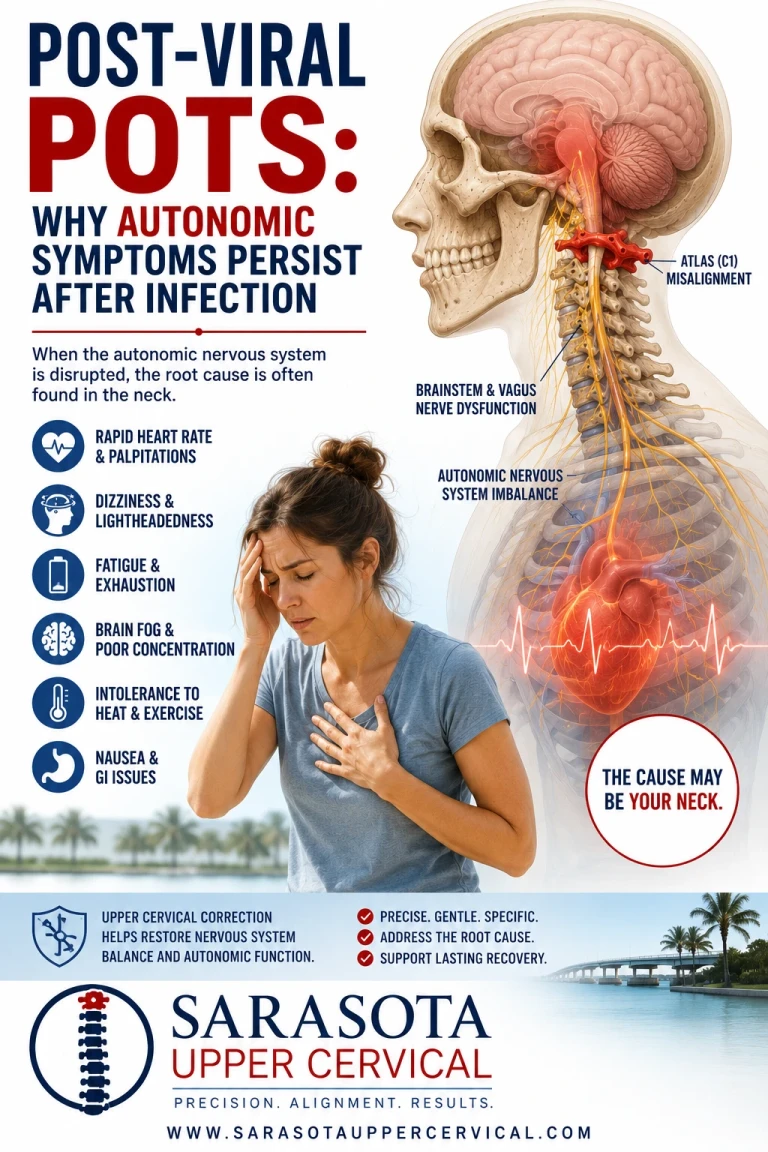
The most common way POTS begins is with an infection that everyone expected you to get over.
It might have been mononucleosis, influenza, a gastrointestinal virus, Lyme disease, or COVID-19. The acute illness ran its course. The fever broke, the test came back negative, the doctor said you were clear. And then the recovery that was supposed to follow simply did not arrive. Standing became difficult. Your heart began racing when you got up. Fatigue settled in that sleep did not touch. Months later you were still waiting for a body that had, apparently, decided not to come back.
Schedule Your Appointment
Schedule appointmentIn pediatric populations, more than half of POTS cases are preceded by an acute viral illness. Across all ages, post-infectious onset is the single most frequently reported trigger. This is not an unusual variant of POTS. It is the most common one.
This article explains what is understood about why autonomic dysfunction persists after infection, what remains genuinely unknown, and where the upper cervical spine fits — which, in post-viral cases specifically, is a more careful and more limited argument than in traumatic-onset POTS.
The leading explanation: autoimmunity
The most developed hypothesis is that some post-infectious POTS is autoimmune.
The mechanism proposed is molecular mimicry. During an infection, the immune system generates antibodies against pathogen proteins. If a pathogen protein sufficiently resembles a human protein, some of those antibodies cross-react with the body's own tissue. The infection clears; the antibodies persist; the damage continues.
In POTS, the targets implicated are receptors central to autonomic function. Cohorts of POTS patients have been found to carry adrenergic and muscarinic autoantibodies — antibodies directed against the alpha-1 and beta-adrenergic receptors that mediate vascular constriction and cardiac response, and against the muscarinic acetylcholine receptors through which parasympathetic signaling operates.
If antibodies are interfering with alpha-1 adrenergic receptors on peripheral blood vessels, those vessels cannot constrict properly on standing. Blood pools in the legs and abdomen. Venous return falls. The body compensates the only way remaining — by increasing heart rate, dramatically. Sympathetic outflow rises not because the sympathetic system is primarily overactive, but because it is working against a peripheral receptor that is not responding.
That model accounts for a great deal of what post-viral POTS patients describe, and it explains why the tachycardia is so resistant to reassurance: it is not anxiety, it is compensation.
It is important to be clear about the status of this evidence. The autoantibody findings are real and have been replicated across multiple groups. Their interpretation is contested. Assay methods vary between laboratories, autoantibodies of these types are found in some healthy controls, and whether they are causal, contributory, or epiphenomenal remains unsettled. Commercial autoantibody panels marketed for POTS are not accepted as diagnostic by autonomic specialists, and a positive result should be interpreted with caution rather than treated as an answer. The autoimmune hypothesis is the strongest available and it is still a hypothesis.
The other mechanisms in play
Autoimmunity is not the only thing happening, and in most patients the picture is probably multifactorial.
Small fiber neuropathy. Infection can damage the small unmyelinated nerve fibers that carry autonomic signals to blood vessels and sweat glands. Skin biopsy studies have identified reduced small fiber density in a subset of POTS patients. Where the fibers supplying lower-limb vasculature are affected, the result is the same failure of vasoconstriction, arrived at through structural nerve damage rather than receptor blockade. This is the basis of the neuropathic POTS subtype.
Persistent low-grade inflammation. Some post-infectious states involve ongoing immune activation long after the pathogen has cleared, with elevated inflammatory cytokines. Cytokines act on the central nervous system, and the brainstem regions regulating autonomic function are not exempt. Neuroinflammation affecting the nucleus tractus solitarius and adjacent medullary nuclei would degrade autonomic regulation directly at the point where it is integrated.
Hypovolemia. Many post-viral POTS patients have measurably reduced blood volume, sometimes with paradoxically low plasma renin and aldosterone given their volume status — suggesting the renin-angiotensin-aldosterone system is not responding appropriately. Less circulating volume makes every orthostatic challenge harder.
Deconditioning. Prolonged illness and bed rest reduce cardiac size, plasma volume, and orthostatic tolerance, genuinely producing orthostatic tachycardia. This is a real contributor and it is also a consequence of POTS, which makes the causal direction extremely difficult to separate in someone who has been unwell for months. It should not be used to dismiss the diagnosis, and it should not be ignored either — recumbent exercise reconditioning is one of the better-supported management approaches precisely because this component is real.
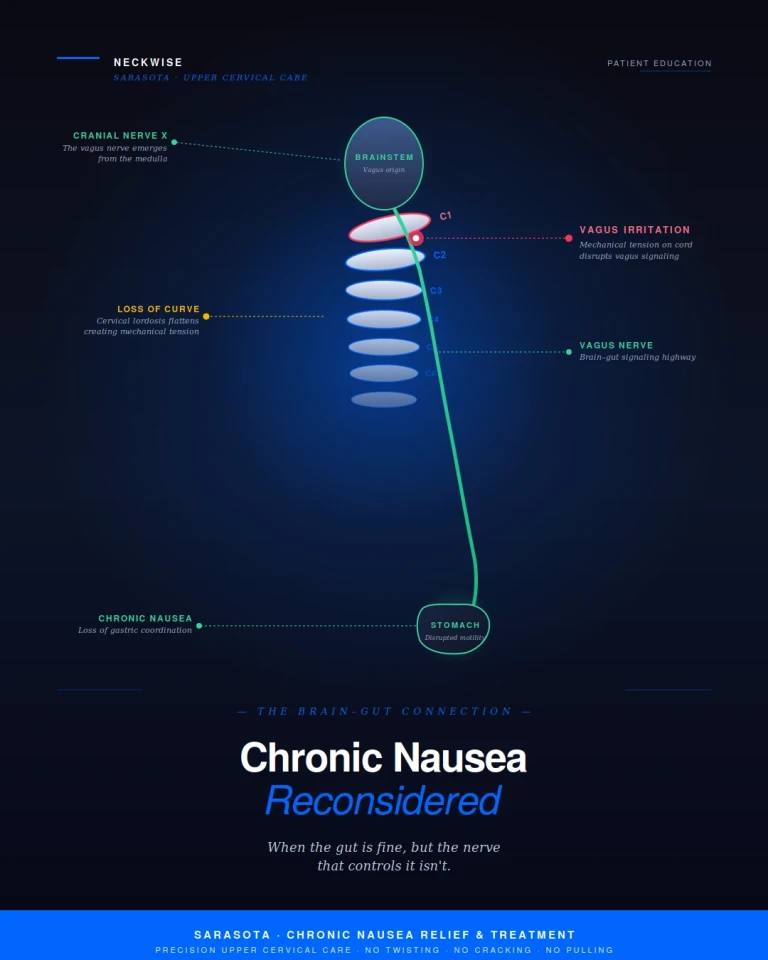
Reduced vagal tone and the inflammatory reflex. The vagus nerve is the efferent arm of the cholinergic anti-inflammatory pathway, in which vagal signaling restrains pro-inflammatory mediator release from immune cells via alpha-7 nicotinic acetylcholine receptors. Reduced vagal tone means reduced restraint on inflammation, and inflammation further degrades autonomic function. It is a self-reinforcing loop, and it may be part of why some post-viral states become self-sustaining rather than resolving.
Long COVID and what it changed
Related article
COVID-19 produced post-viral POTS at a scale that made the phenomenon impossible to ignore. Autonomic dysfunction is among the most frequently documented features of Long COVID, and POTS specifically has been diagnosed in substantial numbers of people following infection.
The clinical significance is not that COVID does something unique — the pattern closely resembles post-viral POTS following other pathogens, which is itself informative. The significance is one of volume and attention. A condition that was previously dismissed as vague or psychosomatic in individual patients became undeniable when it appeared simultaneously in enormous numbers of previously healthy people with a documented, dated, laboratory-confirmed trigger.
For people who developed POTS after other infections years earlier, this has meant something. The mechanism they were describing was finally taken seriously, and research funding followed.
Where the upper cervical spine fits, and where it does not
This requires more care than the traumatic-onset case, and it is worth being explicit about the difference.
When POTS begins immediately after a car accident or a concussion, there is a mechanical event at the craniocervical junction with a clear temporal relationship to symptom onset, and the neck is an obvious candidate. When POTS begins after mononucleosis, there is no such event. A virus does not misalign the atlas. Suggesting otherwise would be dishonest.
What can reasonably be proposed is different: that upper cervical dysfunction may function as a predisposing or perpetuating factor rather than a trigger — a reason why one person's autonomic system fails to re-stabilize after an infectious insult while another's recovers.
The anatomical basis is this. Blood pressure regulation on standing is a brainstem operation. Baroreceptors in the carotid sinus and aortic arch signal via the glossopharyngeal and vagus nerves into the nucleus tractus solitarius, the first central relay for cardiovascular afferent input. The NTS projects to the caudal ventrolateral medulla, which inhibits the rostral ventrolateral medulla, the principal generator of sympathetic outflow to the heart and vasculature. Parasympathetic cardiac output arises from the nucleus ambiguus and dorsal motor nucleus of the vagus. This is where autonomic balance is set, immediately above the atlas.
Cervical afferents feed into that system. Bolton and colleagues demonstrated in 1998 that stimulating the C2 dorsal root ganglion and the C2 and C3 branches supplying the dorsal neck muscles produced measurable responses in splanchnic sympathetic nerve activity, and that cervical and vestibular influences on sympathetic output are arranged antagonistically — an arrangement that lets the brain distinguish whole-body postural change, which requires a cardiovascular response, from head movement on a stationary trunk, which does not. Subsequent human work showed that neck muscle stretch modulates muscle sympathetic nerve activity to the lower limbs, leading investigators to conclude that neck proprioceptors may contribute to blood pressure regulation during orthostatic challenge. The suboccipital muscles supplying that information carry one of the highest muscle spindle densities in the human body, functioning as continuous high-resolution reporters of head position on the trunk.
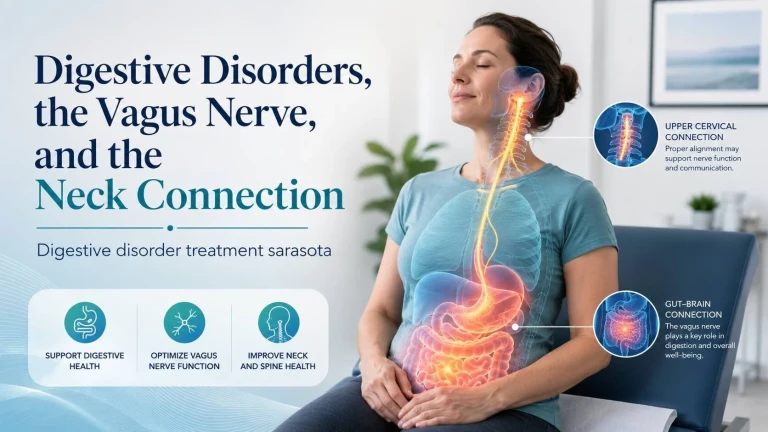
The vagus nerve exits the jugular foramen and descends in the carotid sheath immediately anterior to the transverse process of the atlas, which places both the efferent parasympathetic pathway and the afferent arm of the inflammatory reflex in close anatomical relationship to the first cervical vertebra.
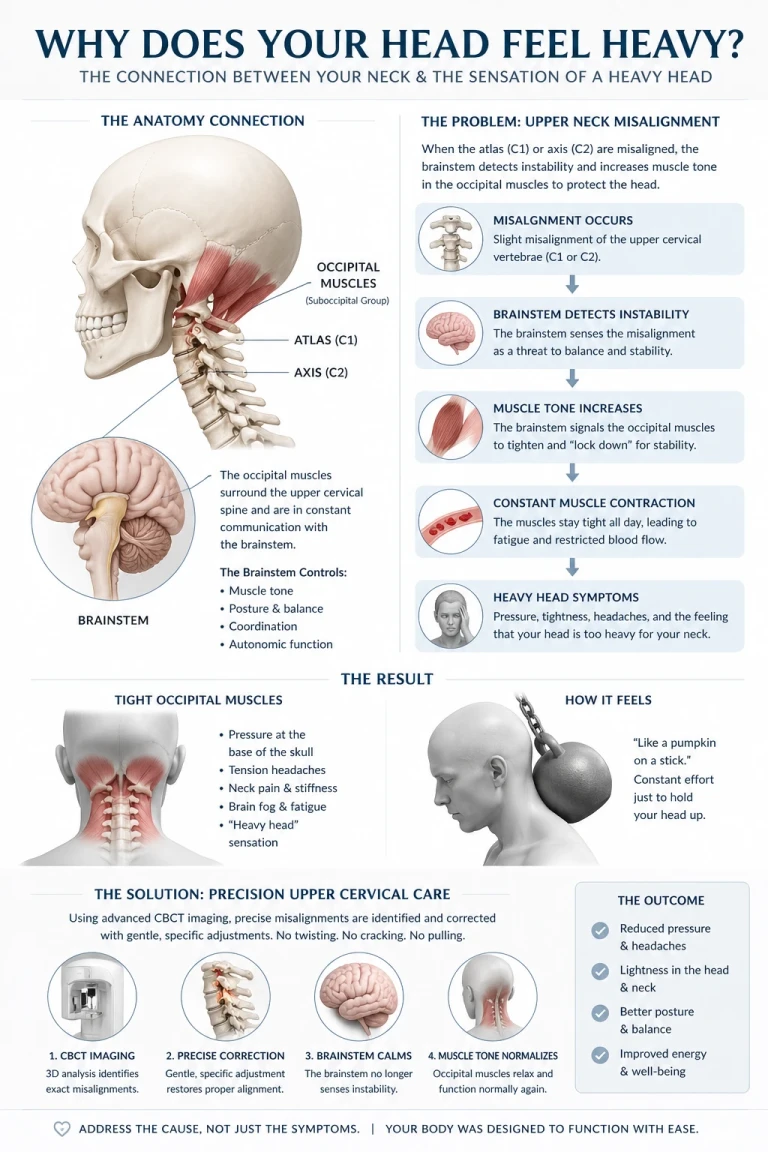
So the proposition is one of reserve capacity. A person recovering from a significant infectious insult to autonomic regulation is asking a compromised system to re-stabilize. If the postural information feeding that system is already degraded, the recovery is being attempted with less margin. That may be part of why some people re-stabilize and some do not.
This is a hypothesis about a contributing factor. It is not a claim that the neck caused post-viral POTS, and it is not a claim that correcting the neck resolves it. Upper cervical chiropractic evidence in POTS consists of case reports — a 2024 Cureus report by Trager and colleagues describing marked improvement in a patient with cervicogenic dizziness, upper cervical instability and POTS, and a 2022 case study in the Journal of Upper Cervical Chiropractic Research. Case reports cannot establish causation and their outcomes should not be presented as typical. It is also true that alignment and degenerative findings in the cervical spine are common in asymptomatic people, so imaging findings alone establish nothing about an individual case.
What actually helps, in order
Medical management comes first and it is not optional. Post-viral POTS requires physician evaluation to confirm the diagnosis, exclude the conditions that mimic it, and address treatable contributors. Established first-line management — increased sodium and fluid intake, compression garments covering the abdomen and lower limbs, and graded recumbent exercise reconditioning — has better evidence behind it than anything else discussed in this article, and it should not be deprioritized in favor of anything.
Pacing matters, particularly where post-exertional symptom worsening is present. This is a real feature in a subset of post-viral patients and it means that conventional exercise advice can make things worse rather than better. Reconditioning protocols in this population start recumbent and progress slowly for that reason.
An upper cervical evaluation is reasonable as an assessment of one additional structural variable, and it is most worth considering when there is a history of head or neck trauma at any point, whether or not it seemed related; when there is persistent upper neck pain, suboccipital tightness, or headache alongside the autonomic symptoms; when dizziness varies with head position; or when there is a connective tissue diagnosis or documented hypermobility. Evaluation involves history, orthostatic measurement, examination of upper cervical mechanics and proprioceptive function, and where appropriate three-dimensional cone beam CT imaging of the alignment relationship between skull, atlas, and axis.
The last thing worth saying is about prognosis, because post-viral POTS patients are rarely told this. It is often not permanent. One study following POTS patients aged thirteen to fifty found that thirty-seven percent no longer met diagnostic criteria at one-year follow-up. Post-infectious cases in particular can improve substantially over time. Recovery is frequently slower than anyone wants and rarely linear, but the trajectory for many people bends in the right direction.
Upper cervical care is a complementary approach addressing one variable in a complex condition. It is not a cure, and it is not a substitute for the medical management this condition requires.
If your POTS started after an infection and you want to find out whether the upper cervical spine is part of why your autonomic system has not re-stabilized, schedule a free consultation or call 941-259-1891.
Medical disclaimer: This article is for educational purposes only and does not constitute medical advice, diagnosis, or treatment. Post-viral POTS requires evaluation and management by qualified medical professionals, and several conditions produce similar symptoms and require exclusion. Upper cervical chiropractic care is a complementary approach and is not a substitute for medical care. Individual results vary, and outcomes described in published case reports should not be interpreted as typical or expected. Always consult your physician before making changes to your care.
Leave a comment