

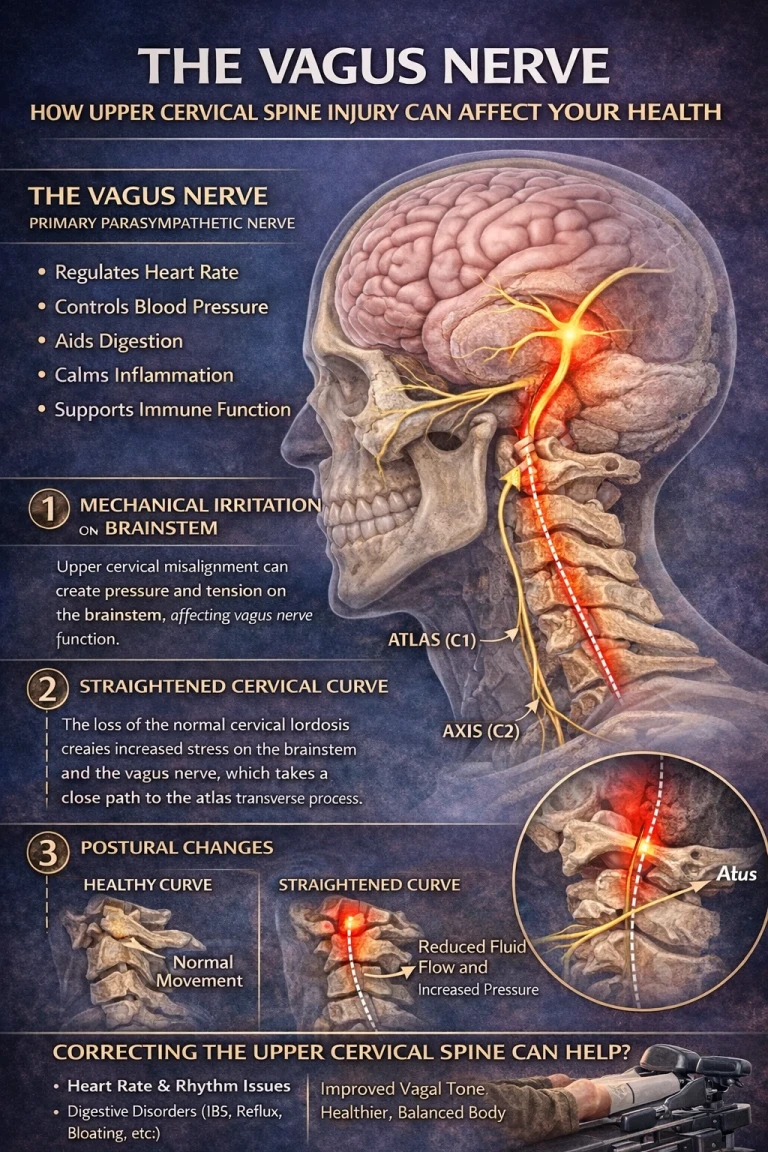
How Neck Misalignment Can Impact Your Nervous System and Overall Health
The vagus nerve is one of the most important—and most overlooked—structures in the human body when it comes to chronic health conditions. As the primary regulator of the parasympathetic nervous system, it plays a central role in controlling heart rate, digestion, inflammation, breathing, and even emotional balance.
Schedule Your Appointment
Schedule appointmentWhen functioning properly, the vagus nerve helps the body stay calm, regulated, and resilient. But when its function is disrupted, the body can shift into a chronic state of stress and dysregulation—often referred to as dysautonomia.
One of the most overlooked causes of vagus nerve dysfunction is upper cervical spine injury and misalignment, particularly involving the atlas (C1) and axis (C2). Because of their close anatomical relationship to the brainstem and vagus nerve, structural changes in this region can have profound neurological consequences.
Book a FREE consultation by clicking here.
What Is the Vagus Nerve?
The vagus nerve (cranial nerve X) originates in the brainstem and travels down through the neck into the chest and abdomen. It connects the brain to many major organs, including:
The heart
The lungs
The digestive tract
The liver and pancreas
Its primary role is to regulate the parasympathetic nervous system, often called the “rest and digest” system. This system helps:
Slow the heart rate
Lower blood pressure
Stimulate digestion
Reduce inflammation
Promote relaxation and recovery
When the vagus nerve is functioning well, the body is adaptable and balanced. When it is impaired, the body can become stuck in “fight or flight.”
Upper Cervical Spine: The Critical Intersection
The upper cervical spine—specifically the atlas (C1) and axis (C2),is uniquely positioned at the base of the skull, directly beneath the brainstem.
This region is:
The most neurologically dense area of the spine
Responsible for supporting the head and allowing movement
Closely associated with the brainstem, where the vagus nerve originates
Because of this proximity, even slight misalignments in this region can influence neurological function.
Book a FREE consultation by booking here.
How Upper Cervical Injury Affects the Vagus Nerve
Injuries such as:
Related article
Lakewood Ranch TMD Specialist | Neck & Jaw Connection | Holistic TMD Relief
Mar 12, 2026Whiplash
Concussions
Falls
Repetitive postural stress (forward head posture)
can alter the alignment of the atlas and axis. These structural changes can create a cascade of effects that disrupt vagus nerve function.
1. Mechanical Irritation of the Brainstem
The brainstem houses the nuclei that give rise to the vagus nerve. When the atlas is misaligned, it can place abnormal mechanical stress on this region.
This may lead to:
Altered signaling through the vagus nerve
Disruption of autonomic control centers
Imbalance between sympathetic and parasympathetic activity
Even subtle irritation can have widespread effects because the brainstem regulates so many vital functions.
2. Loss of the Normal Cervical Curve
A healthy neck has a natural lordotic curve. This curve helps distribute mechanical stress and protects the spinal cord and brainstem.
When this curve is lost—often due to poor posture or injury—it can:
Increase tension on the spinal cord and brainstem
Reduce shock absorption
Alter biomechanics of the upper cervical joints
This added stress can interfere with the normal function of the vagus nerve and other autonomic pathways.
3. Postural Changes and Vagus Nerve Tension
Forward head posture is one of the most common postural distortions seen today. As the head moves forward:
The upper cervical spine compensates
Muscles tighten and shorten
Neural structures are placed under tension
The vagus nerve, which travels through the neck, can be affected by these changes in structure and tension.
4. Proximity to the Atlas Transverse Process
One of the most important anatomical relationships to understand is the close proximity of the vagus nerve to the transverse process of the atlas (C1).
As the vagus nerve exits the skull, it passes just in front of this bony structure.
When the atlas is misaligned, it can:
Alter the spatial relationship between the nerve and bone
Create mechanical irritation or compression
Affect the signaling capacity of the vagus nerve
This is a key reason why structural changes in the upper neck can have such a profound impact on autonomic function.
Book a FREE consultation by clicking here.
Symptoms of Vagus Nerve Dysfunction
When the vagus nerve is not functioning properly, a wide range of symptoms can develop. These often overlap with conditions like POTS and dysautonomia.
Cardiovascular Symptoms
Rapid heart rate (tachycardia)
Heart palpitations
Blood pressure instability
Lightheadedness or dizziness
Neurological Symptoms
Brain fog
Difficulty concentrating
Headaches
Anxiety or panic-like symptoms
Digestive Symptoms
Bloating
Nausea
Constipation or diarrhea
Slow digestion
Systemic Symptoms
Chronic fatigue
Related article
Hearing Loss Treatment in Sarasota | Understanding Eustachian Tube Dysfunction
Mar 23, 2026Poor stress tolerance
Sleep disturbances
Temperature regulation issues
Because the vagus nerve influences so many systems, dysfunction can appear widespread and confusing.
Why Many Treatments Miss the Root Cause
Most conventional approaches to vagus nerve dysfunction focus on:
Medications
Diet changes
Stress management
Vagal stimulation exercises
While these can be helpful, they often do not address structural interference at the level of the brainstem and upper cervical spine.
If the nerve is being mechanically irritated or neurologically disrupted, true resolution may require addressing the underlying structure.
The Role of Upper Cervical Correction
Upper cervical chiropractic care focuses on restoring proper alignment of the atlas and axis to reduce interference in the nervous system.
This approach is highly specific and based on detailed analysis of each individual patient.
Precision Over Force
Unlike traditional chiropractic adjustments, upper cervical corrections are:
Gentle
Precise
Based on objective measurements
Performed with no twisting, popping, or pulling
The goal is not to repeatedly manipulate the spine, but to make a precise correction and allow the body to stabilize.
Advanced Imaging for Accuracy
To ensure precision, upper cervical doctors use advanced imaging such as 3D CBCT scans.
These scans allow for:
Exact measurement of misalignment
Visualization in three dimensions
Customized correction plans for each patient
No two misalignments are the same, and this level of detail ensures accuracy.
Restoring Vagus Nerve Function
When the upper cervical spine is properly aligned, several things can improve:
1. Reduced Brainstem Irritation
Relieving mechanical stress allows for more normal signaling.
2. Improved Neural Communication
The nervous system can send and receive signals more efficiently.
3. Better Autonomic Balance
The body can shift out of chronic “fight or flight” and into a more regulated state.
4. Enhanced Vagal Tone
Improved vagus nerve function supports heart rate variability, digestion, and overall resilience.
What Patients Often Experience
As vagus nerve function improves, patients may notice:
More stable heart rate and blood pressure
Reduced dizziness and lightheadedness
Improved digestion
Better sleep
Increased energy
Reduced anxiety and stress sensitivity
While results vary from person to person, the goal is always the same: restore normal function so the body can heal itself.
Connecting Structure and Function
The vagus nerve does not operate in isolation. It is deeply connected to the structure surrounding it—particularly the upper cervical spine and brainstem.
When that structure is compromised, function often follows.
By addressing:
Atlas and axis misalignment
Postural distortions
Mechanical stress on the brainstem
it becomes possible to influence the vagus nerve in a meaningful and lasting way.
Final Thoughts
Vagus nerve dysfunction is a major contributor to many chronic health conditions, from POTS and dysautonomia to digestive to rheumatoid arthiritis and anxiety-related disorders.
While many treatments focus on managing symptoms, it is essential to consider whether structural interference in the upper cervical spine is playing a role.
By restoring proper alignment and reducing neurological stress at the brainstem level, upper cervical care offers a powerful, non-invasive approach to improving vagus nerve function.
If you are struggling with symptoms that don’t seem to have a clear cause, it may be time to look at the connection between your neck and your nervous system.
Because sometimes, the key to healing isn’t just chemistry—it’s structure.
book a FREE consult by clicking here.
Leave a comment