

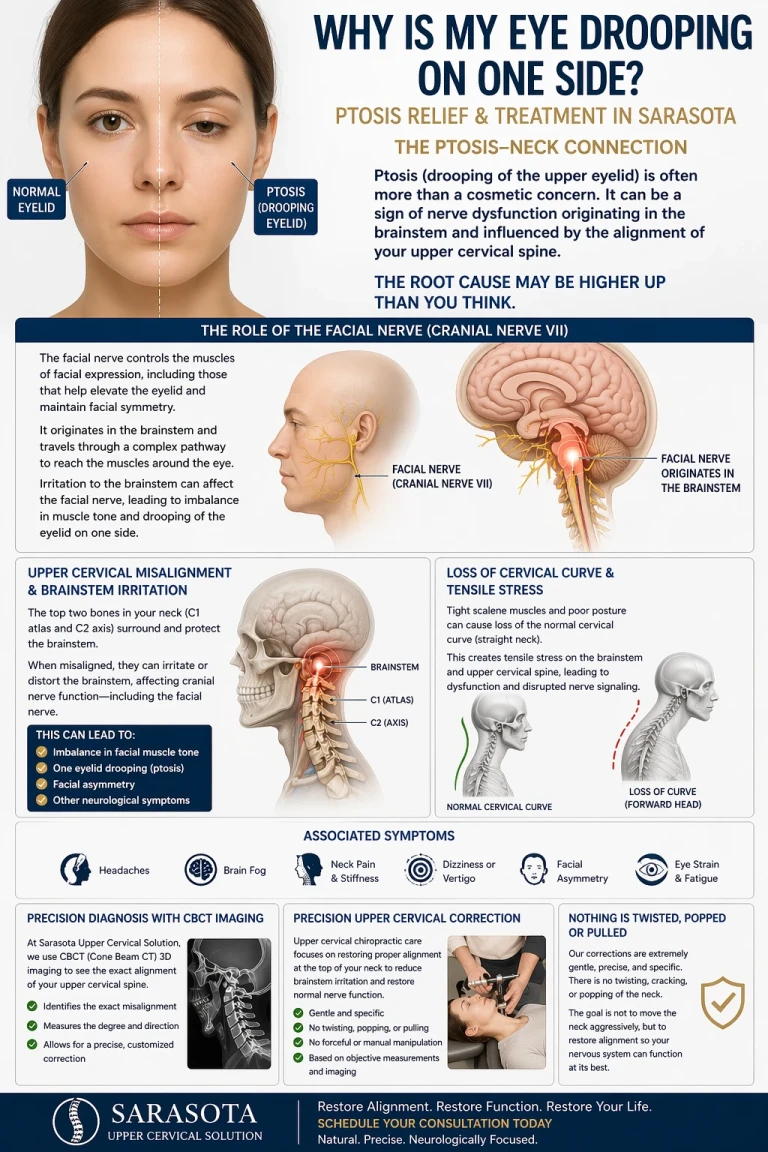
If you’ve noticed that one eyelid is lower than the other—or that your eye looks more “closed” on one side—you may be dealing with ptosis.
For some, it’s subtle. For others, it’s obvious and concerning. You might feel like:
Schedule Your Appointment
Schedule appointmentOne eye looks tired or heavy
Your face appears uneven
You have to strain to keep one eye open
People ask if you’re fatigued or not feeling well
While ptosis is often thought of as a localized eye issue, the truth is:
The control of your eyelid comes from your nervous system—specifically the brainstem and cranial nerves
To understand why this happens, we need to look deeper at how the eye and face are neurologically controlled.
What Is Ptosis?
Ptosis refers to drooping of the upper eyelid. It can affect:
One eye (unilateral)
Both eyes (bilateral)
And it may range from:
Mild asymmetry
To significant obstruction of vision
Ptosis can be caused by:
Muscle weakness
Nerve dysfunction
Structural or age-related changes
But in many cases—especially when it appears suddenly or fluctuates—there may be a neurological component involved.
The Role of the Nervous System in Eyelid Control
Your eyelid position is controlled by a combination of:
Muscles (like the levator palpebrae superioris)
Cranial nerves (especially the oculomotor nerve and facial nerve)
Brainstem coordination
The facial nerve (cranial nerve VII) plays a key role in:
Muscle tone of the face
Symmetry of facial expressions
Coordination between both sides of the face
When nerve signaling is balanced:
Both eyes open evenly
Facial muscles maintain symmetry
But when signaling is disrupted:
You may see asymmetry, including drooping of one eyelid
The Brainstem: The Control Center Behind Facial Symmetry
The brainstem sits at the base of your skull and is responsible for:
Coordinating cranial nerve function
Regulating muscle tone
Maintaining symmetry across the body
Cranial nerves—including the facial nerve—originate from the brainstem.
That means:
Any irritation or dysfunction at the brainstem level can affect how these nerves function
How Upper Cervical Misalignment Can Contribute to Ptosis
The top two bones in your neck—C1 (atlas) and C2 (axis)—surround and protect the brainstem.
This region is called the craniocervical junction, and it plays a critical role in neurological function.
When there is an upper cervical misalignment, it can:
Irritate or distort brainstem signaling
Affect cranial nerve output
Disrupt muscle tone regulation
What Does That Lead To?
Imbalance in facial muscle tone
Asymmetry in eyelid position
One eye appearing more “closed” than the other
Ptosis can be a reflection of neurological imbalance—not just a local eye issue
Why the Facial Nerve Matters
The facial nerve controls:
Muscles around the eyes
Muscles of facial expression
Tone and balance between both sides of the face
If this nerve is not firing properly due to brainstem irritation:
One side of the face may become weaker or less active
The eyelid may not maintain its normal position
Subtle drooping can occur
This is why ptosis is often accompanied by:
Facial asymmetry
Changes in expression
Eye fatigue
Associated Symptoms to Watch For
Because the brainstem and cranial nerves affect multiple systems, ptosis may appear alongside:
Facial asymmetry
Headaches
Neck pain or stiffness
Brain fog or fatigue
Dizziness or vertigo
Eye strain or visual fatigue
These symptoms may seem unrelated—but they often share a common origin:
Upper cervical dysfunction affecting brainstem communication
Related article
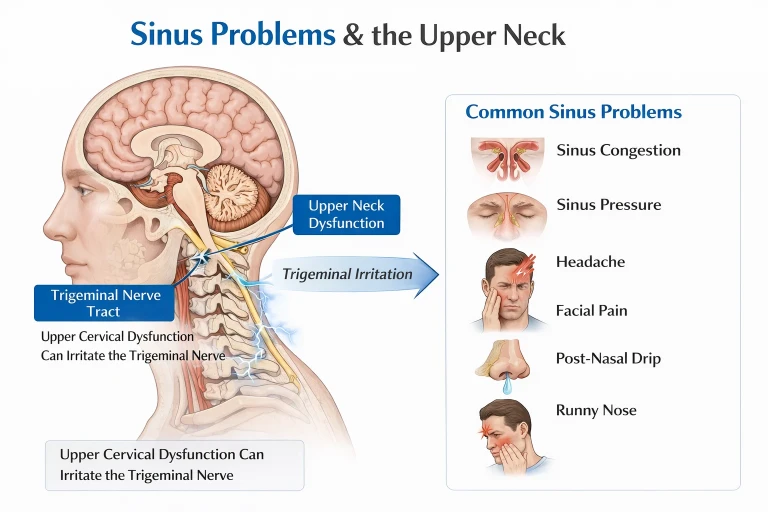
Sinus Pressure & Chronic Sinus Issues in Sarasota and Bradenton | Upper Cervical Approach
Mar 08, 2026
Why Treating the Eye Alone May Not Be Enough
Many approaches to ptosis focus on:
Eye muscles
Cosmetic treatments
Surgical correction
While these may be necessary in some cases, they don’t always address:
Why the nerve controlling the eyelid isn’t functioning properly
If the issue is neurological, the source may be:
Higher up in the system
At the level of the brainstem and upper cervical spine
The Upper Cervical Chiropractic Approach
Upper cervical care focuses on one primary goal:
Restoring proper alignment at the top of the neck to reduce brainstem irritation
This approach is:
Precise
Objective
Neurologically focused
Adjustments are not performed randomly.
They are based on objective findings that show when a correction is needed
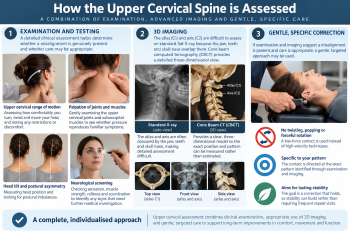
Precision Matters: CBCT Imaging
To achieve precision, upper cervical chiropractors use CBCT (Cone Beam CT) imaging.
This advanced imaging allows us to:
Visualize the upper cervical spine in 3D
Identify the exact misalignment
Measure the direction and degree
No two people are the same.
That’s why every correction is custom-tailored to your anatomy
No Twisting, Popping, or Pulling
Upper cervical adjustments are very different from traditional chiropractic techniques.
They are:
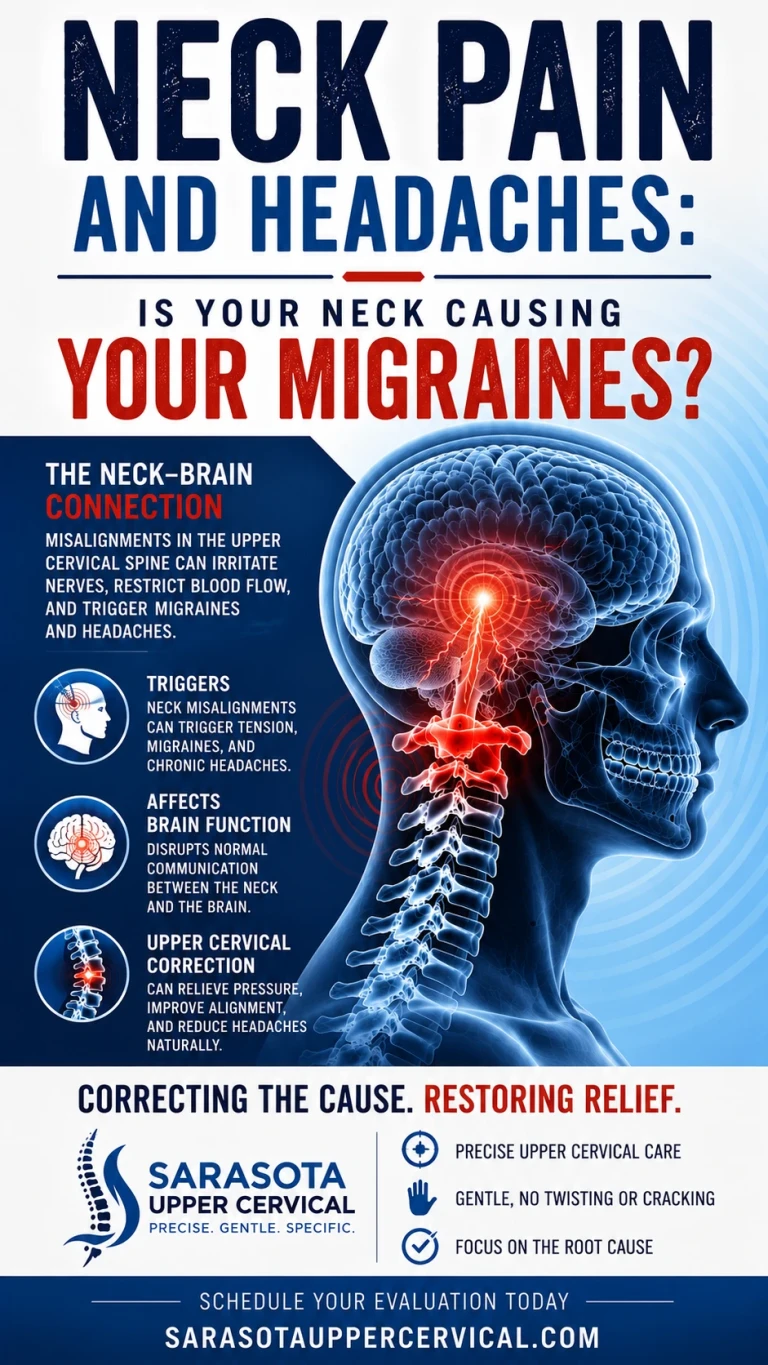
Gentle
Specific
Controlled
There is:
No twisting
No cracking or popping
No forceful manipulation
The goal is not to “move the neck” aggressively…
It’s to restore alignment so the nervous system can function properly
What Happens When Function Is Restored?
When the upper cervical spine is properly aligned:
Brainstem irritation can decrease
Cranial nerve function can improve
Muscle tone can rebalance
This may lead to:
Improved facial symmetry
Reduction in eyelid drooping
Better overall neurological function
A Different Way to Look at Ptosis
If you’re dealing with one-sided eye drooping, it’s worth asking:
“What’s wrong with my eye?”
vs.
“Is there a neurological imbalance affecting my eye?”
That shift can open the door to identifying the true cause.
Final Thoughts
Ptosis is often more than just a cosmetic issue.
It can be:
A sign of cranial nerve dysfunction
A reflection of altered muscle tone
A clue pointing to brainstem irritation
By focusing on the upper cervical spine, we can address the issue at its source—not just manage the symptom.
Looking for Ptosis Relief in Sarasota?
If you’re experiencing:
One-sided eye drooping
Facial asymmetry
Neck pain, headaches, or brain fog
It may be time to evaluate the role of your upper cervical spine and brainstem function.
A proper assessment using CBCT imaging and objective neurological testing can determine if this is contributing to your symptoms.

Leave a comment