

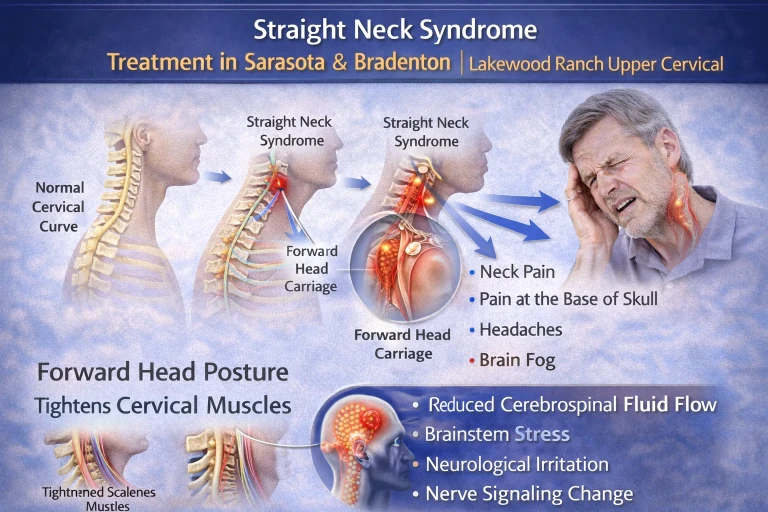
Many people today suffer from chronic neck tension, headaches, brain fog, and stiffness that seems to never fully go away. Often these symptoms are attributed to stress, poor posture, or aging. However, a structural condition known as Straight Neck Syndrome, sometimes called loss of cervical lordosis, is frequently at the root of these problems.
If you are searching for Straight Neck Syndrome treatment in Sarasota, Bradenton, or Lakewood Ranch, understanding how the upper cervical spine—particularly the atlas (C1)—affects neck alignment can be an important first step toward real relief.
Schedule Your Appointment
Schedule appointmentThe upper cervical spine plays a critical role in posture, spinal cord function, and neurological balance. When the atlas becomes misaligned, it can trigger a chain reaction throughout the neck that leads to muscle tightening, forward head posture, and eventually the loss of the natural cervical curve.
Book a FREE consultation by clicking here.
What Is Straight Neck Syndrome?
The cervical spine normally has a gentle C-shaped curve, called the cervical lordosis. This curve acts like a spring, absorbing shock and distributing weight properly through the neck and upper back.
When this curve begins to flatten or reverse, the condition is often referred to as Straight Neck Syndrome or military neck.
Common symptoms include:
Chronic neck pain
Pain at the base of the skull
Headaches
Brain fog
Muscle tightness in the neck and shoulders
Fatigue when holding the head upright
Reduced range of motion
These symptoms occur because the neck loses its ability to properly balance the head.
The Atlas (C1) and Its Role in Neck Alignment
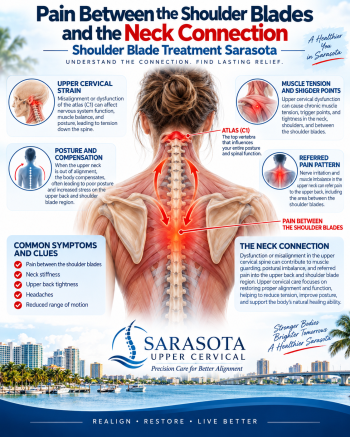
The atlas vertebra (C1) is the top bone of the spine and supports the skull. It sits directly beneath the head and acts as the foundation for the rest of the cervical spine.
Because of its unique shape and mobility, the atlas is particularly vulnerable to injury.
Common causes of atlas misalignment include:
Car accidents
Whiplash injuries
Sports impacts
Slip and falls
Concussions
Chronic poor posture
When the atlas becomes misaligned, it changes how the head sits on the spine.
Even small misalignments can cause the body to compensate with muscle tension and postural changes.
Book a FREE consultation by clicking here.
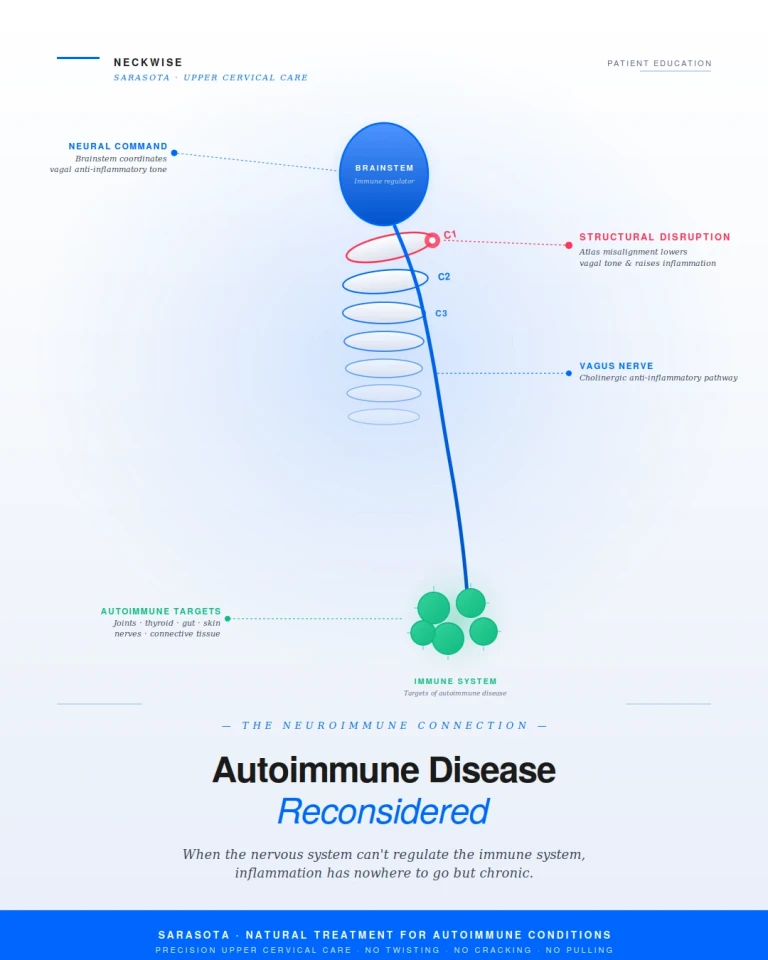
How Atlas Misalignment Leads to Muscle Tightening
When the atlas shifts out of alignment, the body instinctively tries to stabilize the head and protect the nervous system. One of the ways it does this is through muscle tightening.
The muscles most commonly affected are the scalene muscles located in the front and side of the neck.
These muscles help stabilize the cervical spine and assist with breathing. When the atlas is misaligned, the scalenes often become chronically tight.
Over time this tightening can:
Pull the cervical spine forward
Flatten the natural curve of the neck
Restrict normal movement of the vertebrae
Create tension throughout the entire cervical region
This muscular imbalance contributes to the development of Straight Neck Syndrome.
Forward Head Posture and Loss of Cervical Curve
As the muscles tighten and the atlas remains misaligned, the head often begins to drift forward relative to the shoulders. This is known as forward head carriage.
For every inch the head moves forward, the weight placed on the neck increases dramatically.
A human head weighs roughly 10–12 pounds in neutral posture. But with forward head posture, the effective weight placed on the cervical spine can increase to 30–40 pounds or more.
This additional stress causes:
Increased compression on the cervical discs
Muscle fatigue and tightness
Increased pressure at the base of the skull
Reduced spinal mobility
Over time the cervical curve gradually straightens as the body adapts to this new posture.
Effects on the Spinal Cord and Nervous System
The spinal cord runs through the center of the cervical spine and carries communication between the brain and the body.
When the cervical curve is lost, the biomechanics of the neck change significantly. This can place abnormal tension on the spinal cord and surrounding tissues.
The result may include neurological symptoms such as:
Brain fog
Difficulty concentrating
Chronic fatigue
Headaches
Neck stiffness
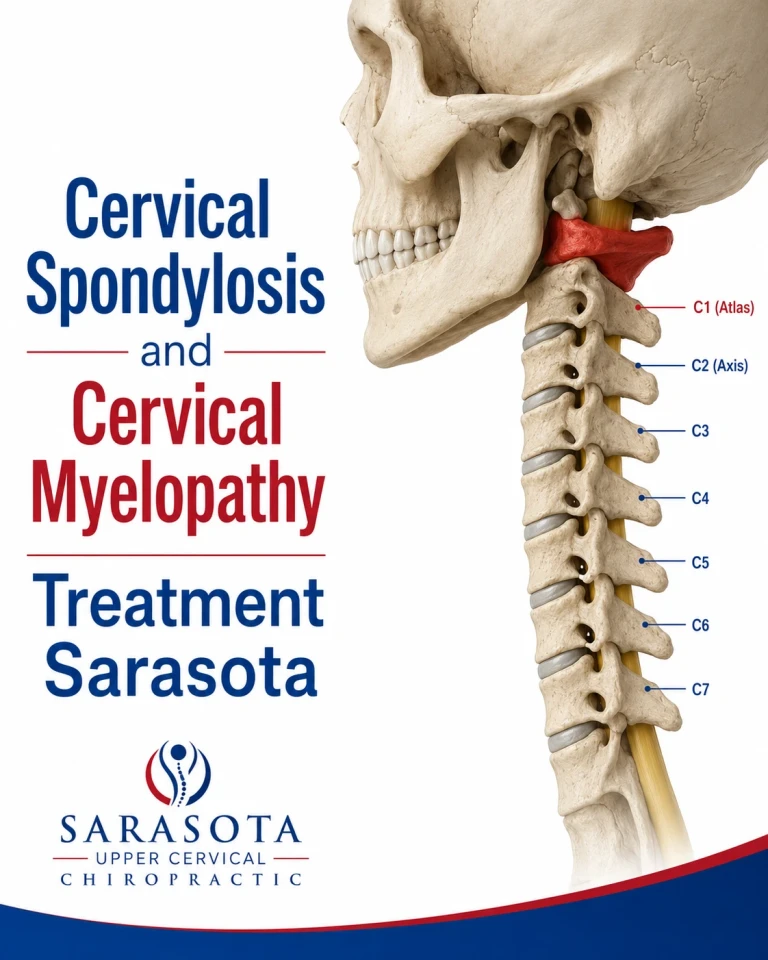
The upper cervical region is especially important because it sits directly beneath the brainstem, which controls many vital functions including balance, autonomic regulation, and muscle tone.
If structural stress exists in this region, the nervous system may struggle to function optimally.
Pain at the Base of the Skull
One of the most common symptoms of straight neck syndrome is pain at the base of the skull.
This occurs because the small stabilizing muscles in this area—called the suboccipital muscles—must work harder when the head is positioned forward.
These muscles become tight and inflamed, which can irritate nearby nerves.
Patients often describe symptoms such as:
Sharp pain at the base of the skull
Pressure behind the head
Tension headaches
Pain radiating toward the temples or eyes
This type of pain is frequently mistaken for migraine or tension headache, when the underlying issue is actually structural.
Headaches and Brain Fog
Forward head posture and cervical muscle tension can also reduce normal circulation and neurological signaling between the brain and body.
This can contribute to:
Chronic headaches
Mental fatigue
Difficulty focusing
Brain fog
Many patients with straight neck syndrome report feeling mentally clearer once the structural alignment of the neck improves.
The Upper Cervical Approach
Upper cervical chiropractic focuses specifically on the top two vertebrae of the spine: the atlas (C1) and axis (C2).
Instead of aggressive manipulation, the goal is to restore proper alignment with precise, gentle corrections.
When the atlas returns closer to its natural position, the body can begin to relax the muscles that have been compensating.

This may allow:
Scalene muscles to relax
Forward head posture to improve
Cervical curve to gradually restore
Pressure on the spinal cord to decrease
The body often begins to correct itself once the structural foundation of the neck is stabilized.
The Importance of Precision Imaging
Because each person’s anatomy is unique, upper cervical doctors often use 3D CBCT (Cone Beam CT) imaging to analyze the exact alignment of the atlas.
This imaging allows precise measurement of:
Rotational displacement
Lateral shift
Angular misalignment
Skull-to-atlas relationship
With this information, adjustments can be customized to the patient’s specific alignment pattern.
This level of precision is especially important when working near the brainstem and spinal cord.
Gentle Corrections Without Twisting or Cracking
Many patients are surprised to learn that upper cervical chiropractic does not involve forceful twisting or cracking of the neck.
Adjustments are typically:
Gentle
Low-force
Highly precise
Based on imaging measurements
The goal is simply to restore normal alignment so the nervous system and musculature can function more efficiently.
Straight Neck Syndrome Treatment in Sarasota & Bradenton
If you are dealing with chronic neck tension, headaches, brain fog, or pain at the base of the skull, the issue may not simply be muscle strain or poor posture.
The underlying cause may be a structural misalignment of the atlas that has led to loss of the cervical curve.
Upper cervical care focuses on restoring alignment at the top of the spine so the body can regain proper posture, relieve muscle tension, and support optimal nervous system function.
If you are looking for Straight Neck Syndrome treatment in Sarasota, Bradenton, or Lakewood Ranch, exploring the role of the upper cervical spine may provide the missing piece in your recovery.
Correcting the foundation of the neck often allows the body to rebalance itself naturally—helping reduce pain, improve posture, and restore clearer neurological function.
Our office serves Sarasota, Bradenton, Venice, Englewood, Longboat Key, Apollo Beach , Parish, Arcadia, Punta Gorda, Port Charlotte, and Osprey.
Leave a comment