

Understanding the Brainstem–Autonomic Connection and the Role of Atlas Alignment
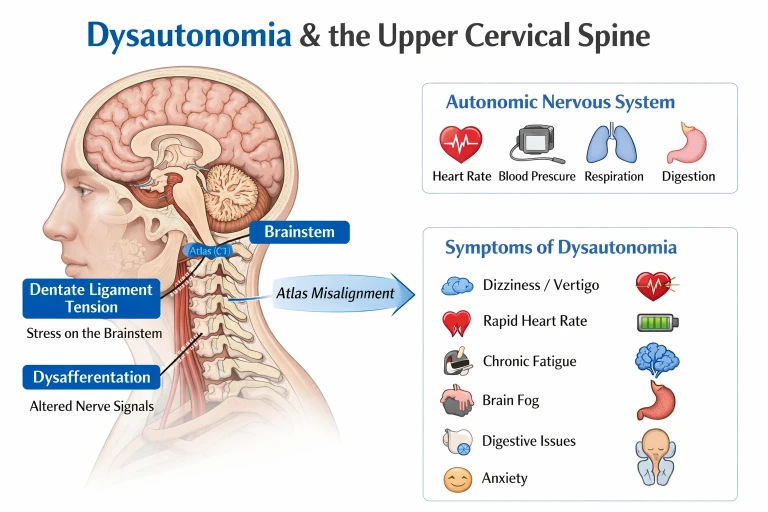
Dysautonomia is a rapidly growing health concern affecting millions of people worldwide. Many patients suffer from persistent symptoms such as dizziness, rapid heart rate, fatigue, brain fog, digestive disturbances, and temperature regulation problems without clear answers. While dysautonomia is often treated as a purely neurological or systemic condition, emerging discussions in neurology and spinal biomechanics highlight the importance of the brainstem and upper cervical spine in autonomic nervous system regulation.
Schedule Your Appointment
Schedule appointmentFor many individuals in Sarasota and Lakewood Ranch, addressing dysfunction at the craniocervical junction — particularly the atlas (C1 vertebra) — may play a role in restoring proper neurological signaling to the body.
This article explores the connection between the brainstem, dysautonomia, atlas misalignment, dentate ligament theory, and dysafferentation theory, and how upper cervical chiropractic care may support autonomic nervous system balance.
Understanding Dysautonomia
Dysautonomia is a term used to describe malfunction of the autonomic nervous system (ANS) — the part of the nervous system that controls the body’s automatic functions. These include:
Heart rate
Blood pressure
Breathing
Digestion
Temperature regulation
Sweating
Hormonal balance
Blood vessel dilation and constriction
Because these processes occur automatically, the autonomic nervous system plays a critical role in maintaining homeostasis, or balance within the body.
When the autonomic system becomes dysregulated, patients may experience symptoms such as:
Rapid heart rate or palpitations
Lightheadedness or dizziness when standing
Chronic fatigue
Brain fog
Temperature intolerance
Digestive disturbances
Anxiety or panic-like symptoms
Sleep disruption
In many cases, dysautonomia appears in conditions such as:
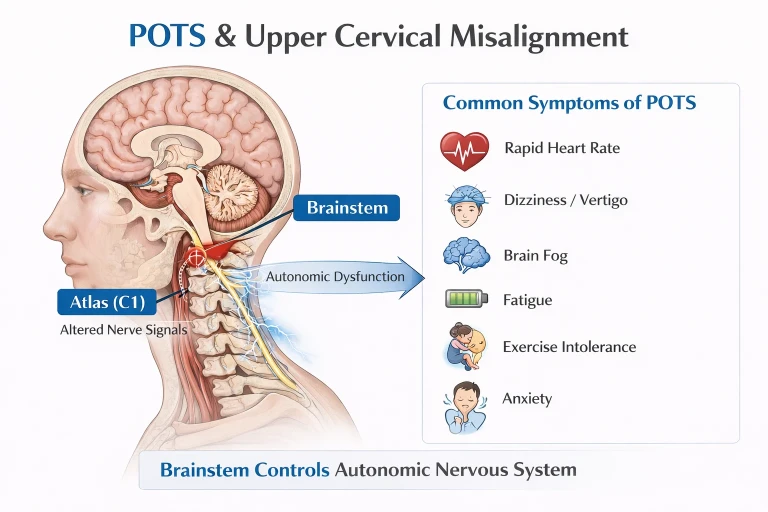
POTS (Postural Orthostatic Tachycardia Syndrome)
Ehlers-Danlos syndrome
Chronic fatigue syndrome
Post-concussion syndrome
Long COVID
Yet one of the most overlooked areas in dysautonomia research is the central autonomic control centers located in the brainstem.
The Brainstem: Command Center of the Autonomic Nervous System
The brainstem sits at the base of the brain and connects the brain to the spinal cord. It contains critical structures including the:
Within these structures are central autonomic nuclei responsible for regulating heart rate, blood pressure, respiration, and digestive function.
The brainstem houses centers that regulate:
Vagal nerve output
Sympathetic nervous system tone
Blood pressure reflexes
Respiratory rhythm
Cardiovascular regulation
Because of this, disturbances affecting the brainstem can produce widespread autonomic symptoms.
In other words, when the brainstem cannot communicate properly with the body, the entire autonomic system can become dysregulated. Of special interest in this dysfunction is the vagus nerve.
The Craniocervical Junction: A Vulnerable Neurological Crossroads
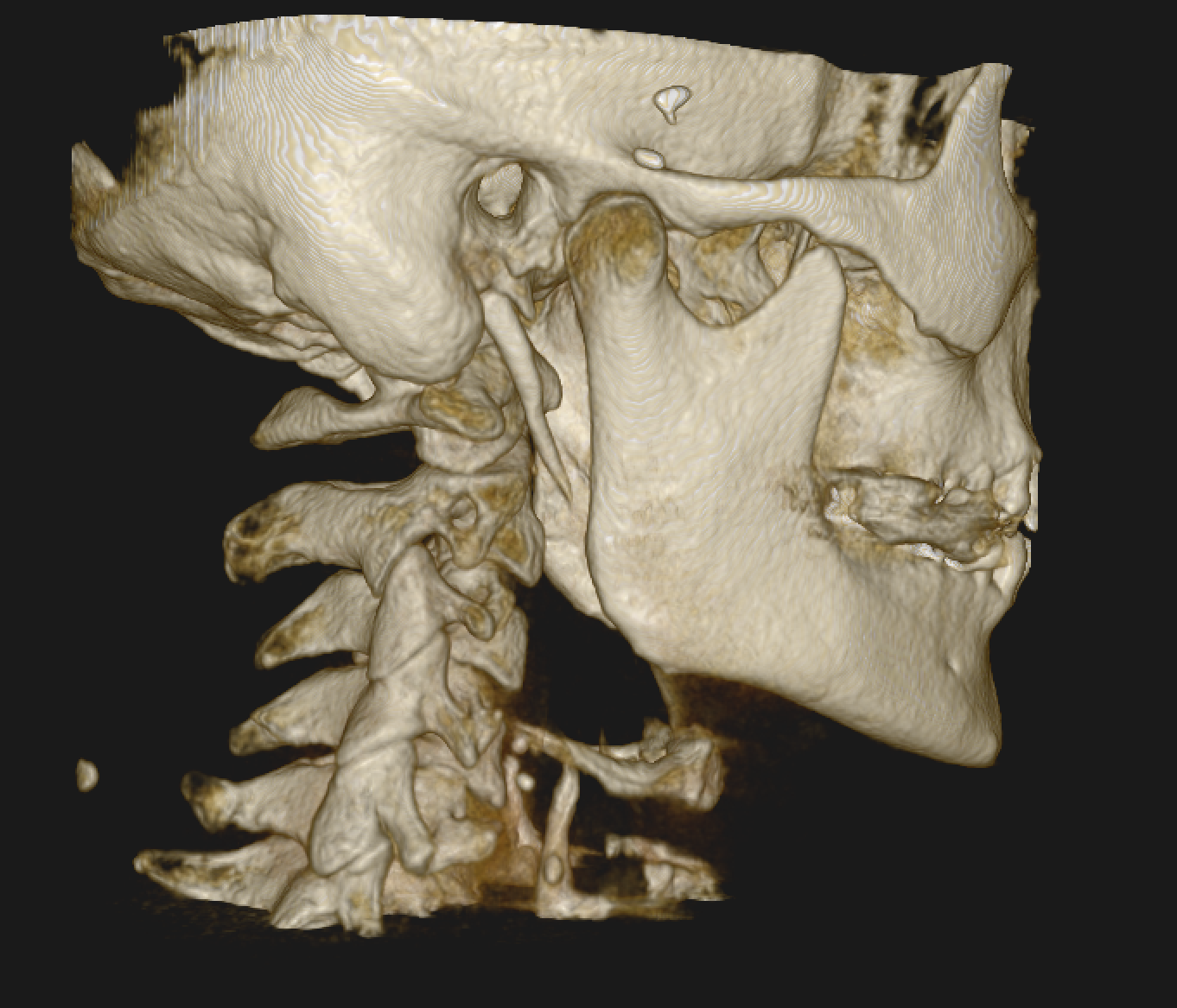
Directly beneath the brainstem lies the craniocervical junction, where the skull meets the first two vertebrae of the spine:
Atlas (C1)
Axis (C2)
This region is one of the most neurologically sensitive areas in the entire body. It contains:
The lower brainstem
The upper spinal cord
Vertebral arteries supplying the brain
The vagus nerve
Sympathetic nerve fibers
Cerebrospinal fluid pathways
Even subtle biomechanical changes in this region can influence neurological signaling between the brain and body.
The atlas vertebra plays a particularly important role because it supports the skull and allows the head to balance over the spine. When the atlas becomes misaligned due to trauma, posture, or ligament injury, it may create mechanical stress in the craniocervical junction.
This is where two important neurological theories come into discussion:
Dentate ligament tension theory
Dysafferentation theory
Dentate Ligament Theory and Brainstem Stress
The dentate ligaments are small fibrous bands that anchor the spinal cord to the dura mater along the cervical spine. Their purpose is to stabilize the spinal cord during movement.
However, research suggests that abnormal cervical biomechanics may transmit mechanical tension through these ligaments to the spinal cord and brainstem.
According to dentate ligament theory, when the atlas becomes misaligned or the cervical spine moves abnormally:
Mechanical forces may be transmitted through the dentate ligaments.
These forces may create tension on the spinal cord and brainstem
Subtle neurological stress may alter autonomic signaling
This mechanical stress could theoretically influence:
Heart rate regulation
Blood pressure reflexes
Vagus nerve activity
Balance and coordination
For patients with dysautonomia, these subtle neurological disturbances could contribute to autonomic instability.
Dysafferentation Theory and Nervous System Chaos
Related article
My heart races when I stand up |Postural Orthostatic Tachycardia Syndrome Specialist in Sarasota
Mar 20, 2026
Another important concept is dysafferentation theory.
The nervous system constantly relies on sensory input from the spine and joints to maintain balance and coordination. These signals travel from spinal mechanoreceptors to the brainstem and cerebellum.
When spinal alignment is disrupted, abnormal sensory signals may travel to the brain.
This is called dysafferentation — distorted sensory input.
Instead of receiving accurate information about posture and movement, the brain receives conflicting signals, which may cause neurological confusion.
This can lead to:
Altered autonomic output
Increased sympathetic activity (fight-or-flight)
Reduced parasympathetic activity (rest-and-digest)
Over time, the nervous system may become stuck in a sympathetic-dominant state, which is often seen in dysautonomia.
Symptoms may include:
Tachycardia
Anxiety
Insomnia
Digestive dysfunction
Cold hands and feet
Poor stress tolerance
Because the brainstem processes both sensory input and autonomic output, abnormal spinal signals could theoretically contribute to autonomic dysregulation.
Atlas Misalignment and Autonomic Function
The atlas vertebra sits directly beneath the brainstem and plays a crucial role in maintaining proper neurological communication.
Trauma such as:
Whiplash injuries
Concussions
Sports injuries
Falls
Car accidents
can cause subtle atlas misalignment.
When this occurs, several mechanisms may affect autonomic function:
1. Brainstem Mechanical Stress
Atlas misalignment may alter biomechanics at the craniocervical junction, potentially affecting brainstem function.
2. Vagus Nerve Irritation
The vagus nerve exits the skull and travels directly alongside the upper cervical spine. Disturbances in this region could influence vagal signaling.
3. Altered Cerebrospinal Fluid Flow
The craniocervical junction regulates cerebrospinal fluid movement between the brain and spine.
4. Abnormal Sensory Signaling
Spinal mechanoreceptors send information directly to brainstem nuclei that regulate autonomic output.
Related article

Upper Cervical Chiropractor Sarasota, Bradenton, Venice and Tampa Bay Area
Nov 15, 2021When these systems are disrupted, patients may experience symptoms consistent with dysautonomia.
Symptoms That May Be Linked to Brainstem–Autonomic Dysfunction
Patients with upper cervical dysfunction often report symptoms such as:
Vertigo or dizziness
Brain fog
Rapid heart rate
Fatigue
Temperature dysregulation
Head pressure
Tinnitus
Digestive disturbances
Orthostatic intolerance
Anxiety or panic sensations
Many of these symptoms overlap with POTS and dysautonomia syndromes.
Because the autonomic nervous system regulates multiple body systems, patients often visit numerous specialists without finding a clear cause.
How Upper Cervical Chiropractic Care May Help
Upper cervical chiropractic focuses on restoring proper alignment of the atlas (C1) and axis (C2) vertebrae.
Unlike traditional spinal manipulation, upper cervical care uses:
Detailed neurological evaluation
Precise imaging (often CBCT or specialized X-rays)
Gentle, targeted corrections
The goal is to restore normal biomechanics at the craniocervical junction so the nervous system can function without interference.
When proper alignment is restored, potential benefits may include:
Improved neurological signaling
Reduced brainstem stress
Improved autonomic balance
Reduced sympathetic overactivity
While more research is still needed, many patients report improvement in symptoms such as:
dizziness
brain fog
heart rate instability
fatigue
Brainstem & Dysautonomia Care in Sarasota
If you live in Sarasota, Lakewood Ranch, or Bradenton and struggle with symptoms of dysautonomia, it may be worth evaluating the health of your upper cervical spine.
Structural stress at the craniocervical junction can affect the most important neurological control center in the body — the brainstem.
Through advanced imaging and precise atlas correction, upper cervical chiropractic aims to restore optimal nervous system communication.
Schedule a Free Consultation click here.
If you experience symptoms such as:
POTS
vertigo
brain fog
rapid heart rate
chronic fatigue
dizziness when standing
you may benefit from an evaluation of your upper cervical spine.
Schedule a Free Consultation Today


Leave a comment