

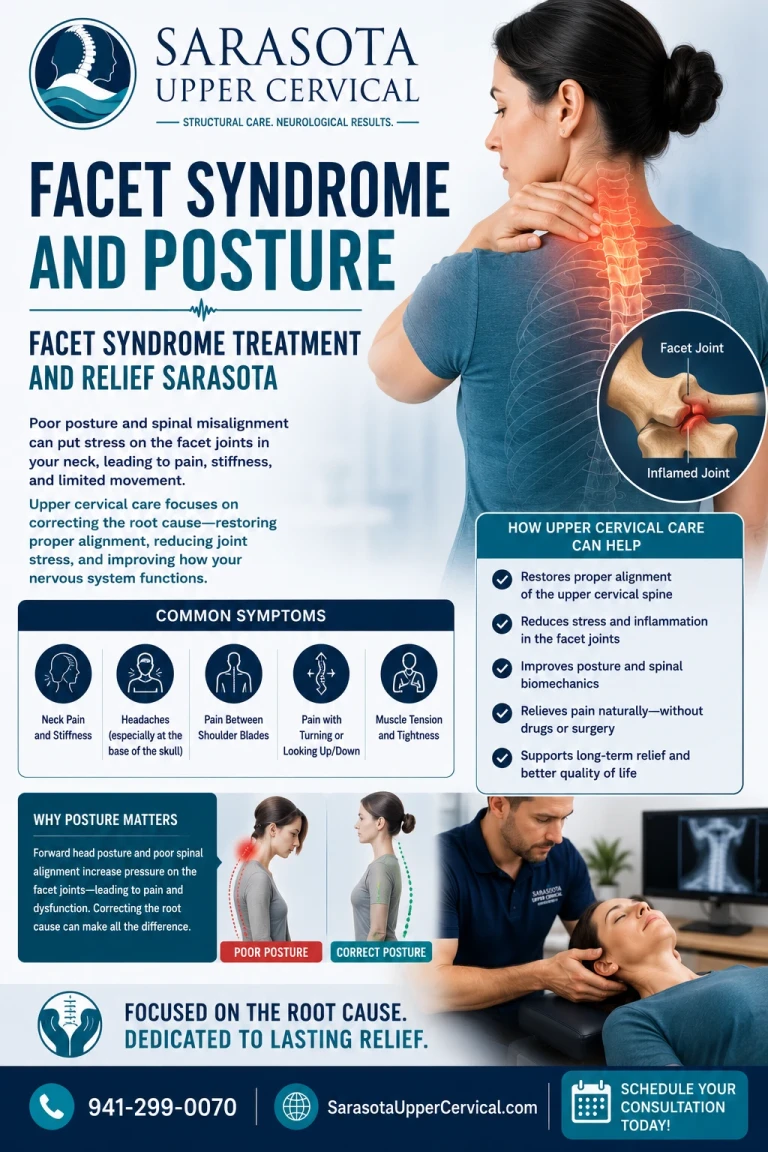
Facet Syndrome Treatment and Relief in Sarasota — The Upper Cervical and Postural Connection
If you have been diagnosed with facet syndrome, you have likely been told it is a “wear and tear” problem in the small joints of your spine. That is true as far as it goes, but it leaves out the more important question: why did those particular joints wear down in the first place? The answer, for many people, leads back to posture, weight distribution, and a control center at the very top of the neck that most facet syndrome discussions never mention: the brainstem and upper cervical spine.
Schedule Your Appointment
Schedule appointmentThis guide connects the dots, how the top of the neck helps govern postural muscle tone, how imbalanced posture and lost spinal curves concentrate abnormal stress on specific facet joints, how that leads to long-term degeneration, and how the altered nerve signaling from these joints can feed back into the nervous system to produce not just pain, but dizziness and other symptoms. Throughout, we point to the published research that supports these mechanisms.
Wondering whether your posture and facet pain trace back to the top of your neck? Schedule a free consultation to find out whether you are a candidate for care. Call 941-259-1891.
What Is Facet Syndrome?
Your spine is a stack of vertebrae, and at the back of each level, paired joints called facet joints connect one vertebra to the next. These small joints guide and limit motion, bear part of the spine’s load, and — importantly — are richly supplied with nerve endings. Like any joint, they are wrapped in a capsule and lined with cartilage.
Facet syndrome (also called facet joint syndrome) refers to pain and dysfunction arising from these joints when they become irritated, inflamed, or degenerated. In the neck it can cause neck pain, stiffness, and headaches; in the low back it can cause localized back pain that often worsens with extension or twisting. Because the facet joints are so densely innervated, they are a significant source of spinal pain — and because their health depends on how load passes through them, posture is central to the story.
The Control Center: How the Top of the Neck Governs Postural Muscle Tone
Here is the part most facet syndrome explanations miss. Your posture is not held up by willpower or by any single muscle — it is continuously, automatically regulated by your nervous system, and the upper cervical spine plays an outsized role in that regulation.
The joints and muscles at the top of the neck contain one of the highest densities of proprioceptors (position and movement sensors) anywhere in the body. The deep intrinsic muscles of the upper neck are especially rich in muscle spindles, the sensors that report muscle length and tension. This is well documented in the research:
Research notes that muscle spindle density is higher in the deep, intrinsic cervical muscles than in other neck muscles, reflecting their significant role in proprioception, and that cervical proprioceptive input provides significant somatosensory feedback impacting postural balance (Cervical flexor fatigue study, PMC7493440).
This constant stream of position information flows into the brainstem, which integrates it with input from the inner ears (vestibular system) and eyes to coordinate posture and balance. The brainstem then sets postural muscle tone throughout the body — the background level of tension in the muscles that hold you upright — partly through reflexes that are directly driven by neck position. The classic tonic neck reflexes, mediated through the brainstem, demonstrate this hard-wired link between the position of the head and neck and the tone of muscles throughout the body.
The practical meaning is profound: if the upper cervical spine is misaligned, the position signals it sends are distorted. The brainstem, receiving faulty information about where the head is, sets postural muscle tone based on bad data, producing imbalanced muscle tone, a tilted or shifted posture, and uneven loading down the rest of the spine. The top of the neck, in effect, is a master dial for postural tone.
From Imbalanced Posture to Abnormal Facet Stress
Once postural muscle tone is imbalanced, the consequences travel down the entire spinal column — and they land squarely on the facet joints.
Loss of the Cervical and Lumbar Curves
A healthy spine has balanced curves, a forward curve in the neck (cervical lordosis), a backward curve in the mid-back, and a forward curve in the low back (lumbar lordosis). These curves act like springs, distributing load evenly and sharing it among the discs, vertebral bodies, and facet joints. When posture is imbalanced, commonly as forward head posture develops, also known as military neck, these curves are compromised. The neck curve flattens, and compensations ripple downward, often reducing the lumbar lordosis as well. Forward head posture is well documented to alter muscle tone and balance control:
Related article
Glossopharyngeal Neuralgia Treatment in Sarasota & Bradenton | Upper Cervical Lakewood Ranch
Mar 16, 2026Forward head posture has been shown to increase upper trapezius muscle tone and impair balance control, and postural misalignment is linked to diminished proprioceptive acuity, which may contribute to chronic pain syndromes (Craniovertebral angle and muscle tone study, PMC12565003).
Uneven Weight Distribution and Concentrated Load
When the curves are lost and posture shifts, weight is no longer distributed evenly across the spine. Forward head posture, for example, dramatically increases the effective load the neck must support, because the head’s weight is cantilevered forward rather than balanced over the spine. The same principle applies throughout: a spine that is tilted, rotated, or shifted concentrates load onto some facet joints while unloading others.
Facet joints are healthiest under balanced, evenly shared load. When load is concentrated abnormally — the same joints absorbing excess stress repetition after repetition, day after day the cartilage wears faster, the capsule is repeatedly strained, and the joint is pushed toward inflammation and, over time, degeneration. This is the mechanical heart of facet syndrome: it is frequently not random wear, but the predictable result of specific joints being chronically overloaded by an imbalanced posture that traces back to how the nervous system is setting tone.
The Long-Term Degeneration Cascade
Over months and years, chronically overloaded facet joints can progress through a familiar cascade: capsular irritation and inflammation, cartilage thinning, the formation of bone spurs as the body tries to stabilize the stressed joint, and progressive osteoarthritis of the facet. What began as a tone-and-posture problem becomes a structural one. Addressing the postural and upper cervical drivers earlier is therefore about more than comfort — it is about changing the mechanical environment that is feeding the degeneration.
The Feedback Loop: Proprioception, Dysafferentation, and Why Facet Problems Cause More Than Pain
Now the story comes full circle, and this is where it becomes about more than the joints themselves. Recall that the facet joints are densely packed with proprioceptors. When a facet joint becomes irritated, inflamed, or restricted, the position information it sends into the spinal cord and up to the brainstem becomes abnormal. This altered, faulty afferent (incoming) signaling is sometimes called dysafferentation.
Why does that matter beyond pain? Because the nervous system relies on accurate proprioceptive input to function. When fatigued or dysfunctional neck structures send distorted signals, both proprioception and postural stability measurably decline:
In an experimental study, inducing cervical muscle fatigue produced a significant decrease in both cervical proprioception and postural stability, which recovered as the muscles recovered — demonstrating the direct, causal link between cervical sensory input and balance (PMC7493440).
So dysafferentation from irritated facet joints and dysfunctional neck structures creates two problems at once. First, it feeds back into the pain pathways, contributing to ongoing neck and back pain and amplifying the sensitivity of the system. Second, because this faulty input flows to the brainstem, where neck signals are integrated with the vestibular and visual systems for balance, the mismatch can produce dizziness and unsteadiness — cervicogenic dizziness , even when the inner ear is healthy. The brain is receiving conflicting reports about head and body position, and it experiences that conflict as vertigo or disequilibrium.
This explains a pattern that puzzles many patients: why a “neck problem” or “facet problem” comes packaged with dizziness, headaches, brain fog, and a general sense of being off-balance. These are not unrelated complaints — they are downstream effects of the same disturbed signaling. Reported symptoms associated with cervical proprioceptive dysfunction and dysafferentation in the literature include neck pain, headaches, impaired balance and postural instability, dizziness, and reduced position sense.
Closing the Loop with Upper Cervical Care
If the top of the neck is a master dial for postural tone, and if imbalanced tone drives the abnormal facet loading that leads to degeneration and dysafferentation, then correcting upper cervical alignment is a logical place to intervene — not to chase each facet joint, but to address a potential root driver of the whole pattern.
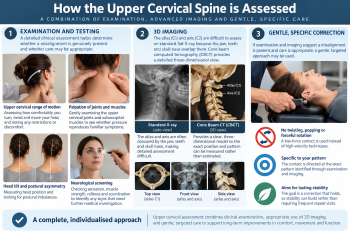
Upper cervical chiropractic focuses on the alignment of the atlas (C1) and axis (C2). By restoring more normal alignment at this control center, the aim is to allow the brainstem to receive accurate position information again — so postural muscle tone can rebalance, weight can distribute more evenly, and the abnormal stresses concentrating on specific facet joints can ease. There is direct, controlled evidence that the upper neck influences postural control:
A randomized controlled trial found that a single upper cervical manipulation produced a significant improvement in standing postural control — decreasing measures of postural sway — and increased upper cervical rotational range of motion in patients with chronic neck pain (J. Clin. Med., 2020; PMC7463842).
Related article
Before You Get Ear Tubes or Balloon Dilation: Conservative Options for Eustachian Tube Dysfunction
Jun 30, 2026That is a published demonstration of the central premise: intervening at the upper neck measurably improves how the body controls posture. For someone whose facet syndrome is being driven by postural imbalance rooted in the upper cervical spine, that is precisely the leverage point.
Precision Through 3D Imaging
Before any correction, detailed 3D imaging (CBCT) is used as a precision measurement tool to analyze your individual anatomy and the exact position of the atlas. Because each person’s structure and misalignment pattern is unique, this individualized, data-driven approach is essential.
Gentle Corrections — No Twisting, Popping, or Yanking
Corrections are gentle and specific, with no twisting, popping, or yanking of the neck. The precision provided by imaging is what allows a light, exact correction along the right path rather than force — and notably, the controlled research showing postural-control benefit used specific upper cervical correction rather than generalized forceful manipulation.
Candidacy First
Not all facet pain is driven by the upper cervical spine, and not everyone is a candidate. A thorough evaluation determines whether the postural and upper cervical signs are present, and will tell you honestly if they are not. Upper cervical care focuses on a potential structural root of the pattern and works alongside other appropriate care.
Who Might Consider an Upper Cervical Evaluation?
It may be worth evaluating the upper neck if you experience:
• Facet-related neck or back pain alongside poor posture or forward head posture
• Neck or back pain that comes with dizziness, unsteadiness, or headaches
• A flattened neck curve, reduced lumbar curve, or visibly imbalanced posture
• Pain that began or worsened after a head or neck injury or whiplash
• Recurrent facet pain that returns despite local treatment of the painful joint
Wondering whether your posture and facet pain trace back to the top of your neck? Schedule a free consultation to find out whether you are a candidate for care. Call 941-259-1891.
Frequently Asked Questions
Related article
Sinus Pressure & Chronic Sinus Issues in Sarasota and Bradenton | Upper Cervical Approach
Mar 08, 2026
What causes facet syndrome?
Facet syndrome arises when the small facet joints of the spine become irritated, inflamed, or degenerated. While it’s often described as wear and tear, a major underlying driver is abnormal, uneven load on specific joints — frequently the result of imbalanced posture, lost spinal curves, and uneven weight distribution that concentrate stress on certain facets over time.
How does the top of my neck affect my posture?
The upper neck is densely packed with position sensors that feed the brainstem, which sets postural muscle tone throughout the body and integrates neck input with the inner ears and eyes for balance. Research shows cervical proprioceptive input significantly affects postural balance. If the upper cervical spine is misaligned, the brainstem receives distorted position information and may set imbalanced muscle tone, leading to postural imbalance and uneven spinal loading.
Why does my facet or neck problem come with dizziness?
Irritated facet joints and dysfunctional neck structures send abnormal position signals into the nervous system, a process called dysafferentation. Because this faulty input reaches the brainstem, where it’s combined with vestibular and visual signals for balance, the mismatch can produce dizziness and unsteadiness even when the inner ear is healthy. Experimental studies confirm that disturbed cervical input reduces both proprioception and postural stability.
Is there research linking the upper neck to posture and balance?
Yes. Published studies show that cervical muscle fatigue decreases both neck proprioception and postural stability; that forward head posture increases muscle tone and impairs balance; and, in a randomized controlled trial, that a single upper cervical correction significantly improved standing postural control and increased upper cervical range of motion in people with chronic neck pain.
How does upper cervical care help facet syndrome?
By focusing on the alignment of the atlas and axis — the control center for postural tone — the aim is to restore accurate position signaling to the brainstem so postural muscle tone can rebalance and load can distribute more evenly, easing the abnormal stresses concentrating on specific facet joints. It addresses a potential root driver of the pattern rather than only the painful joint, and candidacy is determined by evaluation.
How do I find out if I’m a candidate?
Start with a consultation and evaluation, which may include 3D imaging to assess your upper cervical alignment and posture. This determines whether an upper cervical and postural component is contributing to your facet pain. If it isn’t, you’ll be told so. Call 941-259-1891 to schedule a free consultation.
This content is for informational purposes only and does not constitute medical advice. Cited research is referenced to explain proposed mechanisms; individual results vary, and candidacy for upper cervical care is determined by evaluation. Upper cervical care focuses on spinal alignment and works alongside appropriate medical care.


Leave a comment