

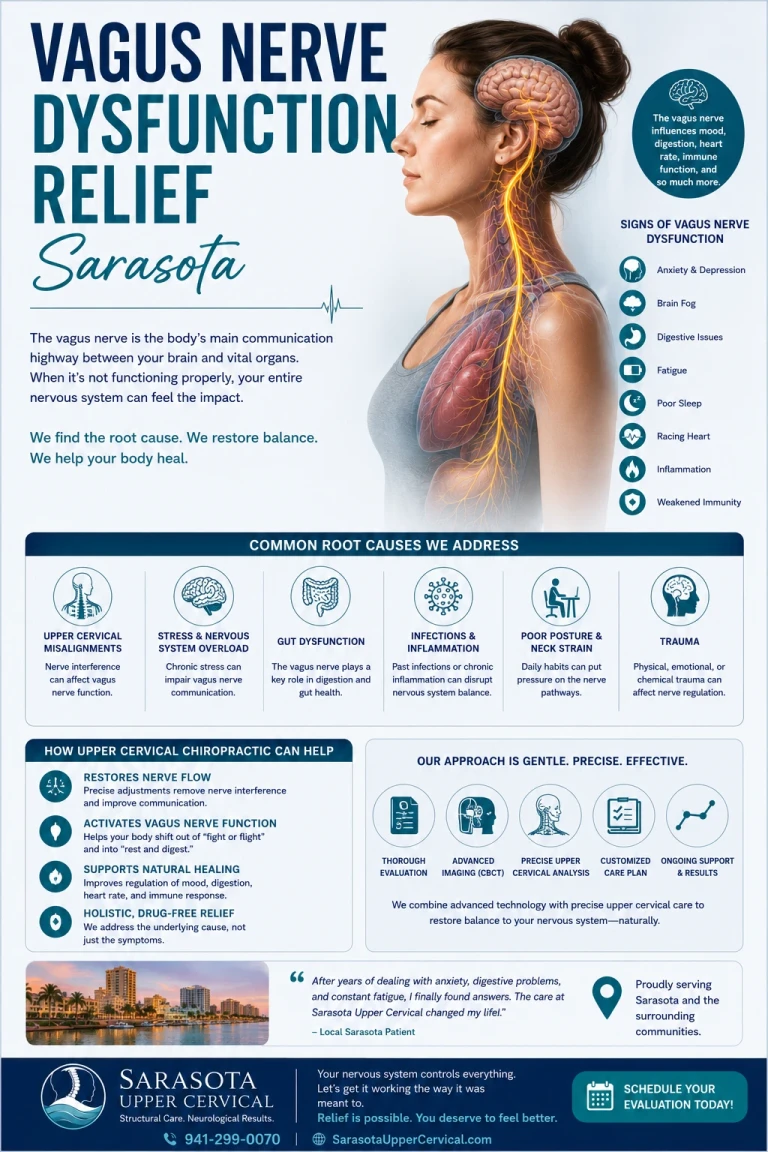
A Complete Guide to How Alignment at the Top of the Neck May Affect Your Body's Master Regulator
The vagus nerve is the longest and most influential nerve of your autonomic nervous system — the body's automatic control network. It is the main pathway of the "rest and digest" system, helping regulate heart rate, digestion, breathing, inflammation, and your ability to recover from stress. When it isn't signaling properly, the effects can be wide-ranging and frustrating, often spanning several body systems at once.
Schedule Your Appointment
Schedule appointmentWhat many people are never told is that the vagus nerve passes through one of the most mechanically dynamic regions in the entire body: the upper neck, right where the skull meets the atlas (C1) and axis (C2). Because of this, the alignment of the upper cervical spine may be an overlooked structural contributor to vagus nerve dysfunction. This guide explains the anatomy, the specific mechanisms by which upper cervical misalignment may irritate the vagus nerve, the symptoms involved, and how precise, imaging-guided care focuses on that potential structural source.
A note up front: upper cervical care is best understood as addressing a potential structural contributor to vagus nerve dysfunction. It is not a cure, and it works alongside, not in place of — the care of your physicians. Vagus nerve dysfunction has many possible causes, and not everyone is a candidate for this approach. Careful evaluation comes first.
Wondering if your symptoms have an upper cervical component? Schedule a free consultation to find out whether you are a candidate for care. Call 941-259-1891 to get started. Or click here.
Meet the Vagus Nerve: Your Body's Master Regulator
The vagus nerve (cranial nerve X) originates in the brainstem and travels down through the neck, chest, and abdomen, branching to the heart, lungs, and digestive organs. It is the primary nerve of the parasympathetic nervous system, the branch responsible for calming the body, slowing the heart, supporting digestion, and dialing down inflammation. In a very real sense, healthy vagal function is what allows your body to rest, repair, and regulate itself.
Because the vagus nerve influences so many systems, when its signaling is disrupted the symptoms rarely stay in one place. People often experience a confusing constellation that doesn't fit neatly under a single diagnosis — which is part of why vagus nerve dysfunction is so often missed.
Why the Upper Neck Is Central to Vagal Function
The upper cervical spine — the atlas (C1) and axis (C2) — sits at the base of the skull, directly beneath the brainstem where the vagus nerve originates. This is the most neurologically dense and mechanically sensitive region of the spine. It supports the full weight of the head, allows a remarkable range of motion, and sits at the crossroads of the brainstem, major blood vessels, and several cranial nerves, including the vagus.
This proximity is not a vague claim. The transverse process of the atlas is a well-recognized anatomical landmark, and the neurovascular bundle of the upper neck — including the internal jugular vein, the internal carotid artery, and the pathway of the vagus nerve with its inferior (nodose) ganglion — sits just in front of (anterior to) it. In surgical anatomy, the transverse process of C1 is specifically used as the landmark to locate these structures. In other words, the bone and the nerve are close neighbors. When the position of that bone changes, the spatial relationship between bone and nerve changes with it.
Four Mechanisms: How Upper Cervical Misalignment May Affect the Vagus Nerve
There are several distinct, anatomically grounded ways that misalignment or loss of normal curve in the upper neck may interfere with vagal function. These are best understood as proposed mechanical mechanisms — well-supported by anatomy, and an active area of clinical interest. Here are the four most important.
1. Mechanical Irritation at the Transverse Process of the Atlas
Because the vagus nerve and its nodose ganglion pass just anterior to the transverse process of the atlas, the position of C1 matters directly. When the atlas shifts or rotates out of its normal position, the transverse process can alter the spatial relationship between the bone and the nerve, creating mechanical irritation of the vagus nerve and its sensory ganglion. The nodose ganglion is essentially a sensory hub for the autonomic system — relaying information about blood pressure, oxygen levels, respiratory rate, and signals from the digestive organs — so irritation here can ripple into all of those functions. This is one of the most direct and least appreciated structural relationships in autonomic dysfunction.
2. Loss of the Cervical Curve and Mechanical Traction on the Vagus Nerve
A healthy neck has a gentle backward C-shaped curve (cervical lordosis) that distributes mechanical load and keeps the neural structures at comfortable, normal tension. When that curve flattens or straightens — from forward-head posture, trauma, or chronic muscle tension — the architecture that normally protects the nerves and brainstem is compromised.
When the curve is lost, the neck effectively lengthens its front-to-back path, and the neural and vascular structures running through the region can be placed under increased mechanical traction. For the vagus nerve, which travels through this column, a flattened curve can mean sustained, abnormal tension along its course — a low-grade mechanical stress that may interfere with normal signaling. The flattened curve also reduces shock absorption and alters the biomechanics of the upper cervical joints, compounding the effect.
3. The Myodural Bridge as a Source of Mechanical Irritation
The myodural bridge is a dense band of connective tissue that physically connects the deep suboccipital muscles at the base of the skull to the dura mater, the membrane surrounding the brainstem and spinal cord. It is a direct mechanical link between the muscles of the upper neck and the covering of the central nervous system.
When upper cervical misalignment leads to chronic tightness or spasm of these deep suboccipital muscles, that abnormal tension can be transmitted through the myodural bridge to the dura. Because the brainstem — the origin of the vagus nerve — sits within this dural environment, sustained traction transmitted by the myodural bridge is another proposed route by which upper neck dysfunction may create irritation affecting vagal output. It is a reminder that the upper neck's influence on the nervous system is mechanical and direct, not abstract.
4. Aberrant Proprioceptive Input from the Upper Cervical Spine
The upper cervical spine contains one of the highest densities of mechanoreceptors, position and movement sensors, anywhere in the body. These receptors constantly feed the brainstem precise information about the position and motion of the head. The brainstem uses this proprioceptive stream to coordinate balance, posture, and, importantly, autonomic regulation. This is what proprioception is.
Related article
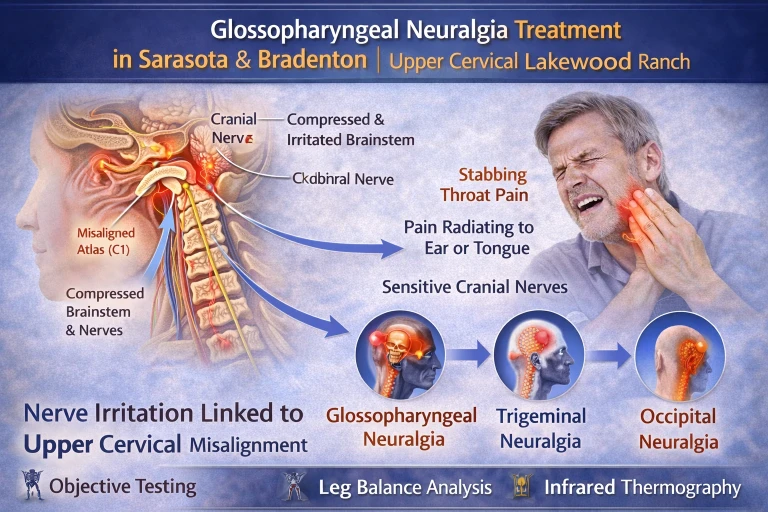
Glossopharyngeal Neuralgia Treatment in Sarasota & Bradenton | Upper Cervical Lakewood Ranch
Mar 16, 2026When the upper cervical joints are misaligned, this input becomes distorted, the brain receives aberrant proprioceptive signals that don't accurately reflect reality. Because the brainstem integrates this position information alongside its autonomic control functions, a steady stream of faulty signaling can contribute to dysregulation of autonomic responses, including those mediated by the vagus nerve. In this mechanism, the problem isn't only pressure on a nerve, it's bad information being delivered to the very control center that runs the autonomic system.
A Shared Theme: Traction on the Brainstem
Notice the thread connecting these mechanisms: the brainstem is the origin of the vagus nerve, and several of these mechanisms converge on it. When the cervical curve is lost, the resulting mechanical traction can extend to the brainstem and spinal cord themselves. Misalignment can place abnormal mechanical stress on the region housing the vagal nuclei. The myodural bridge can transmit tension into the dural environment surrounding the brainstem. In each case, the structure that generates and regulates vagal signaling is being mechanically stressed, which is why addressing the upper cervical structure is so relevant.
Symptoms Associated With Vagus Nerve Dysfunction
Because the vagus nerve touches so many systems, its dysfunction can produce a broad, multi-system picture. Symptoms commonly associated with vagus nerve dysfunction include:
• Heart rate and blood pressure irregularities — palpitations, racing heart, or a rapid heart rate on standing (as seen in POTS and related dysautonomia)
• Lightheadedness, dizziness, or feeling faint, especially with position changes
- Long covid has been connected to vagus nerve dysfunction
• Digestive problems — nausea, bloating, acid reflux, slow digestion (gastroparesis), constipation, or IBS-type symptoms
• Difficulty swallowing, a sensation of a lump in the throat, or changes in the voice
• Brain fog, difficulty concentrating, and mental fatigue
• Anxiety, a sense of being "stuck" in fight-or-flight, and difficulty calming down
- migraine and tension headache
• Chronic fatigue and poor recovery from exertion or stress
• Sleep disturbances
• Shortness of breath or air hunger
• Heightened or poorly regulated inflammatory responses
• Temperature regulation problems and abnormal sweating
Related article
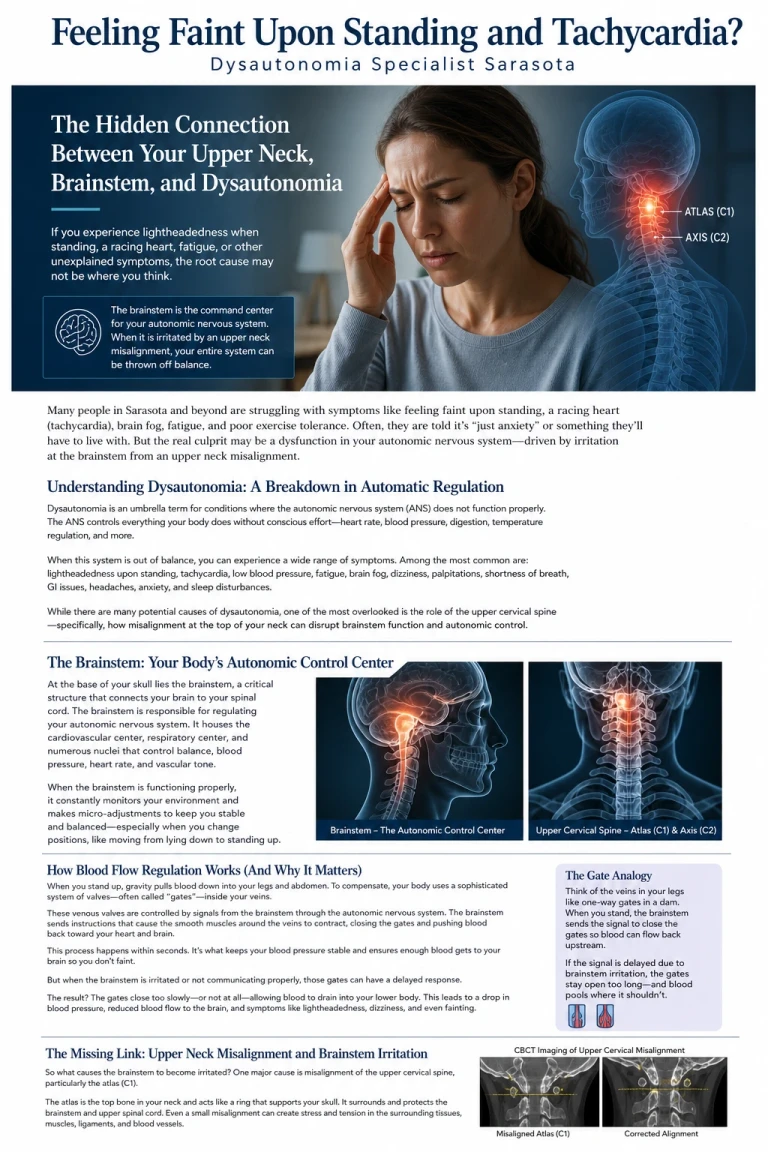
Feeling Faint Upon Standing and Tachycardia? | Dysautonomia Specialist Sarasota
May 03, 2026and autoimmune conditions like rheumatoid arthritis.
Because these overlap with many other conditions, vagus nerve dysfunction is frequently overlooked — and the upper cervical contribution to it even more so. If your symptoms span several of these systems and began or worsened after a head or neck injury, the upper neck is worth evaluating.
Why a History of Head or Neck Trauma Matters
Whiplash, concussions, falls, and even years of repetitive postural stress like forward-head posture can alter the alignment of the atlas and axis and flatten the cervical curve. For many people with vagus-related symptoms, the timeline is telling: the symptoms began, or noticeably worsened, after exactly this kind of event. That pattern is one of the clearest signals that an upper cervical evaluation may be worthwhile, because it points to a structural change in precisely the region where these mechanisms operate.
CBCT Imaging and the Precision of the Correction
Addressing a structural contributor this specific demands precision — and precision begins with seeing your anatomy clearly. At Sarasota Upper Cervical, CBCT (cone beam computed tomography) is used as a precision measurement tool. Unlike a flat X-ray, CBCT captures the upper neck as a true three-dimensional volume, allowing the actual shape, position, and angle of your individual joints to be measured. Given that the vagus nerve sits just anterior to the transverse process of the atlas, knowing the precise three-dimensional position of that structure in your spine is exactly the information needed to plan an accurate correction.
The Blair upper cervical approach uses this imaging to account for the natural asymmetry of each person's spine. Because everyone's joint surfaces are shaped and angled differently, the way the atlas misaligns — and therefore the way it must be corrected — is individual. The imaging reveals which specific joint has misaligned and along what path, so the correction can be matched precisely to your anatomy rather than applied generically.
That precision is what allows the correction itself to be gentle. Because the analysis determines exactly which structure to contact, in which direction, and at what angle, there is no need for force: corrections involve no twisting, popping, or yanking of the neck. A light, specific correction delivered along the right path is both more comfortable and more appropriate — particularly for someone whose nervous system is already dysregulated and sensitized.
Holding the Correction
A central principle of this care is that it isn't the act of adjusting that produces change — it's the body holding its proper alignment over time. The goal is a precise correction that your spine holds, giving the brainstem and vagus nerve a stable, low-interference environment in which to regulate normally. Each visit involves objective testing to determine whether you're still holding; if you are, no adjustment is made that day. As the spine stabilizes, corrections are typically needed less often. Precision is what makes holding possible — a correction matched to your anatomy is far more likely to stay than a generic one.
What the Science Does and Doesn't Say
In keeping with our commitment to honesty: the anatomical relationships described here are well-established. The vagus nerve's proximity to the transverse process of the atlas, the brainstem origin of the vagus, the high mechanoreceptor density of the upper cervical spine, and the existence and function of the myodural bridge are all documented in the anatomical and clinical literature. The biological plausibility that upper cervical alignment can influence vagal function is therefore strong.
At the same time, large-scale randomized controlled trials proving that upper cervical correction resolves vagus nerve dysfunction have not been published. The evidence base is anatomical, mechanistic, and clinical rather than definitive. That is why we frame upper cervical care as addressing a potential structural contributor — a biologically reasonable, complementary approach worth evaluating in the right candidate, not a guaranteed fix and not a replacement for medical care.
Who Should Consider an Evaluation?
An upper cervical evaluation may be worth considering if you:
• Experience multi-system symptoms consistent with vagus nerve or autonomic dysfunction
• Had symptoms begin or worsen after whiplash, a concussion, or head or neck trauma
• Have a flattened or reversed cervical curve, or chronic forward-head posture
• Have neck pain, headaches, or dizziness alongside the autonomic symptoms
• Have not found lasting answers through symptom-focused approaches alone

A thorough evaluation, which may include CBCT imaging, is designed to determine whether your specific anatomy and alignment show the structural signs this care addresses — and to tell you honestly if they don't.
Wondering if your symptoms have an upper cervical component? Schedule a free consultation to find out whether you are a candidate for care. Call 941-259-1891 to get started.
Frequently Asked Questions
How can a misalignment in my neck affect my vagus nerve?
The vagus nerve and its sensory ganglion pass just in front of the transverse process of the atlas (C1), and the nerve originates in the brainstem directly above the upper neck. When the atlas is misaligned or the cervical curve is lost, several mechanical mechanisms — irritation near the transverse process, traction from a flattened curve, tension transmitted by the myodural bridge, and distorted proprioceptive input to the brainstem — may interfere with normal vagal signaling.
What is the connection between losing my neck curve and the vagus nerve?
A healthy cervical curve keeps the neural structures at normal tension and distributes load. When the curve flattens, the structures running through the neck — including the vagus nerve — can be placed under increased mechanical traction, and the brainstem itself can be tractioned. This sustained, abnormal tension is one proposed way a lost curve may affect vagal function.
What symptoms are linked to vagus nerve dysfunction?
Because the vagus nerve regulates many systems, symptoms can include heart rate and blood pressure irregularities, lightheadedness, digestive problems (reflux, bloating, slow digestion), difficulty swallowing, brain fog, anxiety and a fight-or-flight feeling, chronic fatigue, sleep disturbances, shortness of breath, and temperature or inflammation dysregulation. These overlap with many conditions, so the vagal and upper cervical contribution is often missed.
Can upper cervical care cure vagus nerve dysfunction?
No. Upper cervical care addresses a potential structural irritation which can cause vagus nerve dysfunction. The anatomy provides strong biological plausibility, but large-scale trials proving resolution have not been published. With that said many patients with vagus nerve issues find relief or resolution with upper cervical chirorpactic care!
How does CBCT imaging improve the correction?
CBCT captures your upper neck in true 3D, so the precise position and angle of the atlas — and its relationship to nearby structures like the vagus nerve pathway — can be measured. This lets the correction be matched to your individual anatomy. That precision is also what makes the correction gentle: knowing exactly what to contact and in which direction removes any need for twisting, popping, or force.
Is the correction safe and gentle?
Yes. Blair upper cervical corrections are gentle and specific, with no twisting, popping, or yanking of the neck. This is especially appropriate for people whose nervous systems are already sensitized. Care begins with a thorough evaluation to determine whether you are a candidate.
What is my first step?
Schedule a free consultation. The evaluation, which may include CBCT imaging, determines whether your case shows the structural signs that upper cervical care addresses. If it doesn't, you'll be told so. Call 941-259-1891 to get started.
This content is for informational purposes only and does not constitute medical advice. It is not intended to diagnose, treat, or replace care provided by your physicians. Upper cervical care addresses spinal alignment and structure; individual results vary, and candidacy is d


Leave a comment